Ludography
88/100
Players4,365 ratings
80/100
Critics10 reviews
More scores
Metacritic32 critic reviews
94/100
Metacritic usersuser score
87/100
GameFAQsJust Right
4.31/5
Player reviews
94% positive180,970 reviews
Steam Deck
Playable
Runs on
Windows
Price
US$19.99

Where to get it

The Elder Scrolls V: Skyrim cover

2011 · Bethesda Game Studios · Action role-playing · Action-adventure

The Elder Scrolls V: Skyrim

Skyrim reimagines and revolutionizes the open-world fantasy epic, bringing to life a complete virtual world open for you to explore any way you choose. Play any type of character you can imagine, and do whatever you want; the legendary freedom of choice, storytelling, and adventure of The Elder Scrolls is realized like never before.

Also known as
TES5 · Skyrim · TESV: Skyrim · TES Skyrim · Elder Scrolls V, The - Skyrim
Released
11 November 2011
Platforms
WindowsPlayStation 3Xbox 360Nintendo SwitchPlayStation 5PlayStation VRXbox Series X/S
Genres
Action role-playingAction-adventureAdventureFantasyRole-playingVideo game with LGBT character
Developers
Bethesda Game Studios
Publishers
Bethesda Softworks1C CompanySoftclub
Series
The Elder Scrolls
Modes
MultiplayerSingle-player
Perspective
First personThird person
Themes
ActionFantasyStealthSandboxOpen world
Country
United States
Age ratings
GRAC 19+ACB MA 15+ESRB MUSK 16CERO ZPEGI 18CLASS_IND 18
Languages
CzechEnglishFrenchGermanItalianJapanesePolishRussianSpanish (Spain)SpanishChinese
Copies sold
65 million as of 2026-07-17
Time to beat
35hmain story240hcompletionist
Directors
Todd Howard
Composers
Jeremy Soule

About

The Elder Scrolls V: Skyrim is a 2011 action role-playing game developed by Bethesda Game Studios and published by Bethesda Softworks. It is the fifth main installment in The Elder Scrolls series, following The Elder Scrolls IV: Oblivion (2006), and was released worldwide for Windows, PlayStation 3, and Xbox 360 on November 11, 2011. Skyrim was developed using the Creation Engine. The team opted for a rugged, largely sub-arctic world, after Oblivion's Imperial Province of Cyrodiil, which game director and executive producer Todd Howard considered more unique by comparison.

The game is set 201 years after the events of Oblivion and takes place in Skyrim, the northernmost province of Tamriel, a continent on the planet Nirn. Its main story focuses on the player character, the Last Dragonborn, on their quest to defeat Alduin the World-Eater, a dragon prophesied to destroy the world. Throughout the game, the player completes quests and develops the character by improving skills. The game continues the open world tradition of its predecessors by allowing the player to travel to discovered locations in the game world at any time, and to ignore or postpone the main storyline indefinitely.

›Story

The Empire of Tamriel is on the edge. The High King of Skyrim has been murdered. Alliances form as claims to the throne are made. In the midst of this conflict, a far more dangerous, ancient evil is awakened.

Dragons, long lost to the passages of the Elder Scrolls, have returned to Tamriel. The future of Skyrim, even the Empire itself, hangs in the balance as they wait for the prophesized Dragonborn to come; a hero born with the power of The Voice, and the only one who can stand amongst the dragons.

Players say

Media

The articlegameplay, story, development, reception

Gameplay

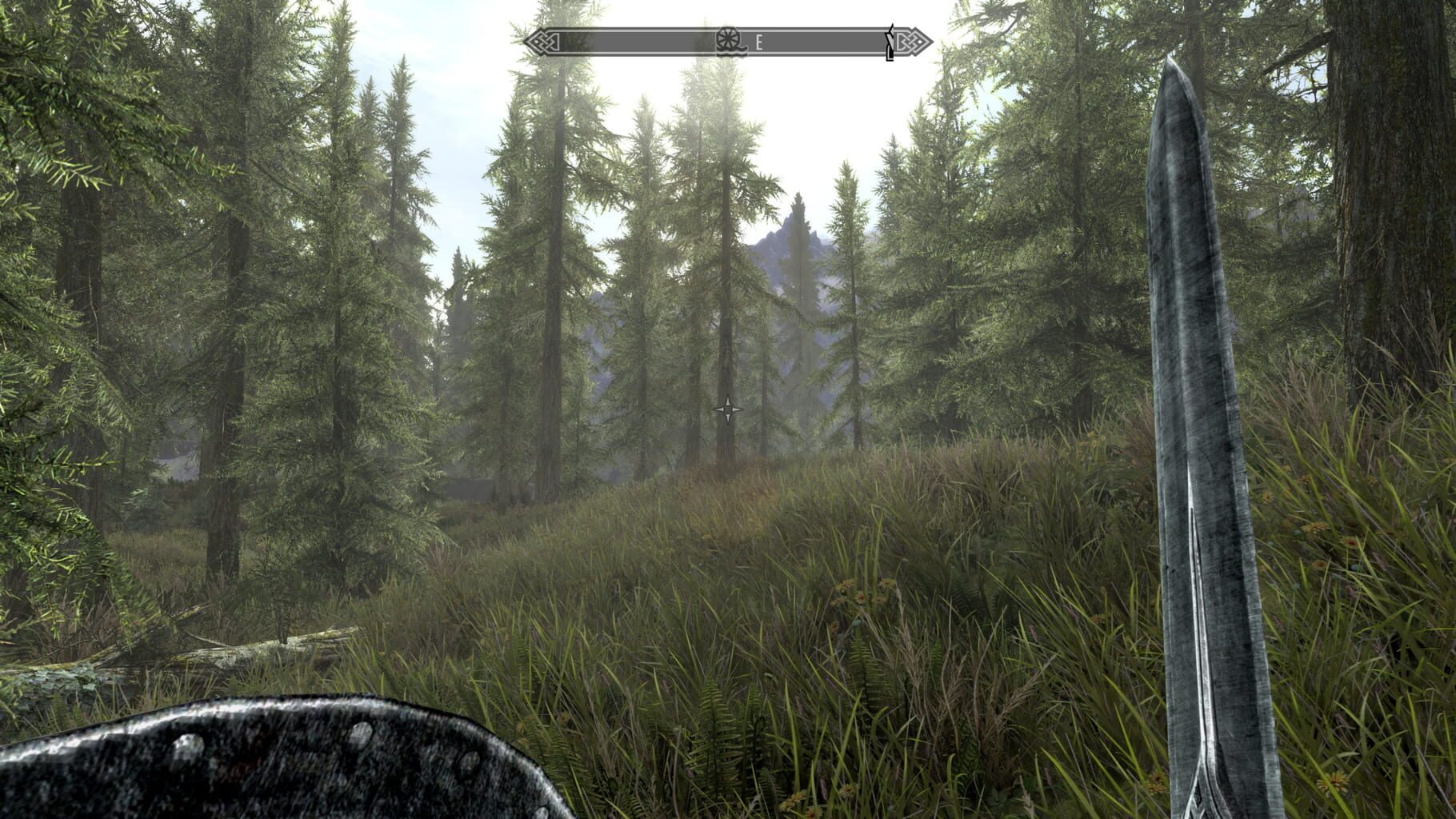
The Elder Scrolls V: Skyrim is a fantasy action role-playing game, playable from a first- or third-person perspective. The player may freely roam over the land of Skyrim, an open world environment based on Scandinavia consisting of wilderness expanses, dungeons, caves, cities, towns, fortresses, and villages. Players may navigate the game world more quickly by riding horses, paying for a ride from a city's stable, or utilizing a fast-travel system that allows them to move their character immediately to a previously discovered location.

At the beginning of the game, players select their character's sex and race, with 10 choices for the latter: Nords, Imperials, Orcs/Orsimer, Bretons, Redguards, Altmer (high elves), Dunmer (dark elves), Bosmer (wood elves), Khajiit, and Argonians. The player chooses the character's appearance; this is not necessarily permanent, however, as an in-game mechanic allows for changing the appearance later. Characters have three primary attributes: health is how much damage the character can take before dying, magicka is depleted to cast spells, and stamina allows the character to perform heavy "power attacks" or sprint. A status bar for each attribute appears onscreen when the attribute falls below its maximum value.

Story

Skyrim is set in the year 201 of the Fourth Era, which started just after the upheaval of the so-called "Oblivion Crisis" from the previous game. Skyrim is a cold and mountainous region in the north of the continent of Tamriel. It has traditionally been divided into nine administrative sections, called "holds", each governed by a jarl from a larger town. Of these settlements, Solitude, Windhelm, Markarth, Riften, and Whiterun are larger and more powerful.

The landscape is littered with forts, camps, and ruins, some of which were built by the now-extinct race of the Dwemer, or Dwarves. The Nords, one of the human races, view Skyrim as their homeland, though members of other races populate Skyrim as well. Most ubiquitous are Dark Elf refugees from the neighboring land of Morrowind, which was devastated by a volcanic eruption; and the Reachmen, a tribal faction of barbaric savages that occupy a large western portion of Skyrim known as the Reach. Various Orc strongholds are also located throughout Skyrim, having been allowed to settle in the region at the behest of the Nords.

Development

Having completed work on The Elder Scrolls IV: Oblivion in 2006, Bethesda Game Studios began work on Fallout 3. It was during this time that the team began planning the next entry in The Elder Scrolls series. From the outset, they had decided to set the new game in the land of Skyrim, incorporating dragons into the main theme of the game. Full development began following the release of Fallout 3 in 2008; the developers considered Skyrim a spiritual successor to both Fallout 3 and previous Elder Scrolls games.

The game was developed by a team of roughly 100 people composed of new talent as well as of the series' veterans. The production was supervised by Todd Howard, who has been the director of several titles released by Bethesda Softworks.

Reception

Skyrim received critical acclaim upon release. It received a combined 40/40 score from four editors of the Japanese video game magazine Famitsu, the first Western-developed game to do so. The removal of the character class system, present in previous The Elder Scrolls entries, was generally well received by reviewers. Billy Shibley of Machinima's Inside Gaming and Charles Onyett of IGN praised its removal because it allowed players to experiment with different skills without having to make decisions about a class early in the game.

John Bedford of Eurogamer stated that by removing the character class system, the game tailored itself to players who wanted to build an all-around character, while still letting other players specialize in a preferred play-style. Steve Butts of The Escapist considered the addition of perks to the character advancement system "a great method to make your character feel even more unique and personal". Kevin VanOrd of GameSpot praised the way perks allowed for the player's preferred skills to become more powerful over time, stating that the perk system "forms around the way you play, but allows for tweaking so that you retain a sense of control". The user interface was also praised by reviewers for its accessibility; Bedford complimented its "elegant design" which succeeded Oblivion's comparatively complex interface.

Awards

Speedruns

Releases by platformdates and regions as published

Releases by platform
PlatformReleasedRegions
Windows10 November 2011Worldwide · North America 10 November 2011 · Japan 8 December 2011
PlayStation 311 November 2011North America · Europe 11 November 2011 · Worldwide 11 November 2011 · Japan 8 December 2011
Xbox 36011 November 2011Worldwide · Japan 8 December 2011

Title IDsone per regional release, with its latest update

Title ids and disc serials by release
PlatformTitle IDRegionLatest update
Nintendo Switch01000A10041EA000—v6
010028D005A3C000—v6
PlayStation 3BLAS50546Asia01.09
BLAS50624Asia—
BLES01329Europe02.09
BLES01330Europe02.09
BLES01885Europe—
BLES01886Europe—
BLES01329/EEurope / Australia—
BLJM55059Japan—
BLJM60413Japan01.09
BLJM61086Japan—
BLAS50404North America—
BLUS30778North America01.09
BLUS30866North America—
BLUS31202North America—
BLUS30778FNorth America / Asia—
BLUS30778GHNorth America / Asia—
BLUS30778GHFNorth America / Asia—
Xbox 360425307F6Europe—
425307E6Europe / North America—
BS-2022Europe / North America—
BS-2034Japan—
BS-2034-1Japan—

Decompilations and portscommunity projects that rebuild or port the game

Editions and related releases

Included in
The Elder Scrolls V: Skyrim - Legendary Edition
Downloadable content
The Elder Scrolls V: Skyrim - DawnguardThe Elder Scrolls V: Skyrim - Hearthfire
Expansions
The Elder Scrolls V: Skyrim - Dragonborn
Follows
The Elder Scrolls IV: Oblivion
Ported as
The Elder Scrolls V: SkyrimThe Elder Scrolls V: Skyrim VR
Remastered as
The Elder Scrolls V: Skyrim - Special Edition
Built on it
The Elder Scrolls V: Skyrim - DragonbornThe Elder Scrolls V: Skyrim - DawnguardThe Elder Scrolls V: Skyrim - HearthfireThe Forgotten CityThe Elder Scrolls V: Skyrim - Special EditionEnderal: The Shards of OrderThe Elder Scrolls V: SkyrimThe Elder Scrolls V: Skyrim VREnderal: Forgotten StoriesThe Elder Scrolls: Skyblivion
Editions
The Elder Scrolls V: Skyrim Collector's EditionThe Elder Scrolls V: Skyrim - Premium EditionThe Elder Scrolls V: Skyrim - Legendary Edition

In the same series

Games like this

Collections18 collections

Description adapted from its source, CC BY-SA 4.0.