
The articlegameplay, story, development, reception
Gameplay
Fallout: New Vegas is an action role-playing game that can be played from either a first-person or a third-person perspective. It is set in the Mojave Desert in 2281, 204 years after a nuclear war that decimated much of the United States. The player controls a courier who survived an attempted killing by an unknown assailant. The initial goal is to complete a series of quests to find the assailant; the game eventually culminates in a war between governing factions that are vying for control of the Hoover Dam and Mojave Desert.
In addition to the main quests, the player can participate in optional, unrelated side quests. Kristinie Stiemer of IGN estimates completing every quest takes around 100 hours.
New Vegas features a freely explorable open world map. The player can explore locations ranging from small settlements and abandoned buildings to large locations like the Hoover Dam and the city of New Vegas, which was built from the remnants of Las Vegas. The player is equipped with the Pip-Boy 3000, a wearable computer that serves as a menu and allows them to access items they have acquired, view detailed character statistics and active quests, and look at the map. They can also use the Pip-Boy to fast travel to previously discovered locations, and listen to makeshift radio broadcasts.
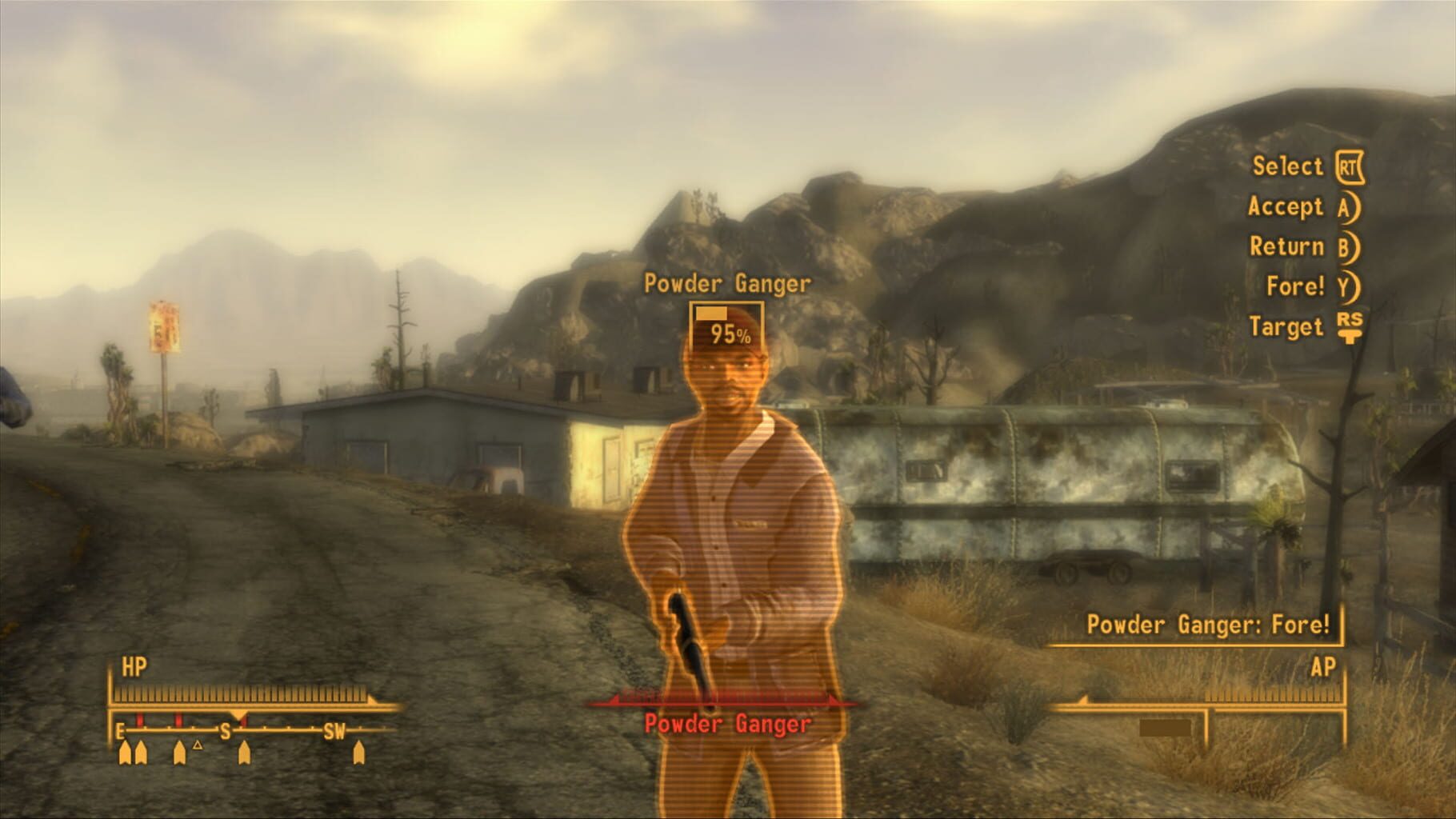
The player can engage in combat with non-player characters (NPCs). The weapons include firearms, energy-based guns, melee weapons, and explosives. Guns can be equipped with additional modifications such as a scope. While in combat, the player can use a gameplay mechanic known as the Vault-Tec Assisted Targeting System (VATS), which pauses the game and allows the player to target specific body parts of an enemy.
VATS is dictated by a statistic known as Action Points. Attacks made using VATS cost Action Points; when the player runs out, they must wait a short period before they can use VATS again. Some NPCs can be recruited as companions, and will accompany the player and assist them in combat.
At the start of the game, the player can customize the courier's appearance by choosing their gender, age, and race (Asian, White, Black, or Hispanic). They can then allocate points into seven primary attributes: strength, perception, endurance, charisma, intelligence, agility, and luck. L" stats. L stats: barter, energy weapons, explosives, guns, lockpick, medicine, melee weapons, repair, science, sneak, speech, survival, and unarmed.
If the player has a high intelligence stat, for example, they will be more proficient in the medicine, repair, and science skills at the beginning of the game. The player can add more points into skill stats whenever they earn enough experience points to level up. Experience points can be earned through several methods, such as killing an enemy or completing a quest. When the player reaches an even-numbered level, they can select a permanent, beneficial upgrade known as a perk.
For example, the Rapid Reload perk increases the reload speed for guns by 25 percent.
The player can initiate conversations with NPCs in the form of dialogue trees. For example, early in the game a doctor tells the player that they nursed them back to health and looked through their belongings for identification. ", and "What do I do now?" Some response options are only available if the player has enough points in a certain skill, such as 50 points in the Barter skill to ask a shopkeeper for a discount, or an Intelligence of 7 to impress someone.
The responses the player chooses during conversations with NPCs as well as any previous actions determine their reputation among the in-game factions. For example, if the player decides to help a faction, they may be given new armor or access to a secret base. If the player's actions are perceived as detrimental, a faction might send assassins to try and kill the player. Some factions dislike one another; if the player is helpful to one, they may be unable to complete quests for another.
Reputation extends to companions; some companions will leave the player if a specific faction dislikes the player.
An optional difficulty level in Fallout: New Vegas is Hardcore Mode, which adds survival mechanics that the player must keep track of. For example, the player must routinely eat, drink, and sleep to avoid dying from starvation, dehydration, or sleep deprivation. Healing items gradually heal wounds but crippled limbs can only be healed by doctors, sleeping in a player-owned bed, or special medication. Ammunition has weight, which necessitates careful inventory management, and companions can permanently die. Hardcore Mode can be enabled or disabled at any point, but if the player completes the entire game with it enabled, they unlock an achievement.
Story
Fallout: New Vegas takes place in 2281, 204 years after a devastating nuclear war between the United States and China, known as the Great War. Three major factions vie for control of the Mojave Desert, known in-game as the Mojave Wasteland: the New California Republic (NCR), a democratic republic attempting to restore representative government and maintain law and order; Caesar's Legion, a violent totalitarian army of tribal slavers inspired by the Roman legion; and Mr. House, a reclusive New Vegas businessman who commands an army of Securitron robots and rules as the city's technocratic dictator. As part of an eastward expansion from California, the NCR took control of the Hoover Dam, which provides electricity to the surrounding area.
Both Caesar's Legion and Mr. House seek to control the Hoover Dam for themselves and advance their own plans for the region. Minor factions include the Boomers, a heavily armed xenophobic tribe at Nellis Air Force Base; the Powder Gangers, escaped convicts from an NCR correctional facility; the Great Khans, a tribe of drug dealers; the Brotherhood of Steel, a militant organization that aims to secure and hold old-world technology; and the Followers of the Apocalypse, a humanitarian organization providing education and medical services to the impoverished people of the New Vegas outskirt areas.
While delivering a data storage device known as the Platinum Chip to New Vegas, the courier is ambushed by mobster and casino owner Benny, who steals the Platinum Chip and shoots the courier in the head. A Securitron personality named Victor digs out the courier from a shallow grave, and physician Doc Mitchell nurses them back to health. The courier departs to search for Benny and the Platinum Chip. They confront Benny in his casino on the New Vegas strip; the courier can either kill Benny and recover the Platinum Chip or let him escape, after which he is captured by Caesar's Legion.
The courier's actions attract the attention of the NCR, Caesar's Legion, and Mr. House, and the three groups each attempt to recruit them to aid in their efforts. It is revealed Mr. House survived the nuclear apocalypse in a life-support chamber.
He created the Platinum Chip, which contains a program capable of upgrading his Securitron army; the device was initially meant to protect Las Vegas during the Great War, but the war began before the Chip could be delivered. After the Platinum Chip was located, the courier was tasked with delivering it to Mr. House. Benny stole the Platinum Chip as part of his plan to usurp Mr.
House with the assistance of a reprogrammed Securitron called Yes Man.
Hoover Dam becomes the center of the conflict between the NCR and Caesar's Legion. The player can choose which faction to support, resulting in one of four endings. If the player supports the NCR, they successfully repel the Legion's attack at Hoover Dam and annex the Mojave Wasteland into the Republic. If the player supports Caesar's Legion, they force the NCR to retreat as the Legion conquers New Vegas and the surrounding area.
If the player supports Mr. House, the overwhelming Securitron army forces both the NCR and the Legion out of the area, securing control of the region for House alone. Alternatively, the player can usurp Mr. House and take control of the Securitron network themselves with the help of Yes Man, establishing an independent New Vegas.
Development
Fallout: New Vegas began with the cancellation of Van Buren, which was intended to be the third game in the mainline Fallout series. Black Isle Studios was set to develop a real-time game with turn-based combat set across Arizona, Colorado, Nevada, and Utah. The game was cancelled in December 2003 following the financial issues faced by Black Isle Studios' publisher, Interplay Entertainment. Prior to Van Buren's cancellation, former Black Isle and Interplay staff cofounded Obsidian Entertainment. Over the next few years, Obsidian developed the role-playing games Star Wars Knights of the Old Republic II: The Sith Lords, Neverwinter Nights 2, and Alpha Protocol, and a canceled Alien role-playing game.
In 2007, Bethesda Softworks purchased the Fallout intellectual property. The following year, Bethesda released Fallout 3, which was well received by critics and sold over five million copies in 2008. Prior to the release of Fallout 3, Bethesda had already started development on The Elder Scrolls V: Skyrim. Bethesda wanted to support Fallout 3 with more content and decided to contract another developer to create a large expansion pack.
Bethesda's creative director, Todd Howard, lobbied for a full game instead of an expansion pack and, based on their experience with the Fallout series, suggested Obsidian. In 2007, Obsidian had rejected an offer from Bethesda to develop a Star Trek game but agreed to develop a spin-off from the Fallout main series.
Bethesda wanted the game to take place on the West Coast of the United States, where the first two Fallout games are set, and Obsidian felt a similar setting would allow them to expand concepts introduced by Fallout 2, like the New California Republic. Other proposals included setting the game in a city based on Reno, Nevada, and allowing the player to play as a human, a ghoul, or a super mutant. The latter idea was rejected due to the technical challenges posed by armor-wearing ghouls and super mutants. The developers chose to set the game in Las Vegas and the surrounding Mojave Desert because they evoked the 1950s imagery for which the series was known and the post-apocalyptic setting of Mad Max.
At the behest of project director Josh Sawyer, Obsidian repurposed digital assets from the canceled Alien game for Fallout: New Vegas. According to Sawyer: "[I] did not want to disrupt our pipelines at all. We basically want to use what's there – add to it, don't change it ... and make great content".
Obsidian wanted New Vegas to take place between the events of Fallout 2 and Fallout 3, although Bethesda mandated each game in the series should follow chronological order.
Sawyer wanted the story of Fallout: New Vegas to focus on greed and excess. The history of Las Vegas served as an inspiration due to that city's connection with organized crime. One of the working titles for the game was Fallout: Sin City. Sawyer used the assassination of John F.
Kennedy in 1963 as a cut-off for any historical references. The game's narrative was structured around factional conflict as a result of fan feedback. Sawyer felt the factions would realistically be most concerned about access to water in the desert setting and Hoover Dam became a focal point for worldbuilding. During a Game Developers Conference presentation, Sawyer noted Obsidian wanted to avoid what he described as "Jesus/Hitler" moments, where factions like the NCR and Caesar's Legion were presented as straightforwardly good or evil, and aimed to make player choices come with moral trade offs.
To capture the ambiance of the Mojave Desert, Obsidian used data collected by the United States Geological Survey (USGS). Sawyer traveled to Las Vegas and took reference photographs of the surrounding areas, including the nearby Red Rock Canyon National Conservation Area. Obsidian used the Las Vegas Beltway as a point of reference while designing the map because they felt circling the map with a road network would help the player navigate. Bethesda requested the inclusion of large structures to serve as visual landmarks for the player.
, as visual landmarks, New Vegas uses kitschy roadside attractions, such as a large dinosaur statue based on the Cabazon Dinosaurs in Cabazon, California. These attractions were motivated by a goal to differentiate New Vegas from Fallout 3. C. metro.
Other differences include a warmer color palette for the graphics, and the inclusion of local flora, such as Joshua trees and prickly pear cacti. Obsidian wanted New Vegas to closely resemble the Las Vegas Strip in the 1950s; this means each casino is adorned with large neon signs, and their architecture is modeled on the contemporary Googie movement.
The gameplay of New Vegas remained largely unchanged from that of Fallout 3. Obsidian instead focused on making minor adjustments, such as giving the player more tactical options while in combat. The player could now use iron sights on guns, and accuracy was greatly affected by player movement. Optional gameplay mechanics that would further evoke a sense of desert survival skills, such as item-crafting, and Hardcore Mode, were added.
According to Sawyer, the feature was added to provide an optional difficulty increase for players. Obsidian was inspired by the Fallout 3 modding community, specifically the mods that sought to improve the game with quality of life changes. Bethesda provided Obsidian with the Gamebryo engine, which had been used for Fallout 3. No Obsidian staff had worked with Gamebryo, so the company hired a modder with experience making mods for The Elder Scrolls IV: Oblivion.
Inon Zur composed the soundtrack of Fallout: New Vegas, which was intended to evoke the soundscape of the American Southwest. While working on the soundtrack, Zur received an email that included the descriptors: "Southwest in the Future.


