
The articlegameplay, story, development, reception
Gameplay
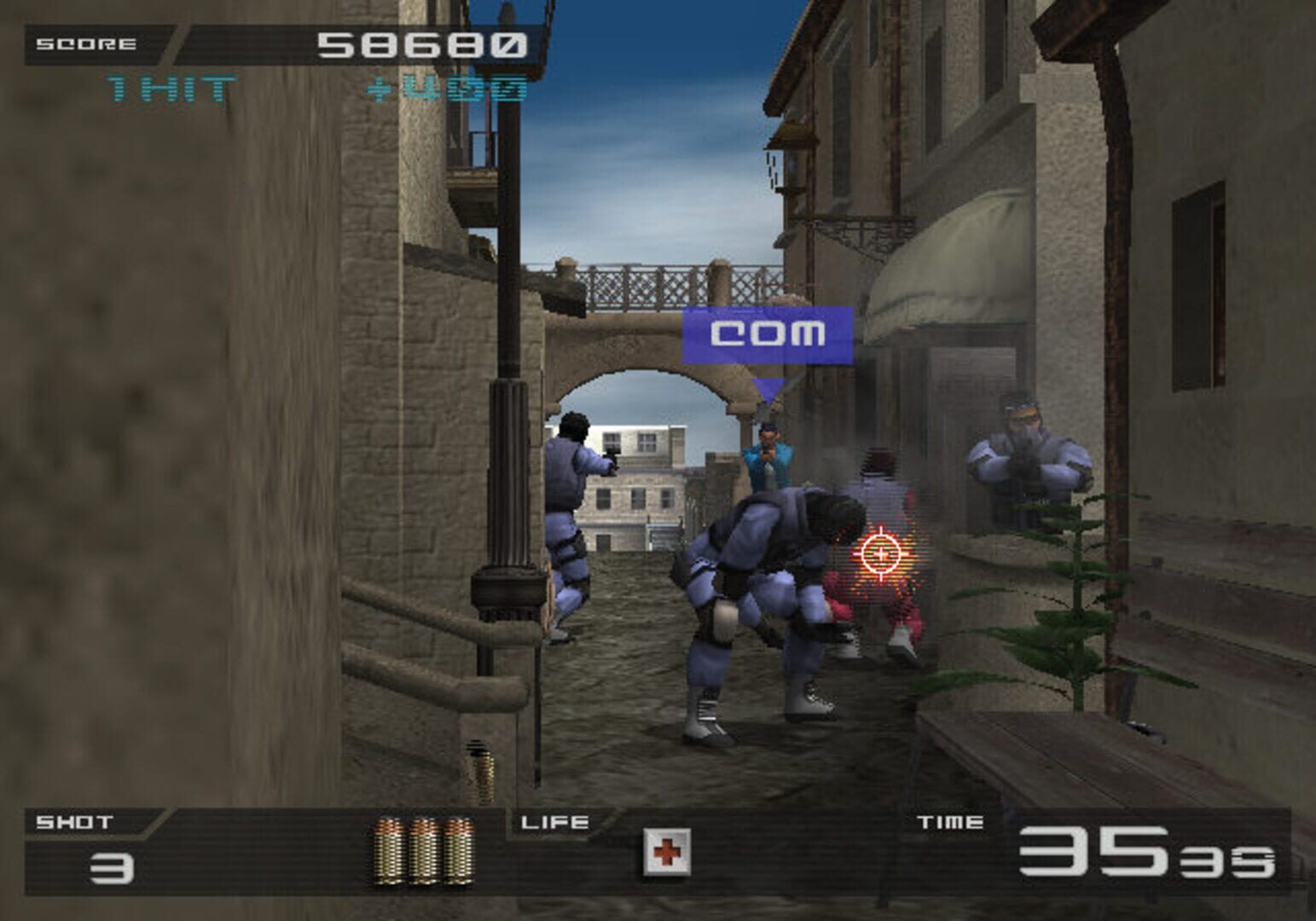
The game utilizes the foot pedal system, just like Time Crisis, allowing players to hide from enemy fire. The "crisis flash" system alerts players when the enemy's attack would cause a direct hit, a feature not present in its predecessor, Time Crisis. When pressing down on the pedal, the player comes out of hiding and can shoot enemies. Releasing the pedal puts the player behind cover to avoid bullets and reload the weapon, though the player cannot shoot while hiding. Certain sections of the game give players a machine gun with unlimited ammo.
The player loses a life if hit by a critical bullet or an obstacle, and the game ends when the player loses all lives. Players also lose a life if the time limit (which is replenished after each area is cleared) drops to zero, unlike the first game, where running out of time results in a game over. Players can continue from their current position, as opposed to the PlayStation version of Time Crisis, which requires players to restart from the beginning of a section.
Story
In 1997, NeoDyne Industries announces it plan to launch a series of 64 satellites, codenamed the "StarLine Network", that will help to unify the world's communication networks. E. agent Christy Ryan discovers that the company's CEO, a Gen Ernesto Diaz, plans to launch an experimental nuclear satellite into space and sell it to the highest bidder, and is using StarLine as a front. E.
agents Keith Martin and Robert Baxter arrive to collect her. While Christy is taken to Diaz, Kinisky flees with the suitcase, forcing the agents to pursue him. After killing him during a boat chase, the pair retrieve the case and learn that the experimental satellite is being transported by train.
Development
Time Crisis 2 was first publicly unveiled at the January 1998 Amusement Trades Exhibition International in London.
Reception
In Japan, Game Machine listed Time Crisis II on their June 15, 1998 issue as being the second most-successful dedicated arcade game of the week. It went on to be the sixth Japanese highest-grossing arcade game of 1999 and 2001 respectively.
The game was met with positive reviews upon release. Edge gave the arcade version the award for 1998 Coin-Op of the Year, above Sega Rally 2 and Get Bass. Edge described Time Crisis II's "separate-screen" two-player mode as "one of the most convincing forms of cooperative play ever seen in the arcade". AllGame gave it a score of four-and-a-half stars out of five.


