Ludography
58/100
Players15 ratings
Turbo OutRun cover

1989 · Sega AM2 · Arcade · Racing

Turbo OutRun

Sega console exclusive

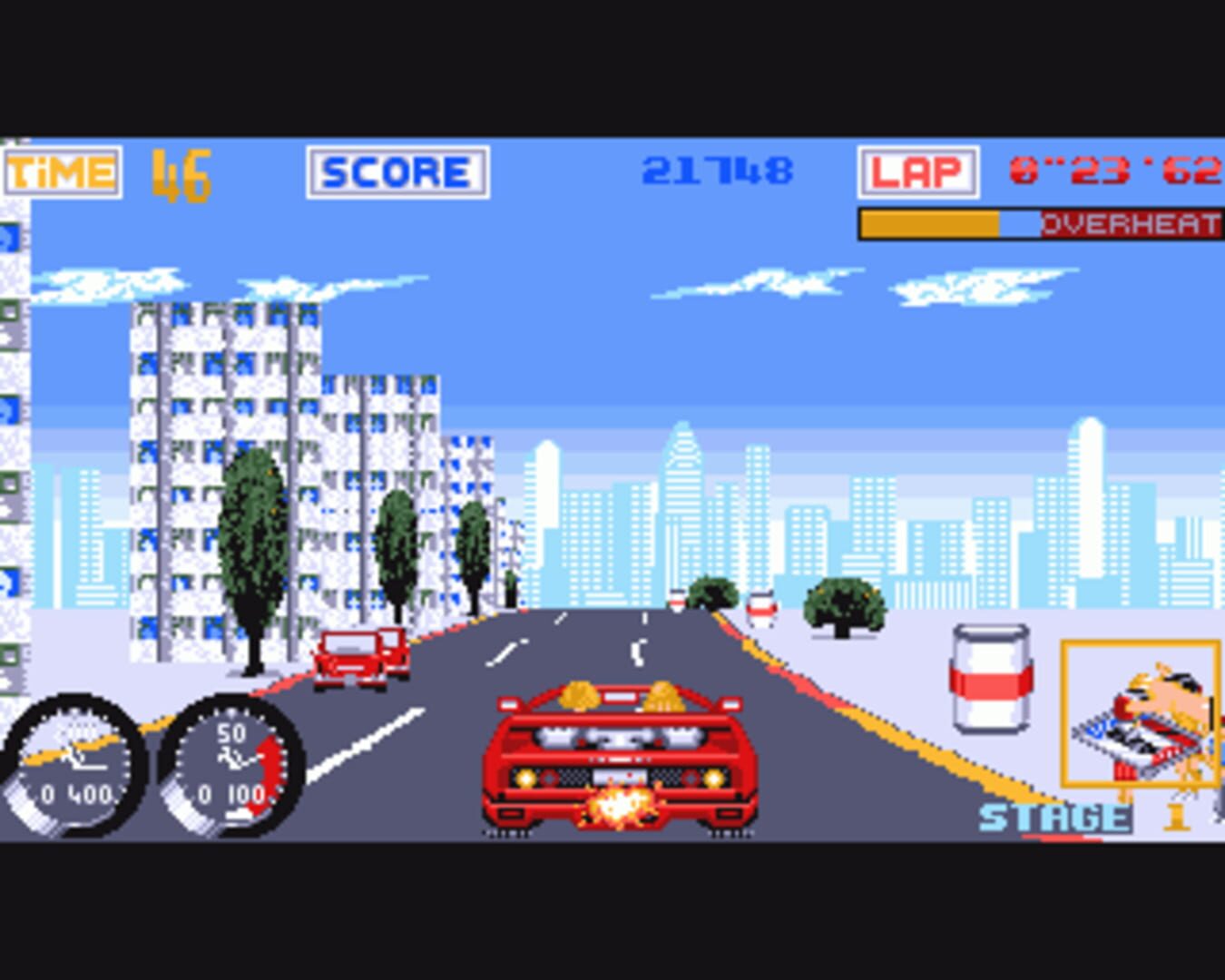
The sequel to OutRun features similar basic gameplay to the original, with the action viewed from behind the car, and the challenge being to complete each stage within the time limit. Contact can cause the car to spin, slow down or even flip; in each case you will lose time.

Also known as
Turbo Out Run
Released
11 February 1989
Platforms
ArcadeAmigaAmstrad CPCAtari ST/STECommodore C64/128/MAXFM TownsZX SpectrumMS-DOSSega GenesisAtari STCommodore 64
Genres
ArcadeRacing
Developers
Sega AM2SEGA Enterprises Ltd.Sega
Publishers
KixxSega Enterprises, Ltd.Sega of AmericaU.S. GoldSEGA Enterprises Ltd.Sega
Modes
Single-player
Perspective
Third person
Themes
Action
Country
Japan
Languages
English
Composers
Hiroshi Kawaguchi

About

Turbo OutRun (ターボアウトラン) is a 1989 racing game developed and published by Sega for arcades. A follow-up to 1986's Out Run, it was released as a dedicated game, as well as an upgrade kit for the original Out Run board. Like its predecessor, Turbo OutRun has players driving a Ferrari, this time a Ferrari F40. Players traverse a set route across the continental United States from New York City to Los Angeles.

In addition to a time limit, Turbo OutRun also adds a computer-controlled opponent driving a Porsche 959. The "Turbo" in the title plays a factor as players can press a button to receive a brief turbo boost of speed. Various power-ups which increase the vehicle's attributes can be chosen at various stages of the game.

Keywords

  • 2.5d
  • street racing
  • drifting
  • snow
  • sequel
  • high score
  • in-game radio
  • leaderboard
  • licensed cars
  • upgradeable vehicles
  • super scaler
  • police chase

Media

The articlegameplay, story, development, reception

Gameplay

The player controls a male driver sitting alongside his girlfriend in a Ferrari F40, racing against the clock and a computer-controlled opponent in a silver Porsche 959 in a race across the United States. The goal is to reach Los Angeles from the starting point of New York City. Unlike the original Out Run, there are no branch roads to choose from. Instead, there is only one path that can be taken to reach the goal.

The player can increase speed by using turbo boost by pressing a button on the side of the console-mounted shifter; the engine temperature will increase in kind on the on-screen gauge. When the gauge reaches "OVERHEAT!", turbo boost cannot be used until the temperature decreases.

Reception

In Japan, Game Machine listed Turbo OutRun as the third most successful upright/cockpit arcade unit of March 1989. In North America, the arcade game had reached number two on the Play Meter video game charts and number six on the RePlay upright cabinet charts by August 1989.

Turbo OutRun received positive to mixed reviews, depending on the version. The arcade and Commodore 64 versions were well received. Commodore User reviewed the arcade version and scored it 8 out of 10. The C64 version was awarded 93% from C+VG and 97% in Zzap!64. The Spectrum version of the game received 70% from Your Sinclair, 78% from Sinclair User and 79% from Crash.

Releases by platformdates and regions as published

Releases by platform
PlatformReleasedRegions
Arcade11 February 1989Japan
Amiga31 December 1989North America · Europe 31 December 1989
Amstrad CPC31 December 1989Europe
Atari ST/STE31 December 1989Europe
Commodore C64/128/MAX31 December 1989Europe · North America 31 December 1990
FM Towns31 December 1989Japan
ZX Spectrum31 December 1989Europe
MS-DOS31 December 1990North America
Sega Genesis27 March 1992Japan · Europe 31 December 1992

Editions and related releases

Included in
Mega Drive 4Super Mega Drive 3: 60 Super JogosSuper Mega Drive 3: 30 Super JogosSuper Mega Drive 3: 71 Super JogosSuper Mega Drive 3: 43 Super JogosWheels of Fire
Followed by
Battle Out Run
Follows
Out-Run 3-D
Ported as
3D Turbo OutRun

Games like this

Collections7 collections

Genres

Publishers

Description adapted from its source, CC BY-SA 4.0.