
The articlegameplay, story, development, reception
Gameplay
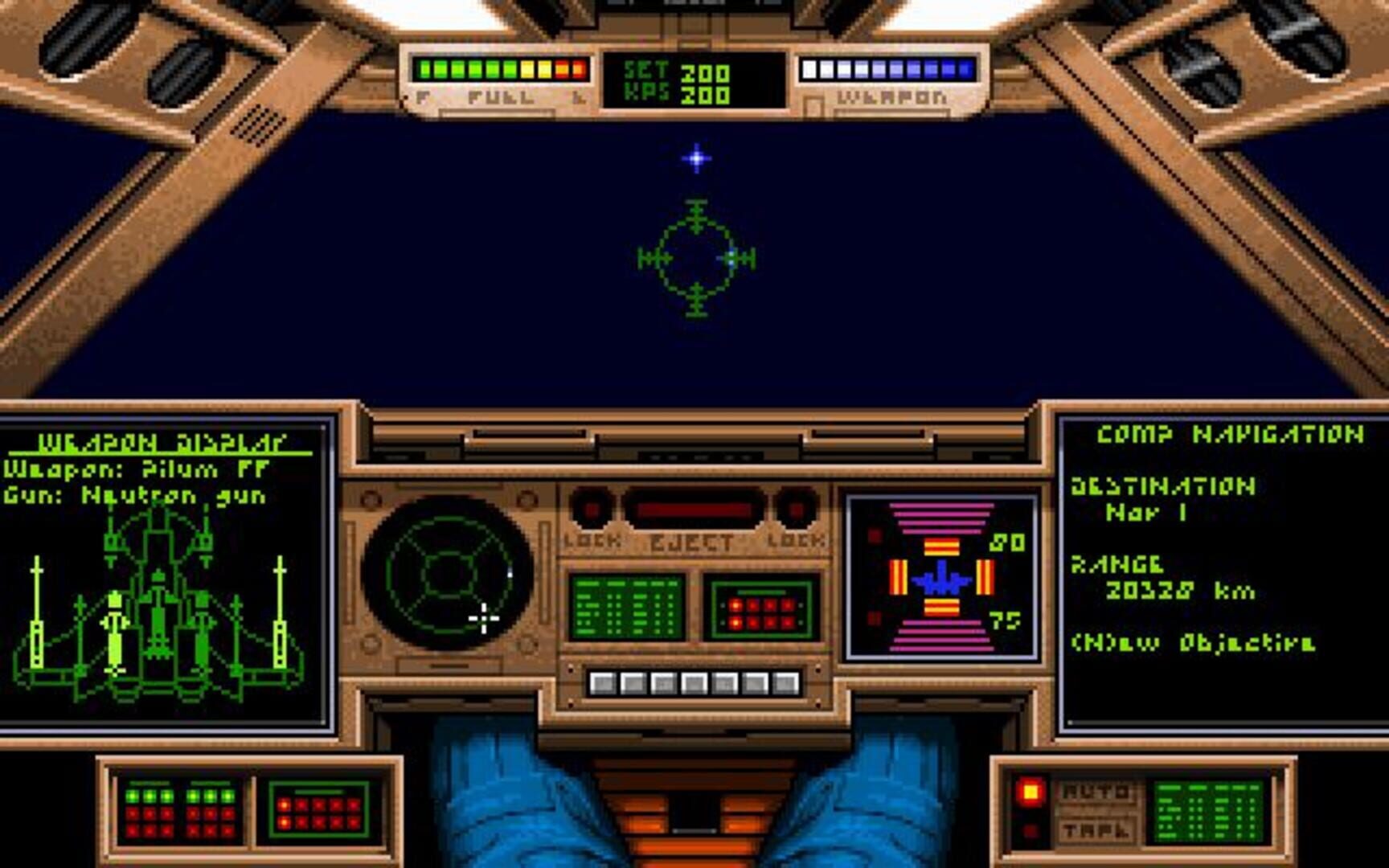
Wing Commander is a space flight simulation game, with the player piloting a ship, completing missions, and engaging enemy ships of various capabilities. As the title suggests, there will generally be an AI-controlled wingman which the player can give orders to. Missions will generally include multiple objectives, but the game can proceed even if objectives are failed as long as the protagonist survives. The game features a branching, open-ended story where overall performance affects the campaign: succeeding at objectives results in medals, promotions in rank, and progressing to missions with better ships; failing at objectives leads to more difficult missions and piloting inferior ships.
The mission tree is designed so players on the "losing" path could work their way back to the "winning" path, and conversely players on the "winning" path could fail subsequent missions to fall into the "losing" path. In addition, the wingmen can be killed permanently in combat, including by the player, and thus be gone for the rest of the campaign.
Story
The player takes the role of a nameless pilot (later referred to as Christopher Blair in sequels) aboard the TCS Tiger's Claw, a Bengal-class Strike Carrier. The player names the pilot and chooses his call sign. The pilot, known in-production to Origin personnel as "Bluehair" after his most notable feature, quickly rises through the ranks of the flight wing. The campaign will split to various different planets and scenarios depending on the player's performance.
If the player performs overall well, they eventually lead a strike on the Kilrathi High Command starbase in the Venice system and force the Kilrathi to retreat. If the player fails too many objectives, missions become increasingly defensive in nature. Human refugees abandon the sector, and eventually the Claw is forced to retreat as well. Of the two endings, the "winning" path is considered canon by the game's two expansion packs as well as its many sequels.
Development
Wing Commander was originally titled Squadron and later renamed Wingleader. During development for Wing Commander, the EMM386 memory manager the game used would give an exception when the user exited the game. It would print out a message similar to "EMM386 Memory manager error..." with additional information.
Before the team could isolate and fix the error and they considered a work-around, one of the game's programmers, Ken Demarest, hex-edited the memory manager so it displayed a different message. Instead of the error message, it printed "Thank you for playing Wing Commander".
Reception
Wing Commander became a best seller and resulted in the development of competing space combat games, such as LucasArts' X-Wing. It was very well received by critics. Dragon gave Wing Commander six stars, out of a five-star system, the Secret Missions Expansion Disk receiving five stars. Computer Gaming World in 1990 described the game as a "stellar warfare adventure in every sense of the word", praising its graphics, story, and music.
The magazine described The Secret Missions expansion as "more of the same", albeit more difficult, but the second as improving computer pilots' intelligence. In a 1992 survey of science fiction games, the magazine gave the title five of five stars, stating that "the richness of the entire package makes this a 'must-have'". A 1994 survey of strategic space games set in the year 2000 and later gave the game four-plus stars out of five. 91, the highest rating in the history of the magazine until 1992, when it was superseded by the sequel Wing Commander II; that year the magazine added Wing Commander to its Hall of Fame for games that readers highly rated over time.


