The articlegameplay, story, development, reception
Gameplay
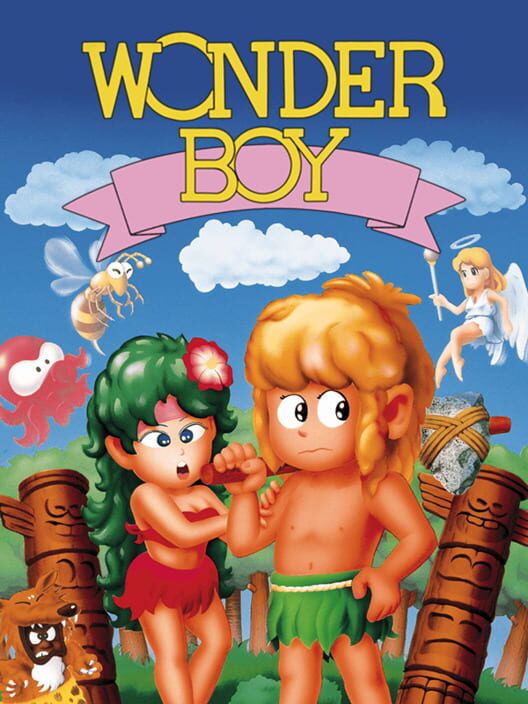
The titular Wonder Boy is a tribal caveman-like boy whose girlfriend Tina has been captured by the dark King (known as Drancon in the Game Gear version). The player must guide the Wonder Boy through seven "areas", each consisting of four "rounds".
Wonder Boy can arm himself with a stone hatchet, which he can throw at oncoming foes, a skateboard with which he can rush through the levels and temporary protection by an angel which allows him to destroy foes by simply running into them. All of the aforementioned power-ups are obtained by breaking open eggs. These eggs can also contain unpleasant surprises – curses which cause him to lose vitality more quickly than usual, and poisonous mushrooms which reduce Wonder Boy's vitality in one go, albeit replacing the original fruit such as apples and bananas with higher scoring desserts such as cake slices and ice cream sundaes. The player must remain aware of the vitality meter, which constantly runs down at a steady pace and can only be refilled by collecting food throughout the level.
There is also one doll to collect in each level, which doubles the bonus points awarded at the end of the level. If all 28 dolls are collected, then a bonus eighth area will be unlocked.
At the end of every "area", Wonder Boy will encounter an incarnation of the chief antagonist as a boss character. Once defeated, the mighty lord's mask flies off and transforms into an item such as a tea cup or a piece of fruit, prior to the lord making his escape. A two-player alternating mode is available where each player takes turn whenever the other one loses a life.
Story
In the far past, a Boy is attacked by the Evil King. He manages to escape, but The King kidnaps his girlfriend, Tina. The Boy explores the island and avoids the Grim Reaper, who has set out under the command of The King to lead him to his doom. After questing for ages, The Boy confronts The King and saves Tina. After returning home, The Boy is heralded as a "Wonder Boy".
Reception
Wonder Boy was a commercial success in arcades. In Japan, Game Machine listed Wonder Boy as the fifth most successful table arcade unit of May 1986. It became Japan's tenth highest-grossing table arcade game during the latter half of 1986. It appeared at number two on Euromax's nationwide UK arcade chart in 1987, just below Capcom's 1942 at number one.
The arcade game was critically acclaimed upon release. In Computer and Video Games, the game was lauded by reviewer Clare Edgeley for its detailed, bright, colorful graphics and simple, addictive gameplay, whilst some criticism was leveled towards the lack of variety. She also stated it reminds her of Super Mario Bros. though "not as complicated but just as playable." Writers now note that both games share a common ancestor in Pac-Land.
The Master System port received positive reviews from Computer Entertainer and Computer and Video Games.
Amstrad Action awarded the Amstrad CPC version of the game 68% on its original release in 1987, and 62% on its re-release three years later. Computing With the Amstrad awarded the game 88% on its original release.
Reviewing the ZX Spectrum version, CRASH remained unconvinced, citing technical shortcomings, including poor character-based scrolling, considerable slowdown, and confusion induced by the monochrome display. On its re-release, while quoting the aforementioned problems, the reviewer was willing to overlook them, highlighting the quality of the sprites and the fun offered by the game, and offering it 69%. Sinclair User was the most enthusiastic about the game, offering it 8 out of 10 on its original release, and 72% on its re-release. Your Sinclair offered 7 out of 10 on its original release and 67% on its re-release.
The C64 version shares the same graphics as the Amstrad CPC version; unlike the ZX Spectrum and Amstrad versions, however, the game featured smooth horizontal scrolling. CVG and Your Commodore reviewed the game reasonably well on initial release, with Your Commodore remarking that it was an excellent arcade conversion but feeling it was lacking in originality, and CVG describing it as addictive, whilst Zzap were much more critical, rating the game 52% and criticising the poor sound and labelling the actual arcade game itself as 'ordinary'.
IGN awarded the mobile version 7.1 out of 10, praising its accuracy to the arcade original.