
The articlegameplay, story, development, reception
Gameplay
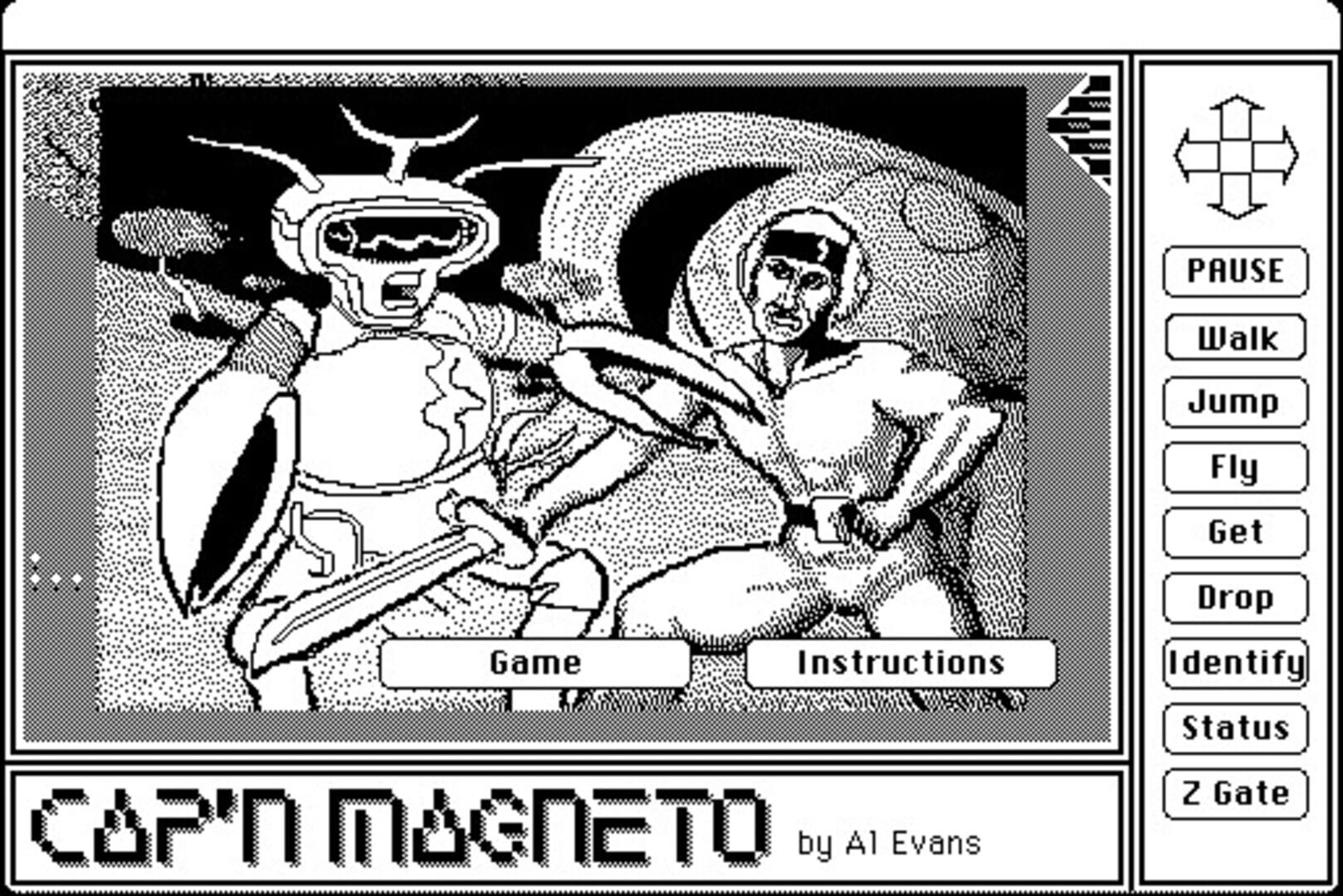
The game takes place on a top-down 2-D map, which is colorized in recent versions. The characters, including Magneto, appear in side view. By modern standards the map is quite small, wrapping around after about three window-sizes, the windows remaining limited to the original 512 × 342 resolution of the early Macs. Magneto could move only in the four cardinal directions, either by pressing buttons on the "control panel" on the right side of the screen, or by using the cursor keys in modern versions (early Macs did not include cursor keys). There are several other buttons used to identify objects and translate the alien speech, pick up or drop objects, and to use the various equipment found while playing.
Cap'n Magneto is based on finding and collecting important items scattered around the map, and then using them to access different areas of the map and continue in this fashion. Most of the map consists of various "buildings", including the broken remains of Magneto's ship, as well as a useful apple tree and a small island. Some of the map locations lead to "new maps" when entered, areas that are represented by smaller buildings on the original "outdoors" map.
Story
Captain Lance Magneto of the Intergalactic Rangers, crash-landed on an alien planet to find the space pirate named The Menturg. His mission was to gather supplies and tools scattered across the world to defeat the villain and find his way back home.
Development
The game was originally written by Al Evans for the original 128K Macintosh in Lisa Pascal, and was released as shareware in 1985. It is a rewritten and expanded version of Evans' 1983 Apple III game Cap'n Magneto. Evans describes it as "the first truly interactive game for the Apple Macintosh" and writer Richard Moss claims it is the "first free-roaming direct control adventure game" released for Macintosh. This version continued to work on all of the early versions of the classic Mac OS and was a common shareware fixture. The game stopped working under System 7, and several compatibility updates followed.
Evans intended Cap'n Magneto to show a vision of how he conceived the world worked, "an amalgamation of hard-earned lessons on the value of relationships, being an active participant in shaping the world and knowing how to move on." He was inspired by the Ultima series but annoyed that combat was the only interaction possible with creatures. He implemented the ability to befriend creatures because he felt that a game in which everyone is the enemy "doesn't reflect the game of life [...] most people actually, are probably pretty friendly."
Reception
Macworld named the Macintosh version of Cap'n Magneto the "Best of Show" as part of its Shareware and Public Domain Game Awards in 1987. Macworld praises Cap'n Magneto's gameplay, stating that "Although Cap'n Magneto resembles other games with its emphasis on fighting and destroying enemies, it requires strategy to win. Moreover, making friends is at least as important as fighting, which sets Cap'n Magneto apart from the rest. Cap'n Magneto successfully combines arcadelike features with the puzzle-solving spirit of a good adventure game."
In 1989, MacUser magazine named Cap'n Magneto one of the 200 best Macintosh products, calling it "an old favorite that's still popular" and enjoyable despite being "crude compared with some more recent games."
Legacy
In 1993, Cap'n Magneto was updated for compatibility with System 7 and Macintoshes up to the Quadra 850. This version was never widely distributed, as the original publisher went out of business before it was released. A quickly-patched version running on Mac OS X appeared as one of the "hacks" at MacHack 2000, known as The Return of Cap'n Magneto. In 2005 a new Carbonized version with colorized graphics replacing the previous black and white graphics was released to run natively on Mac OS X, and the original and 1993 versions were released free for download.
The Carbonized version is not compatible with Intel-based Macs running Mac OS X Lion and newer versions of macOS, due to the dropping of Rosetta support. In 2020, Al Evans released Cap'n Magneto as freeware and posted a free-to-use registration code on the official Cap'n Magneto website, following the demise of KAGI, the company that handled the game's registration.


