Ludography
Darius II cover

1990 · Taito · Arcade · Shoot 'em up

Darius II

Timed Sega exclusive

Darius II is a 1989 arcade video game developed by Taito. It is the direct sequel to the 1987 Darius. It was later released as Sagaia in Japan in 1991 for the Game Boy as well as non-Japanese ports. A remake was released for the PC Engine Super CD-ROM as Super Darius II in 1993.

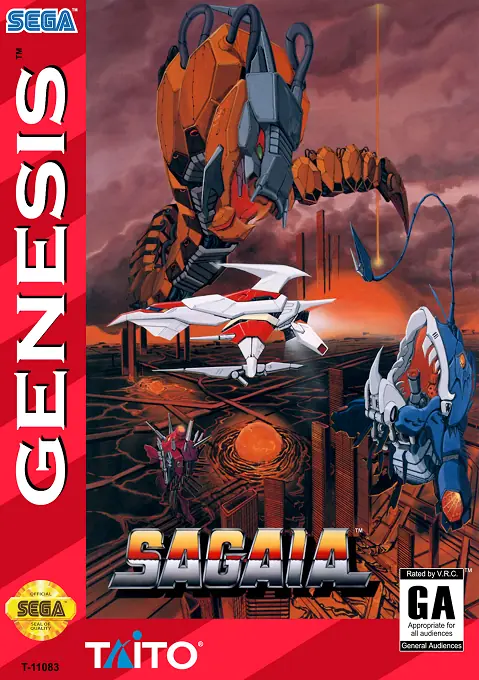
A Mega Drive conversion was released in Japan in 1990; it was later released for the Genesis in the United States and Brazil in 1991, where it was renamed Sagaia. Changes include a boss rush mode (via a code) and various modifications to levels and mechanics, such as the boss Steel Spine being moved to another level and the boss Killer Higia being replaced with a similar creation called Nehonojia. This conversion does not support two players, so the ability to choose between Proco Jr. and Tiat Young was added; Proco plays like normal, while Tiat starts every life off with one power level to every weapon.

A Master System conversion, developed by Natsume, was released in Europe and Brazil in 1992, also titled Sagaia. It is somewhat based on the Mega Drive port, and while Tiat Young and her abilities are still present (though even more limited), many zones (and thus bosses) have been completely removed.

The Super CD-ROM version features an entirely new set of bosses, major changes to levels, and a fully arranged soundtrack including new songs.

Also known as
Sagaia · Saagaia
Released
20 December 1990
Platforms
ArcadeSega GenesisSega Master System/Mark IIISega SaturnWiiGame BoyMaster SystemNintendo SwitchTurboGrafx-16
Genres
ArcadeShoot 'em upShooter
Developers
Taito
Publishers
Taito
Modes
MultiplayerSingle-player
Perspective
Side view
Themes
Science fiction
Country
Japan
Age ratings
CERO A
Languages
EnglishJapanese
Composers
Hisayoshi Ogura

About

Darius II, released outside Japan as Sagaia, is a 1989 horizontally scrolling shooter video game developed and published by Taito for arcades. It is a direct sequel to the 1987 title Darius. It was later released in Japan in 1991 for the Game Boy as well as non-Japanese ports. A remake was released for the PC Engine Super CD-ROM² as Super Darius II in 1993.

Keywords

  • shoot 'em up
  • shmup
  • wii virtual console

Media

The articlegameplay, story, development, reception

Gameplay

The game is set in the inner half of the Solar System, and has the same branching level structure as Darius. Similar to the first Darius game, Darius II was programmed for multiple screens; while a three-screen version like the original exists, Darius II is more commonly and generally represented as a two-screen game.

The red/green/blue powerups from the first game return, and have the same function, respectively. They provide upgrades to the "missile" main weapon, the "bomb" subweapon, and a shield to absorb damage. Two new powerups were added: a yellow powerup that adds a new "laser" main weapon which functions somewhat similarly to the bombs, and a rainbow powerup that grants one upgrade to all the players weapons. Acquiring these powerups and the upgrade path is vastly different from Darius.

A formation of a specific enemy must be completely destroyed (and a formation may not have a powerup), and every single powerup now grants some kind of upgrade. Furthermore, the various weapons upgrade differently, though the shield upgrade is the same as before.

Another new feature in Darius II is the appearance of minibosses known as "captains"; large enemies that appear somewhere in the level before the main boss. In Darius II, these are all smaller versions of bosses from the first game, with similar abilities.

Story

Darius II takes place sometime after the first Darius game. The colonized planet Darius is recuperating from its invasion from the alien Belser Army thanks to that game's heroes Proco and Tiat. Darius' inhabitants have since situated themselves on the planet Olga while Darius' societies, architecture and attacked areas were being repaired. The space flight Headquarters established on Olga picks up an SOS signal coming from Earth, where the first colonists originated before colonizing Darius.

The signal included the description of alien ships similar to those of the Belser Army. Suspecting these might be their remaining Earthling ancestors, the people of Darius sends both Proco Jr. and Tiat Young to help them.

Reception

In Japan, Game Machine listed Darius II as the sixth most successful upright/cockpit arcade unit of November 1989.
Releases by platformdates and regions as published

Releases by platform
PlatformReleasedRegions
Arcade1 September 1989Japan · Europe 31 December 1989 · North America 31 December 1989
Sega Genesis20 November 1990Japan · Brazil 14 October 1991 · North America 31 December 1991 · Europe 31 December 1991
Sega Master System/Mark III1 July 1992Brazil · Europe 31 December 1992
Sega Saturn7 June 1996North America · Europe 30 September 1996
Wii31 December 2009Worldwide

Title IDsone per regional release, with its latest update

Title ids and disc serials by release
PlatformTitle IDRegionLatest update
Sega GenesisT-11083Japan—
TS-0039-40North America—
Sega Master System/Mark III7078Europe—
Sega SaturnMK81085-50Europe—
T-1104GJapan—

Box artone per regional release we hold art for

Editions and related releases

Included in
Darius Cozmic CollectionDarius Cozmic Collection: Special EditionDarius Cozmic Collection: Console EditionTaito Memories II JoukanTaito Milestones 2Darius Cozmic Collection Arcade
Ported as
SagaiaSuper Darius IIArcade Archives: Darius II
Built on it
SagaiaSuper Darius II

Games like this

Collections8 collections

Publishers

Description adapted from its source, CC BY-SA 4.0.