
The articlegameplay, story, development, reception
Gameplay
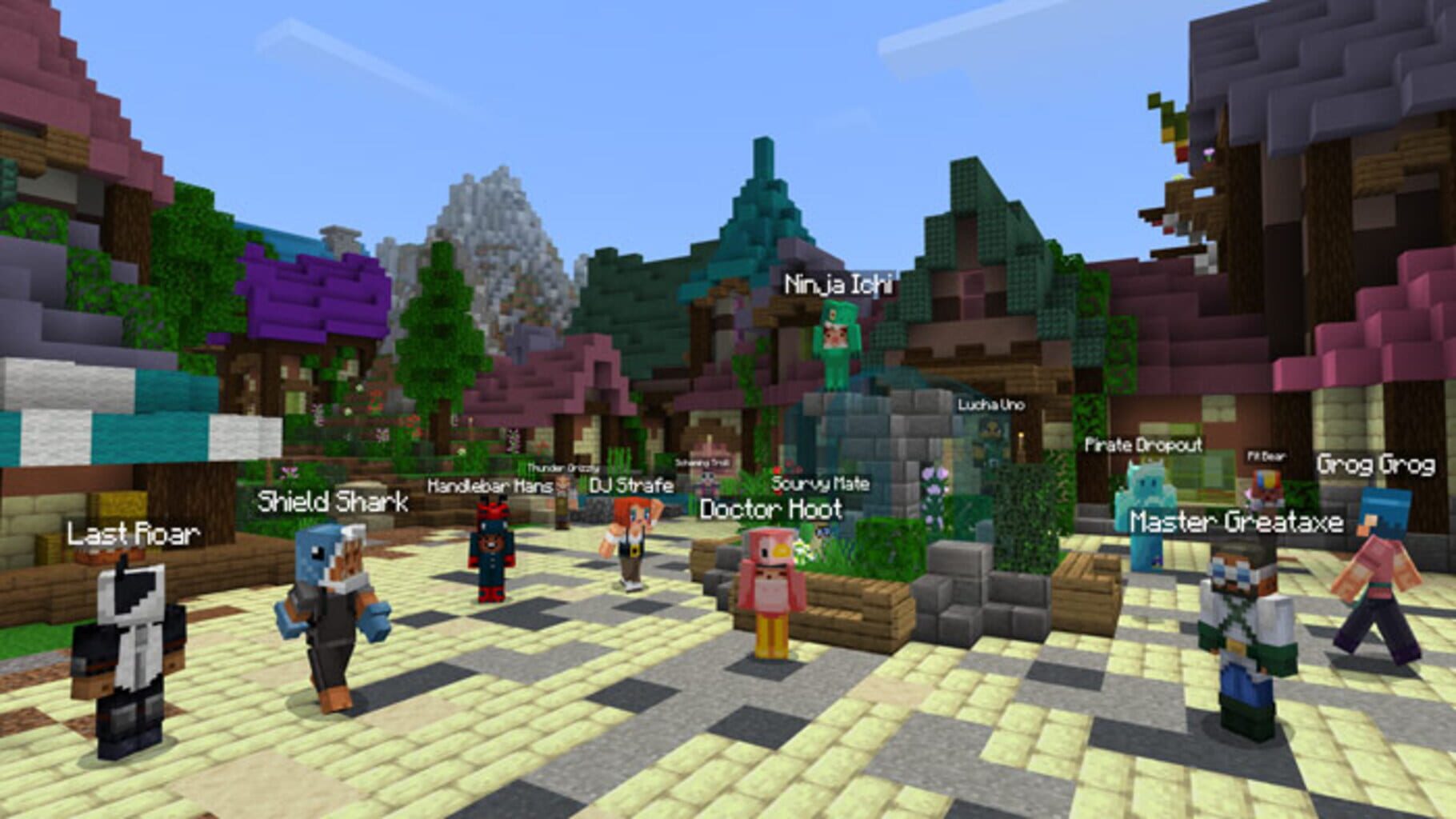
Minecraft is a three-dimensional (3D) sandbox video game played in discrete, persistent instances called "worlds". These worlds are composed of rough 3D objects—mainly cubes, referred to as blocks—arranged in a voxel grid and representing various materials, such as dirt, stone, ores, logs, water, and lava. The core gameplay revolves around picking up and placing these blocks: players can move freely around the world, breaking, or mining, blocks and then placing them elsewhere to build structures. Most blocks are not affected by gravity, instead maintaining their voxel position in the air.
Minecraft has no required goals to accomplish, giving players a large amount of freedom in choosing how to play the game, though an optional achievement system is included. Gameplay is in the first-person perspective by default, but players have the option of third-person perspectives (back and front).
Development
Before creating Minecraft, Markus "Notch" Persson was a game developer at King, where he worked until March 2009. At King, he primarily developed browser games and learned several programming languages. During his free time, he prototyped his own games, often drawing inspiration from other titles, and was an active participant on the TIGSource forums for independent developers.
One such project was RubyDung, a base-building game inspired by Dwarf Fortress, but with an isometric, three-dimensional perspective similar to RollerCoaster Tycoon. Among the features in RubyDung that he explored was a first-person view similar to Dungeon Keeper, though he ultimately discarded this idea, feeling the graphics were too pixelated at the time. Around March 2009, Persson left King and joined jAlbum, while continuing to work on his prototypes. Infiniminer, a block-based open-ended mining game first released in April 2009, inspired Persson's vision for RubyDung's future direction.
Reception
Minecraft has received critical acclaim, receiving a weighted score of 93 out of 100 on the review aggregator website Metacritic for the PC version of the game. Alec Meer of Eurogamer rated it 10/10, calling it "unmissable" and the defining game of its decade, and Sean Bell of The Telegraph rated it 5/5, describing it as an "international phenomenon". Writing years later, Alex Avard of GamesRadar+ continued to treat it as a foundational and commercially significant title, crediting it with popularizing the survival-crafting genre. It has been regarded as having introduced millions of children to the digital world, insofar as its basic game mechanics are logically analogous to computer commands.
Critics singled out the game's procedurally generated worlds and open-ended building as its central strengths. Jaz McDougall of PC Gamer described the terrain as a patchwork of biomes, with forests giving way to plains, deserts, or icy islands, and Bell noted that a world would keep expanding as it was explored. McDougall also pointed to redstone circuitry and player-built computers as evidence of the game's depth, while Meer summarized the core loop simply as the ability to create and destroy, saying it could support anything from towers to functioning rail networks. Anthony Gallegos of IGN wrote that building his first wooden door gave him a sense of ownership that purchasing pre-built houses in other games could not replicate, and Avard described the game as a "big, beautiful 'Welcome' mat" to a player's imagination. The blocky visual style itself drew mixed reactions: Lukasz Znojek of GRY-Online.pl felt its "angular" look would not appeal to everyone, while Gallegos and GameTrailers both described the graphics as dated at first glance but ultimately charming and memorable once players adjusted to them.
Legacy
In September 2019, The Guardian classified Minecraft as the best video game of the 21st century to date, and in November 2019, Polygon called it the "most important game of the decade" in its 2010s "decade in review". In June 2020, Minecraft was inducted into the World Video Game Hall of Fame. Minecraft is recognized as one of the first successful games to use an early access model to draw in sales prior to its full release version to help fund development. As Minecraft helped to bolster indie game development in the early 2010s, it also helped to popularize the use of the early access model in indie game development.
Social media sites such as YouTube, Facebook, and Reddit have played a significant role in popularizing Minecraft. Research conducted by the Annenberg School for Communication at the University of Pennsylvania showed that one-third of Minecraft players learned about the game via Internet videos. In 2010, Minecraft-related videos began to gain influence on YouTube, often made by commentators. The videos usually contain screen-capture footage of the game and voice-overs.


