The articlegameplay, story, development, reception
Gameplay
Fire Emblem Gaiden is a tactical role-playing game set on the continent of Valentia. Players assume control of two armies, led by Alm and Celica, who navigate an overworld and can visit towns, where they may recruit new allies or talk to traders to transfer items between the groups. The overworld is freely navigable, with additional areas opening up as the story progresses. The game features two difficulty levels: "Normal" and "Easy". On easy mode, experience points earned through actions in combat are doubled and items can be exchanged between units beyond vendor stalls.
Battles use a turn-based battle system, with the player, enemies, and sometimes non-playable characters each taking turns and moving across a grid-based battlefield; battles are won by the player defeating all enemies in a map or killing a boss character. Enemies include human troops and monsters. The players are given a limited number of units, which are each assigned unique character classes that have various functions in battle, such as being mounted or having access to magic. A unit's class also affects their range of movement on the battlefield.
Story
The continent of Valentia was once divided between the Earth Mother Mila and the War Father Duma, sibling gods who split up and formed rival nations devoted to worshiping them: Mila's Kingdom of Zofia, and Duma's Empire of Rigel. The two deities, who each held extreme viewpoints on the world, ended up corrupting their subjects, and Zofia was eventually swallowed in a war triggered by its military leader, Chancellor Desaix, who attempted a coup d'état. Rigel's ruler Emperor Rudolf used this opportunity to lead Rigel's armies across Valentia in an attempt to conquer both countries. A village boy named Alm sets out on a quest to overthrow Desaix and drive Rudolf out of Zofia.
Meanwhile, his childhood friend Celica, the exiled Princess Antheise of Zofia, embarks on a pilgrimage to discover Mila's whereabouts after she vanishes, causing a drought in Zofia. The two meet at Zofia Castle, but part ways when Alm is unwilling to attempt to find a peaceful resolution with Rudolf. Alm invades Rigel and defeats Rudolf, who reveals with his dying breath that Alm is actually his son Albein Alm Rudolf. It is then explained that Rudolf's invasion was intended to strengthen the continent's military forces and create a champion capable of defeating Duma and Mila, who have both fallen into insanity due to their extreme power.
Development
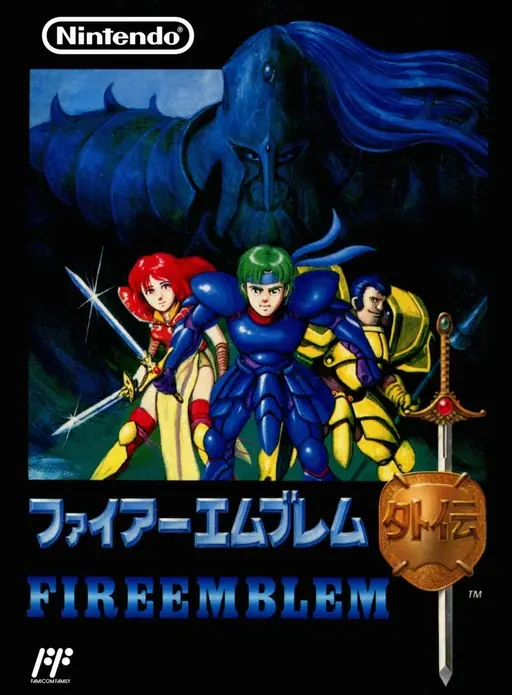
The development began following the commercial success of Fire Emblem: Shadow Dragon and the Blade of Light in 1990. The original game's designer and writer Shouzou Kaga returned to those roles and also became director. In addition to Kaga, Gunpei Yokoi returned from Shadow Dragon and the Blade of Light as the game's producer, while the visuals were created by Naotaka Ohnishi, Satoshi Machida and Toshitaka Muramatsu. The music and sound design was handled by Yuka Tsujiyoko, who had worked on the first Fire Emblem. The game's subtitle, "Gaiden", is a Japanese term for a side story related to a larger work, denoting the game's status as a secondary adventure set in the same timeline as the first game.
Kaga designed Gaiden to address issues raised with the first game, such as tedious elements of map navigation. The system of Shadow Dragon and the Blade of Light was used as the base for various improvements to aspects such as enemy AI, although the gameplay adjustments ended up removing some of the strategic elements. These elements included a navigable overworld and more overt role-playing elements, along with the introduction of the class evolution system. Balancing these elements proved challenging for the team.
Reception
In Japan, it topped the Famitsu sales chart in March 1992. As of 2002, Gaiden had sold 324,699 units. This made Gaiden the fourth best-selling title in the Fire Emblem series to that date.
Four critics reviewed Fire Emblem Gaiden in video game magazine Famicom Tsūshin. In their review, critics noted that its gameplay changes meant that it could not be compared to its predecessor, with one critic enjoying its gameplay and calling it better than the first game. Another critic noted that it was fairly easy during the first half, then became rapidly more difficult during the later stages. Another reviewer noted that, while the number of maps had increased, the strategic elements had become noticeably weaker.