
1997 · Square · Mecha · Real-time strategy
Front Mission Alternative
PlayStation exclusive
The first game in the Front Mission series to take you to the African Continent. The year is 2034 and guerilla fighters are terrorizing local governments in Africa. You are charged with breaking these terrorist organizations with the WAWs (Walking Armored Wanzers) at your disposal.
- Released
- 18 December 1997
- Platforms
- PlayStationPlayStation 3PlayStation Portable
- Genres
- MechaReal-time strategy
- Developers
- Square
- Publishers
- SquareSquare Enix
- Series
- Front Mission
- Modes
- Single-player
- Perspective
- First personThird person
- Themes
- Science fictionWarfare
- Country
- Japan
- Age ratings
- CERO BGRAC 12+
- Languages
- Japanese
About
Front Mission Alternative is a real-time tactics video game developed and published by Square, and was released in Japan on December 18, 1997. Front Mission Alternative is the second spin-off entry and the fourth entry overall in the Front Mission series. Unlike other Front Mission titles, Front Mission Alternative is the precursor to the serialized storyline and features a completely standalone story and cast of characters.
›Story
Set in 2034, the story of Front Mission Alternative takes place in Africa. In the early 21st century, nations around the world form regional entities to combat a global recession and other crises. While many regions thrive under their newly formed supranational unions, the nations of Africa fall deeper into environmental, racial, and ethnic conflicts. In an attempt to help them, the European Community (EC) and the Oceania Cooperative Union (OCU) assisted the African countries in forming a continental alliance called the Organization of African Consolidation (OAC).
Although it initially thrives in the first three years, disputes flare up between the OAC's five regional blocs - the Union of Northern African States (UNAS), the South African United States (SAUS), the Community of Central African States (CA), the East African Communities (EA), and the West African States Community Union (WA). Tensions rise and with diplomatic efforts failing, the nations go to war, leading to the outbreak of the African Conflict.
The plot of Front Mission Alternative revolves around the Independent Mobile Assault Company (IMAC), a special joint unit of soldiers from the OCU and the SAUS led by OCU Ground Defense Force 2nd Lt Earl McCoy. The SAUS government deploys the IMAC to stop the civil conflicts in its territory and in the other blocs. Piloting a new bipedal weapons platform called the wanderwagen or WAW, the IMAC successfully quells the violence across the continent. As they travel north to support the Western African Liberation Front, the company starts encountering unknown WAWs and WAW-vehicle hybrids known as "mobile weapons" being used by terrorist forces.
The EC intervenes through the deployment of an elite anti-terrorism unit, but appear to be aiding the UNAS in prolonging the war. As the IMAC starts fighting their way into UNAS territory, they uncover connections between the terrorist uprisings, civil conflicts, the true cause of the war, and how the EC factors into the situation.
Keywords
- anime
- robots
- playstation network
- digital distribution
- psone classics
- playstation tv support
- backwards compatibility
- japan only
- mechs
Media
The articlegameplay, story, development, reception
Gameplay
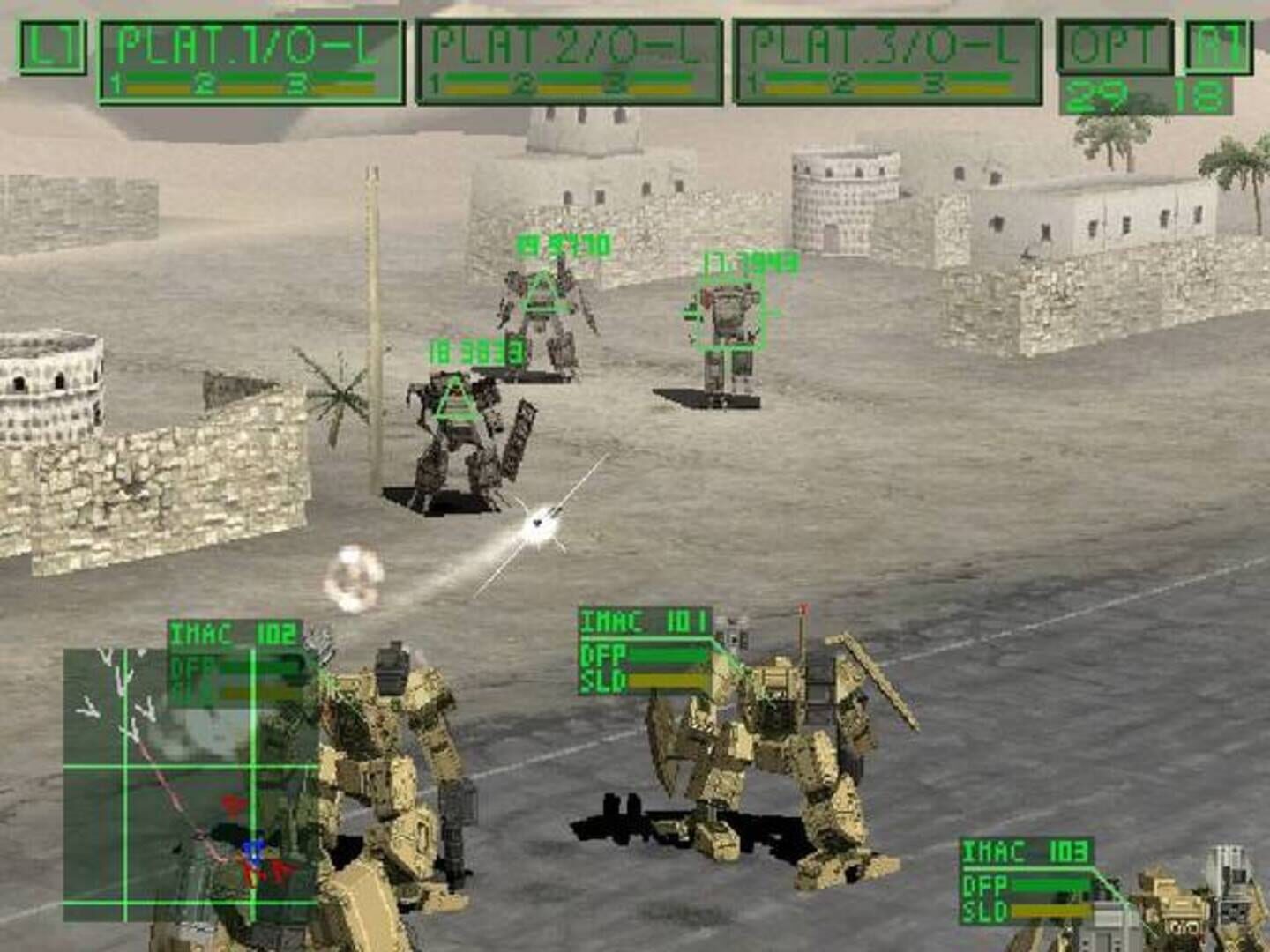
As a real-time strategy spin-off, the gameplay of Front Mission Alternative differs from the tactical role-playing game entries of the numbered Front Mission titles. Rather than being played out on a grid-based map and using a turn-based structure, battles takes place in real-time on full 3D maps. The player controls up to three platoons, each platoon consisting of three mecha - the wanderwagen, or WAW. During missions, they have complete control over where their platoons move, and what enemy platoons they can attack.
Movement on the battlefield is done through waypoints; the player must select preset waypoints on the map in order to move their platoons. Player-controlled platoons can attack enemy targets along the way to the waypoints, or if they are ordered to attack the aforementioned targets.
Story
Set in 2034, the story of Front Mission Alternative takes place in Africa. In the early 21st century, nations around the world form regional entities to combat a global recession and other crises. While many regions thrive under their newly formed supranational unions, the nations of Africa fall deeper into environmental, racial, and ethnic conflicts. In an attempt to help them, the European Community (EC) and the Oceania Cooperative Union (OCU) assisted the African countries in forming a continental alliance called the Organization of African Consolidation (OAC).
Although it initially thrives in the first three years, disputes flare up between the OAC's five regional blocs - the Union of Northern African States (UNAS), the South African United States (SAUS), the Community of Central African States (CA), the East African Communities (EA), and the West African States Community Union (WA). Tensions rise and with diplomatic efforts failing, the nations go to war, leading to the outbreak of the African Conflict.
Development
The game was developed at the same time as Front Mission 2. Alternative was created in order to recoup the costs of that game's development. The music of Front Mission Alternative was done by DJ Riow Arai. A preview of the game was shown off at the 1997 Tokyo Game Show.
Reception
Greg Kasavin of GameSpot praised the graphics and audio experience, but criticized the game for being too short and rewarding players with more elaborate story sections if they failed to achieve game missions, indirectly rewarding failure. He also called the soundtrack "a bunch of dizzying techno that doesn't suit the onscreen grandeur". Hardcore Gaming 101 noted it was not a very deep real time strategy game, but praised its branching stories and variety of endings.
Releases by platformdates and regions as published
Title IDsone per regional release, with its latest update
In the same series
 78
Front Mission
1995 · Nintendo DS, PlayStation +2
G-Craft
 Nintendo exclusive78
Front Mission Series: Gun Hazard
1996 · SNES, Wii
Square
 PlayStation exclusive
Front Mission 2: Remake
1997 · PlayStation, PlayStation 3 +1
 84
Front Mission 3 Remake
1999 · Remake · PlayStation, PlayStation 3 +7
Square
 PlayStation exclusive76
Front Mission 4
2003 · PlayStation 2
Square Enix
 Nintendo exclusive
Front Mission 2089: Border of Madness
2005 · Legacy Mobile Device, Nintendo DS
Square Enix
 PlayStation exclusive
Front Mission 5: Scars of the War
2005 · PlayStation 2
Square Enix
 PlayStation exclusive
Front Mission Online
2005 · PlayStation 2, Windows
Square Enix
 65
Front Mission Evolved
2010 · PlayStation 3, Windows +1
Double Helix Games
Games like this
 PlayStation exclusive
Gunparade March
2000 · PlayStation, PlayStation 3 +1
Mecha · Often paired
 PlayStation exclusive
Space Griffon VF-9
1995 · PlayStation, PlayStation 3 +2
Mecha · Anime

Linda³ Again
1995 · Remake · PlayStation, PlayStation 3 +2
Often paired
 Timed SNK
Voltage Fighter Gowcaizer
1995 · Arcade, Neo Geo +4
Anime · Often paired
 PlayStation exclusive
Kowloon's Gate
1997 · PlayStation, PlayStation 3 +1
Often paired
 PlayStation exclusive75
Star Gladiator
1996 · Arcade, PlayStation +2
Often paired
 Timed Sega
Psychic Force 2012
1999 · Arcade, Dreamcast +4
Anime · Often paired

Assault Suits Valken Declassified
1992 · PlayStation, PlayStation 3 +2
Anime · Often paired
Collections2 collections
Platform libraries
Description adapted from its source, CC BY-SA 4.0.