
The articlegameplay, story, development, reception
Gameplay
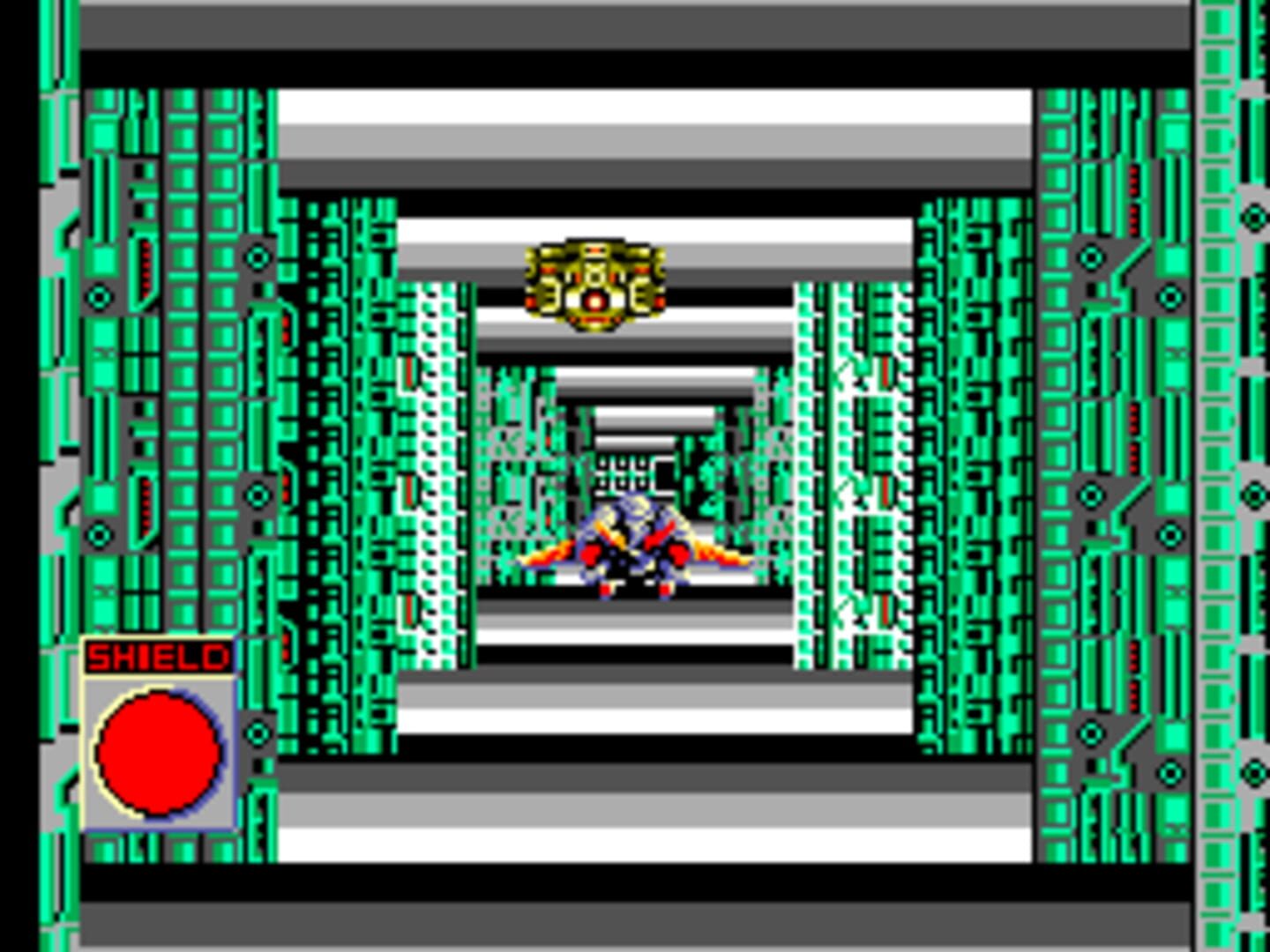
Galaxy Force is a third-person rail shooter video game. The player assumes control of a starship named the TRY-Z, in its mission to vanquish the Fourth Empire before they take over the entire galaxy. Gameplay involves maneuvering the TRY-Z through six different stages, referred to as "worlds" in-game, all while shooting down incoming enemies and avoiding collision with either them, their projectiles, or an obstacle such as a wall. The TRY-Z is equipped with two weapons to destroy enemies; a standard laser shot, and a limited supply of heat-seeking missiles that automatically track down targets.
Additional missiles can be found throughout specific portions of levels. A shield is displayed at the bottom left of the screen that will deplete should the TRY-Z collide with an obstacle or projectile. The TRY-Z has an energy meter at the bottom of the screen that depletes as the level progresses; energy is decreased by firing weapons and coming into contact with obstacles or projectiles. When the energy meter is fully depleted, the game will end.
Development
Created as part of Sega's "Super Scaler" line of arcade games, which also included games such as Out Run and Space Harrier, Galaxy Force was designed specifically to show off the Sega Y Board arcade system, showcasing graphical features such as rotating scrolling backgrounds and many on-screen sprites. Development of the game was handled by a group of developers that later went on to form Sega AM1, and was in production alongside Yu Suzuki's Power Drift. Three cabinet versions of the game were produced; a standard upright cabinet, a "Deluxe" machine, and a "Super Deluxe" version that could twist and turn 335 degrees left and right, and move forwards and backwards at 15 degrees. The Super Deluxe version also included a headphone jack.
The music in Galaxy Force was composed jointly by Katsuhiro Hayashi and Kouichi Namaki, both of whom previously worked on the soundtrack for Thunder Blade. The game was largely inspired by Star Wars, containing several subtle references in-game through its stage design.
Reception
The January 15, 1989 issue of trade publication Game Machine listed it as the thirteenth most-popular coin-operated arcade game in Japan at the time. In North America, it was an arcade hit; it was one of the highest-earning games at a number of arcades through 1990, and the top-earner at some arcades, but the game was not widely available at most American arcades.
Galaxy Force was critically acclaimed by a number of publications, and is seen among Sega's best arcade games of the era. In late 1988, Sinclair User gave the game the "Shoot 'Em Up of the Year" award for its impressive graphics and hardware.


