The articlegameplay, story, development, reception
Gameplay
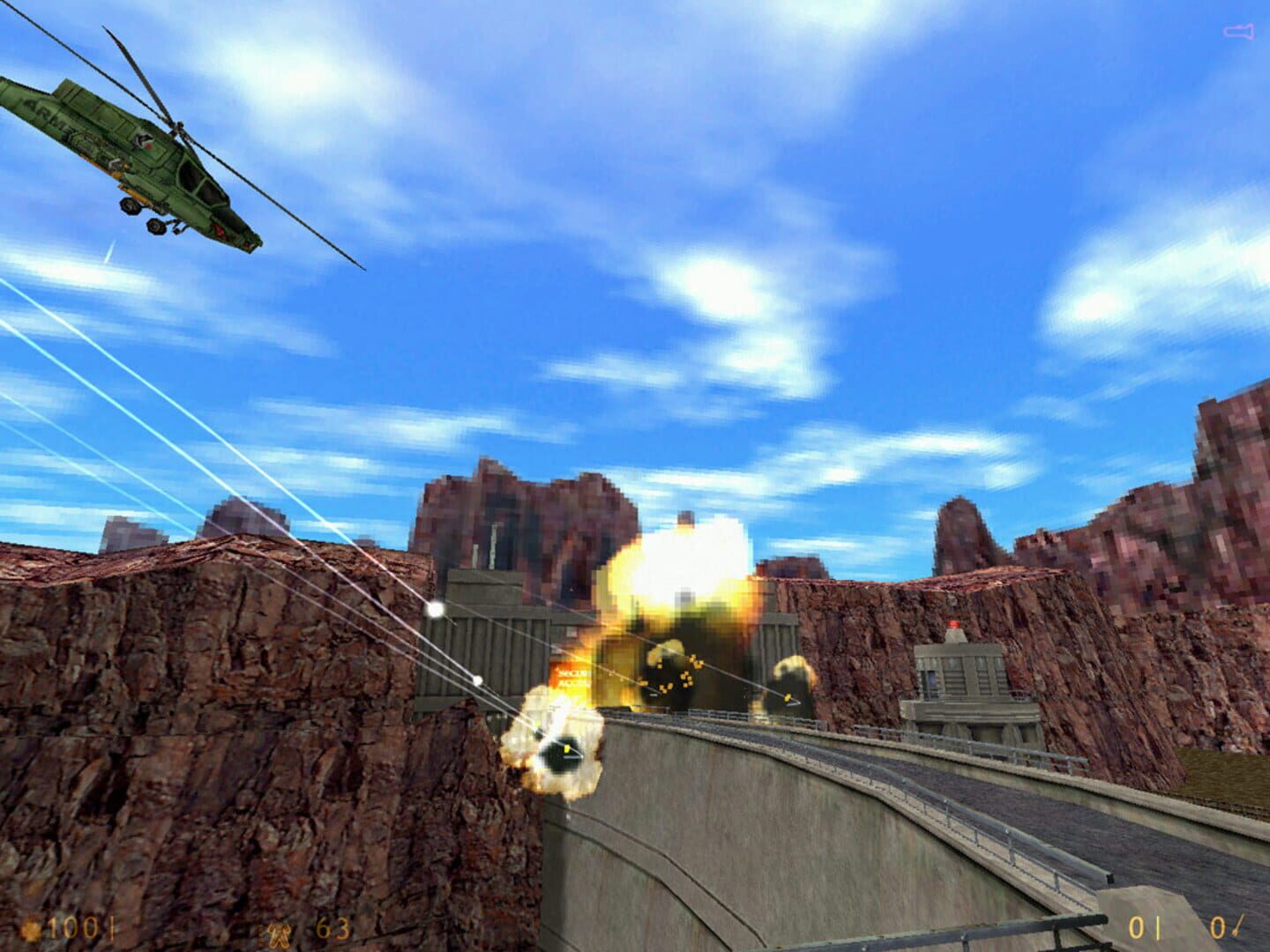
Half-Life is a first-person shooter (FPS) that requires the player to perform combat tasks and solve puzzles to advance. Unlike most FPS games at the time, which relied on cut-scene intermissions to detail their plotlines, Half-Life's story is told mostly using scripted sequences (bar one short cutscene), keeping the player in control of the first-person viewpoint. In line with this, the player rarely loses the ability to control the player character, Gordon Freeman, who never speaks and is never actually seen in the game; the player sees "through his eyes" for the entire length of the game. Half-Life has no levels; it instead divides the game into chapters, whose titles briefly appear on screen as the player progresses through the game. With the exception of short loading pauses, progression throughout the game is continuous, with each map directly connecting to the next, although levels with teleportation are an exception.
The game regularly integrates puzzles, such as navigating a maze of conveyor belts or using nearby boxes to build a small staircase to the next area the player must travel to. Some puzzles involve using the environment to kill an enemy, like turning a valve to spray hot steam at their enemies. There are few bosses in the conventional sense, where the player defeats a superior opponent by direct confrontation. Instead, such organisms occasionally define chapters, and the player is generally expected to use the terrain, rather than firepower, to kill the boss.
Late in the game, the player receives a "long jump module" for the HEV suit, which allows the player to increase the horizontal distance and speed of jumps by crouching before jumping. The player must rely on this ability to navigate various platformer-style jumping puzzles in Xen toward the end of the game.
The player is occasionally assisted by security guards and scientists. The guards fight alongside the player, and both guards and scientists can assist in reaching new areas and pass on plot information. Alien enemies include headcrabs, bullsquids, vortigaunts, and headcrab zombies. The player also faces hostile human soldiers and Black Ops assassins.
Half-Life includes online multiplayer support for both individual and team-based deathmatch modes. It was one of the first mainstream games to use the WASD keys as the default control scheme.
Story
At the underground Black Mesa Research Facility, the theoretical physicist Gordon Freeman participates in an experiment on a crystal of unknown origin. This triggers a "resonance cascade", which greatly damages the facility and teleports in hostile alien creatures. Eli Vance tells Freeman to get to the surface and find help. After going through several layers of Black Mesa, Freeman discovers that United States Marines and black operators have been dispatched to the facility to terminate the aliens but also to cover up the incident by eliminating all the remaining Black Mesa personnel. A scientist instructs him to make his way to the Lambda Complex to stop the alien invasion.
Freeman then discovers a monster called the Tentacle, and kills the giant creature using a rocket engine test facility that incinerates it, and uses an underground monorail to reach a rocket silo. He launches a satellite to help the Lambda team, but is captured by vengeful Marines and left for dead in a trash compactor. Escaping through a waste treatment complex, Freeman travels through a part of Black Mesa filled with alien specimens, collected long before the resonance cascade.
Overpowered by the aliens, the Marines withdraw and began to launch air strikes. Freeman crosses the facility's surface to reach the Lambda Complex, where he discovers secret teleportation technology. There, scientists inform him that a powerful alien creature is preventing them from closing the portal. They teleport him to the alien dimension Xen to kill it.
There, Freeman encounters dead scientists who teleported to Xen before him. He kills a large alien, the Gonarch, and finds a factory that manufactures alien soldiers. Finally, he enters the Nihilanth's lair and kills it. Freeman is detained by the G-Man, a mysterious agent who claims his "employers" wish to hire Freeman.
If he accepts, Freeman is placed into stasis; if not, he is teleported to his death.
Development
Valve was founded in Kirkland, Washington in 1996 by the former Microsoft employees Gabe Newell and Mike Harrington. For their first product, Valve settled on a concept for a horror first-person shooter (FPS) game. They did not want to build their own game engine, as this would have created too much work for a small team and Newell planned to innovate in different areas. Instead, Valve licensed the Quake engine and the Quake II engine from id Software and combined them with their own code.
Newell estimated that around 75% of the final engine code was by Valve. As the project expanded, Valve cancelled development of a fantasy role-playing game, Prospero, and the Prospero team joined the Half-Life project.
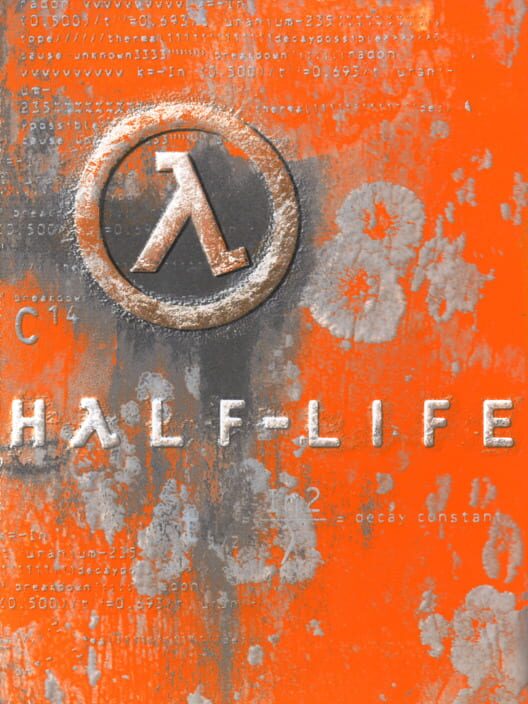
Half-Life was inspired by the FPS games Doom (1993) and Quake (1996), Stephen King's 1980 novella The Mist, and a 1963 episode of The Outer Limits titled "The Borderland". According to the designer Harry Teasley, Doom was a major influence and the team wanted Half-Life to "scare you like Doom did". The project had the working title Quiver, after the Arrowhead military base from The Mist. The name Half-Life was chosen because it was evocative of the theme, not clichéd, and had a corresponding visual symbol: the Greek letter λ (lower-case lambda), which represents the decay constant in the half-life equation.
According to the designer Brett Johnson, the level design was inspired by environments in the manga series Akira. Newell said that Half-Life was influenced by the immersive first-person experience of Ultima Underworld, the horror of Resident Evil 2, and the game design of Super Mario 64.
Valve struggled to find a publisher, as many believed Half-Life was too ambitious for a first-time developer. Sierra On-Line signed Valve for a one-game deal as it was interested in making a 3D action game, especially one based on the Quake engine. Sierra gave Valve an advance of around $1 million in exchange for 30% of the revenue and 100% of the intellectual property; the rest of development was funded by Newell and Harrington. Valve first showed Half-Life in early 1997; it was a success at E3 that year, where Valve demonstrated the animation and artificial intelligence. Novel features of the artificial intelligence included fear and pack behavior.
Valve aimed for a November 1997 release to compete with Quake II. By September 1997, the team found that, while they had built some innovative aspects in weapons, enemies, and level design, the game was not fun and there was little design cohesion. Playtesting produced "lukewarm" responses. Sierra would not agree to extra funding, so Newell took out a loan to fund additional development to rework the game and delay its release date.
Valve took a novel approach of assigning a small team to build a prototype level containing every element in the game and then spent a month iterating on the level. When the rest of the team played the level, which the designer Ken Birdwell described as "Die Hard meets Evil Dead", they agreed to use it as a baseline. The team developed three theories about what made the level fun. First, it had several interesting things happen in it, all triggered by the player rather than a timer so that the player would set the pace of the level.
Second, the level responded to any player action, even for something as simple as adding graphic decals to wall textures to show a bullet impact. Finally, the level warned the player of imminent danger to allow them to avoid it, rather than killing the player with no warning.
To move forward with this unified design, Valve sought a game designer but found no one suitable. Instead, Valve created the "cabal", initially a group of six individuals from across all departments that worked primarily for six months straight in six-hour meetings four days a week. The cabal was responsible for all elements of design, including level layouts, key events, enemy designs, narrative, and the introduction of gameplay elements relative to the story. The collaboration proved successful, and once the cabal had come to decisions on types of gameplay elements that would be needed, mini-cabals from other departments most affected by the choice were formed to implement these elements. Membership in the main cabal rotated since the required commitment created burnout.
The cabal produced a 200-page design document detailing nearly every aspect of the game. They also produced a 30-page document for the narrative, and hired the science fiction novelist Marc Laidlaw to help manage the script. Laidlaw said his contribution was to add "old storytelling tricks" to the team's ambitious designs: "I was in awe of [the team]. It felt to me like I was just borrowing from old standards while they were the ones doing something truly new."
Rather than dictate narrative elements "from some kind of ivory tower of authorial inspiration", he worked with the team to improvise ideas, and was inspired by their experiments. For example, he conceived the opening train ride after an engineer implemented train code for another concept.
Valve initially planned to use traditional cutscenes, but switched to a continuous first-person perspective for lack of time. Laidlaw said they discovered unexpected advantages in this approach, as it created a sense of immersion and enforced a sense of loneliness in a frightening environment. Laidlaw felt that non-player characters were unnecessary to guide players if the design had sufficiently strong "visual grammar", and that this allowed the characters to "feel like characters instead of signposts". An early version of Half-Life began immediately after the disaster, with the environments already wrecked.
Laidlaw worked with Johnson to create versions of the lab environment before the disaster to help set the story. He said: "These were all economical ways of doing storytelling with the architecture—which was my whole obsession. The narrative had to be baked into the corridors."
Within a month of the cabal's
Reception
On the review aggregation website Metacritic, Half-Life has a score of 96 out of 100, indicating "universal acclaim". Computer Gaming World's Jeff Green said it was "not just one of the best games of the year. It's one of the best games of any year, an instant classic that is miles better than any of its immediate competition, and—in its single-player form—is the best shooter since the original Doom." Next Generation wrote: "It is fast paced, it is dramatic, and it brings the very idea of adventure on a PC out of the dark ages and into a 3D world.
All that and not a single Orc in sight." IGN described it as "a tour de force in game design, the definitive single player game in a first-person shooter". GameSpot said it was the "closest thing to a revolutionary step the genre has ever taken".
Several reviewers cited the level of immersion and interactivity as revolutionary. AllGame said, "It isn't everyday that you come across a game that totally revolutionizes an entire genre, but Half-Life has done just that." Hot Games commented on the realism, and how the environment "all adds up to a totally immersive gaming experience that makes everything else look quite shoddy in comparison". Gamers Depot wrote that it was the most immersive game they had played.
The final portion of the game, taking place in the alien world of Xen, was generally considered the weakest. Besides introducing a wholly new and alien setting, it also featured a number of low-gravity jumping puzzles. The GoldSrc engine did not provide as much precise control for the player during jumping, making these jumps difficult and often with Freeman falling into a void and the player restarting the game. Wired's Julie Muncy called the Xen sequence "an abbreviated, unpleasant stop on an alien world with bad platforming and a boss fight against what appeared, by all accounts, to be a giant floating infant". The Electric Playground said that Half-Life was an "immersive and engaging entertainment experience" in its first half and that it "peaked too soon".
During the AIAS' 2nd Annual Interactive Achievement Awards, Half-Life was awarded "Computer Entertainment Title of the Year" and "PC Action Game of the Year"; it also received nominations for "Game of the Year" and outstanding achievement in "Art/Graphics", "Character or Story Development", "Interactive Design", and "Software Engineering".
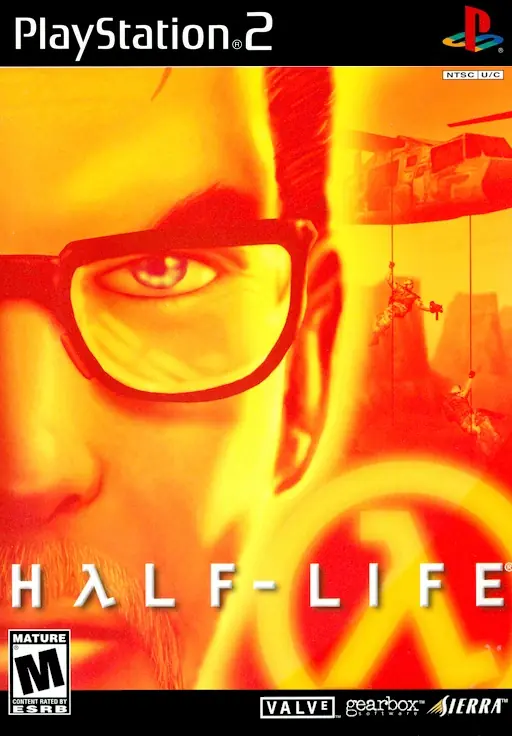
Jeff Lundrigan reviewed the PlayStation 2 version for Next Generation, rating it three out of five, and wrote that "it may be getting old, but there's still a surprising amount of life in Half-Life". The PlayStation 2 version was a nominee for The Electric Playground's 2001 Blister Awards for "Best Console Shooter Game", but lost to Halo: Combat Evolved for Xbox.
In 1999, 2001, and 2005, PC Gamer named Half-Life the best PC game of all time. In 2004, GameSpy readers voted Half-Life the best game of all time. Gamasutra gave it their Quantum Leap Award in the FPS category in 2006. GameSpot inducted Half-Life into their Greatest Games of All Time list in May 2007.
In 2007, IGN described Half-Life as one of the most influential video games, and in 2013 wrote that the history of the FPS genre "breaks down pretty cleanly into pre-Half-Life and post-Half-Life eras". In 2021, the Guardian ranked Half-Life the third-greatest game of the 1990s, writing that it "helped write the rulebook for how games tell their stories without resorting to aping the conventions of film".
According to Newell, Half-Life was budgeted with the expectation of lifetime sales of around 180,000 copies. However, it was a surprise hit. In the United States, it debuted at #8 on PC Data's weekly PC game sales chart for the November 15–21 period, with an average retail price (ARP) of $49. It rose to sixth place the following week, before dropping to position 10 for the week ending December 5.
During the December 6–12 period, the game climbed back to sixth place; by this time, its ARP had dropped to $36. It placed between sixth and eighth on PC Data's weekly charts through the end of December, and its ARP rose back to $45 by the week ending January 2. PC Data declared Half-Life November's sixth-best-selling PC game in the United States, a position it held for the month of December. S.
6 million in the United States by the end of 1998.
In January 1999, Half-Life debuted at #3 on Chart-Track's PC game sales rankings for the United Kingdom, and remained in PC Data's weekly top 10 for the entire month, peaking at #4. By January 19, after two full months of availability, global sales of Half-Life surpassed 500,000 copies. In the United States, it was the fifth-best-selling PC game for the month of January. On PC Data's weekly charts, it rose to #2 from February 7–20, with an ARP of $35.
Holding a position in the weekly top 10 for the rest of February, it climbed to fourth for the month. The game remained in PC Data's weekly top 10 until the week of March 21 and dropped to position 11 for March as a whole. In the United Kingdom, it placed second in February—behind the debut of Baldur's Gate—and fifth in March. In April, it claimed #3 on Chart-Track's rankings and dropped to #16 on those of PC Data.
On April 23, Sierra announced that global sales of Half-Life had reached almost 1 million copies.
, Half-Life exited PC Data's monthly top 20 in June. S. Its domestic sales during 1999 reached 290,000 copies by the end of September. , with sales of 445,123 copies.
S. 98 million. H