
The articlegameplay, story, development, reception
Gameplay
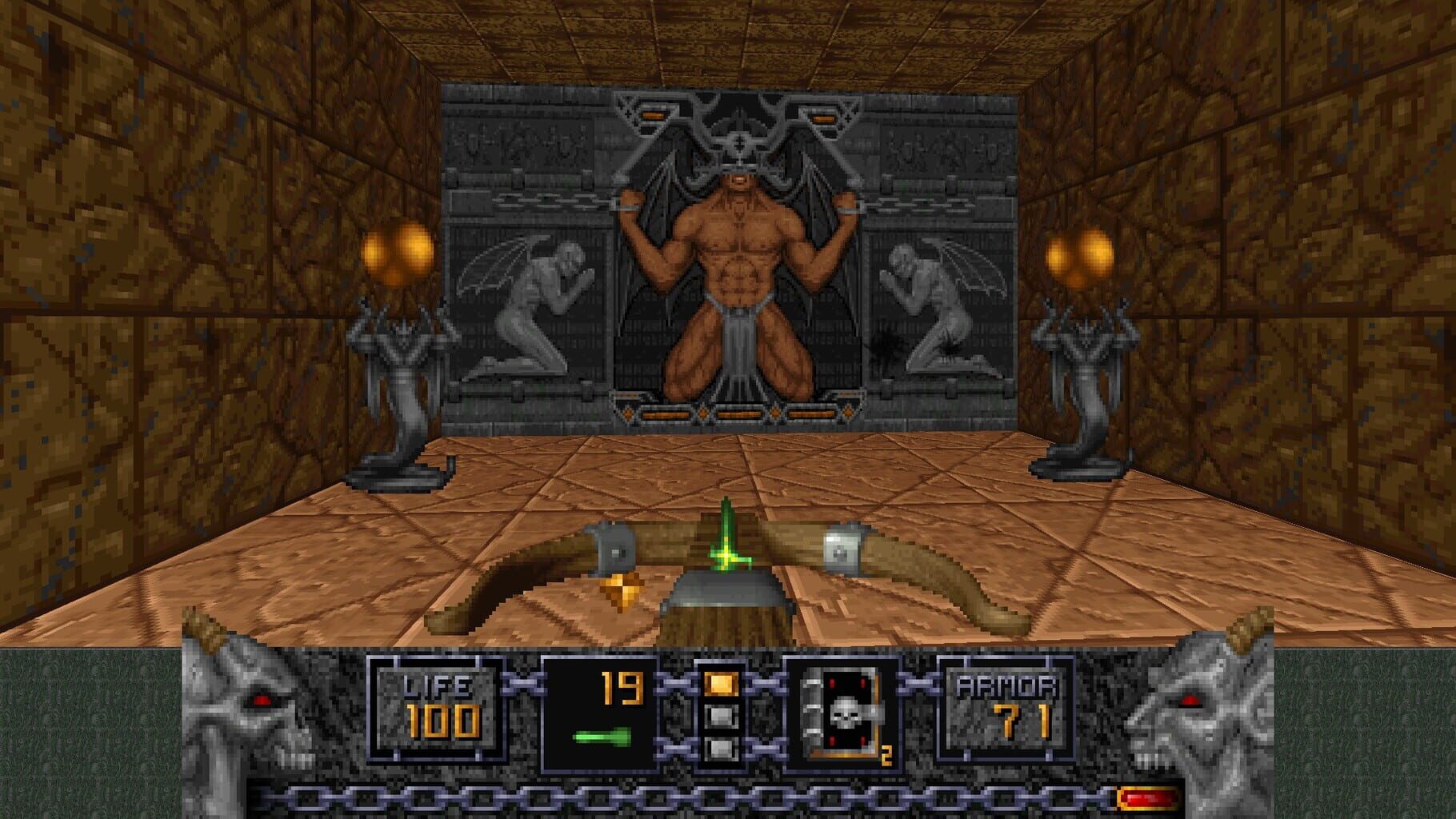
The gameplay of Heretic is heavily derived from Doom, with a level-based structure, an armor system, triggers which open concealed chambers filled with enemies, and an emphasis on finding the proper keys to progress. Raven added a number of features to Heretic that differentiated it from Doom, notably interactive environments, such as rushing water that pushes the player character along, and inventory items. In Heretic, the player can pick up certain items to use at their discretion. These items range from health potions to the "morph ovum", which transforms enemies into chickens.
The "Tome of Power" acts as a secondary firing mode for certain weapons, resulting in a much more powerful projectile from each weapon, some of which change the look of the projectile entirely. Heretic also features an improved version of the Doom engine, sporting the ability to look up and down within constraints, as well as fly. However, the rendering method for looking up and down merely uses a proportional pixel-shearing effect rather than any new rendering algorithm, which distorts the view considerably when looking at high-elevation angles.
Story
Three brothers (D'Sparil, Korax, and Eidolon), known as the Serpent Riders, have used their powerful magic to possess seven kings of Parthoris, turning them into mindless puppets and corrupting their armies. The Sidhe elves resist the Serpent Riders' magic, thus prompting the Serpent Riders to declare the Sidhe to be heretics and wage war against them. The Sidhe are forced to take a drastic measure to sever the natural power of the kings, destroying them and their armies at the cost of weakening the elves' power and giving the Serpent Riders an advantage to slay the elders. While the Sidhe retreat, one elf (revealed to be named Corvus in Heretic II) sets off on a quest of vengeance against the weakest of the three Serpent Riders, D'Sparil. He travels through the "City of the Damned", the ruined capital of the Sidhe (its real name is revealed to be Silverspring in Heretic II), then past the demonic breeding grounds of Hell's Maw and finally the secret Dome of D'Sparil.
The player is the elvish protagonist Corvus and must first fight through the undead hordes infesting the location where the elders performed their ritual. At its end is the gateway to Hell's Maw, guarded by the Iron Liches. After defeating them, the player must seal the portal and so prevent further infestation, but after he enters the portal guarded by the Maulotaurs, he finds himself inside D'Sparil's dome. After killing D'Sparil, Corvus ends up on a perilous journey with little hope of returning home. However, he eventually succeeds in his endeavor, only to find that Parthoris is in disarray once again.
Development
Heretic was developed by Raven Software with assistance by publisher id Software, the latter of which had recently pioneered the first-person shooter genre with Wolfenstein 3D and Doom. According to Brian Raffel, the game's director and vice-president of Raven at the time, the developer first came to id's attention with the release of its debut title Black Crypt. Id had provided Raven with a modified Wolfenstein 3D engine for its next project ShadowCaster and were impressed by the final result. John Romero first proposed Heretic as a medieval themed Doom-like title to the wider id team around November 1993, and Raven signed on shortly afterwards.
Raffel considered himself and his colleagues as typical D&D fans and initially drafted the game with role-playing elements, but id did not want the group to vary too much from the Doom format. They then took instruction from id programmer John Carmack to simply "do it like Doom, and add the fantasy flavor."
Reception
Heretic and Hexen shipped a combined total of roughly 1 million units by August 1997. Individually Heretic sold more than 500,000 copies.
PC Zone remarked that Heretic's weapons are stylistically unsatisfying, the ability to look up and down is useless, the level designs are poorly conceived and confusing, and the flying ability lacks depth and a sense of true flight, more closely resembling "sitting on the front of a forklift truck". While they regarded the inventory mechanic as genuinely innovative, they felt that overall Heretic failed to differentiate itself from Doom to the extent of contemporaries such as Descent and Star Wars: Dark Forces, and concluded, "Not as good as Doom 1 or 2. Still fun, but I'd rather wait for Quake, thanks."
Legacy
Heretic has received three sequels: Hexen: Beyond Heretic, Hexen II, and Heretic II. Following ZeniMax Media's acquisition of id Software in 2009, Activision owns the intellectual property of the game while Bethesda owns the publishing rights; this has been resolved by the 2025 release after both companies were acquired by Microsoft Gaming.
The game was re-released for Windows on Steam on August 3, 2007.


