
The articlegameplay, story, development, reception
Gameplay
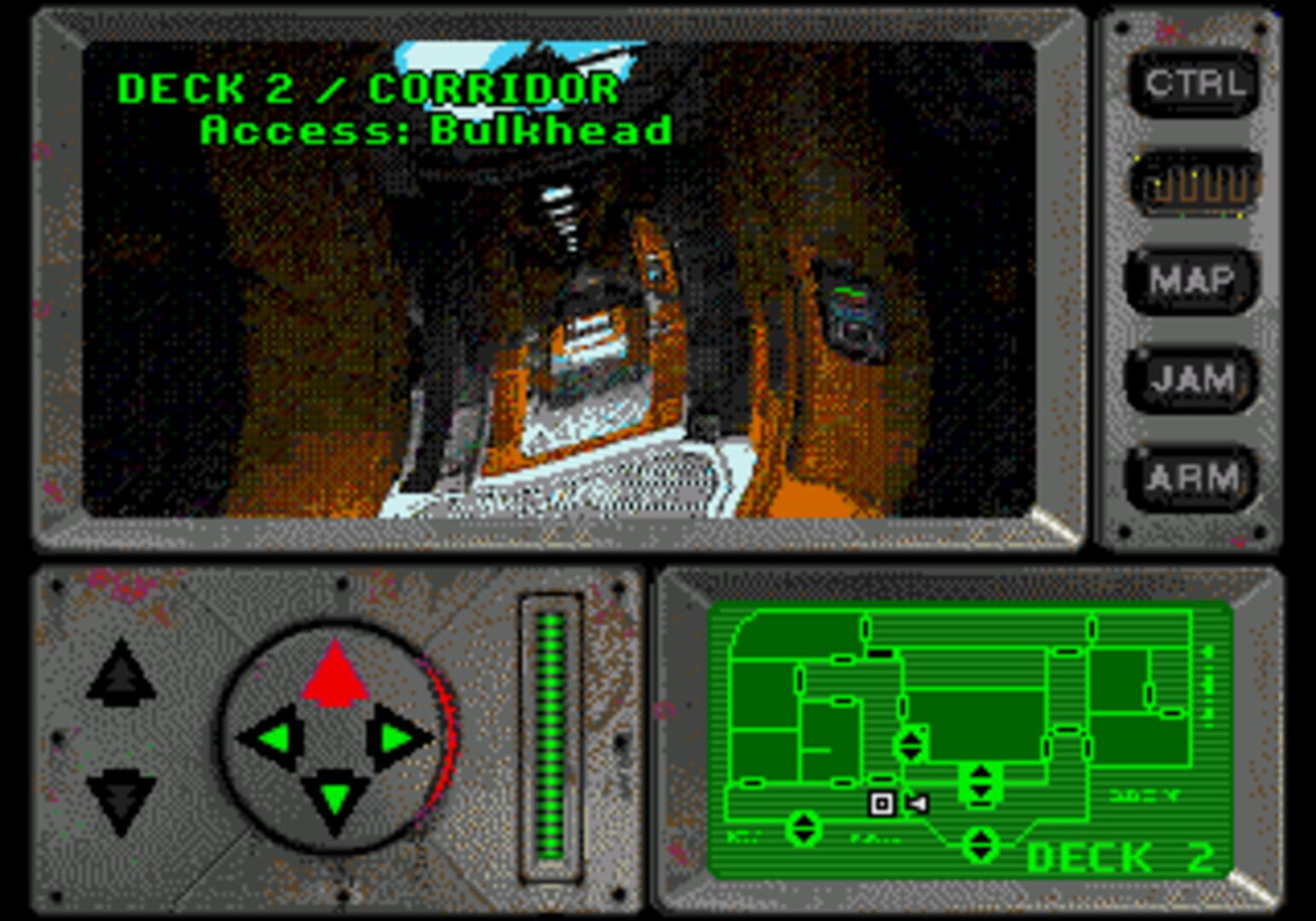
The game takes place in a screen divided into several sections. In the lower-left, taking up about 1/4 of the screen, is a simple control panel with buttons that move the robot in one of the four cardinal directions or up and down if it is located in a vertical shaft. The buttons light up to indicate which directions the robot can move from its current location. To the right is a small 2D map of the ship, showing the current level, or deck.
Above this control panel is a small television-like display showing a 3D view as seen from the robot's point of view, taking up perhaps 1/5 of the display. To its right is a video panel that is used to replay videos gathered from the dataports. Between the two displays is a small control panel with buttons that operate the robot, scanning for DNA samples or accessing dataports.
Story
Set far in the future, the human race is in the middle of a cold war with an alien race called the Thanatosians. During a target practice by an Earth fleet that will destroy an uninhabited planet, the heavy destroyer Jeremiah O'Brien is infected with an unknown virus that mutates the crew. No longer recognized due to the changes in their DNA, the O'Brien's security robot, simply known as "the Ship's Defender", assumes they are invaders and kills them. An apparent technical malfunction has caused the O'Brien's computer to believe that it was in a real life war situation, and select the planet Calliope as a target for destruction.
Like all of the human fleet's Cerberus-class destroyers, the O'Brien carries a weapon known as "Iron Helix", which is capable of destroying all life on a planet in a single act. An attack on Calliope, a peaceful Thanatosian planet, would cause the war to go "hot".
Development
The inspiration for creating the game came from the atmosphere of the SS Jeremiah O'Brien ship. Developer Drew Huffman had many issues to consider in the game's creation, especially fitting the game on to portable storage devices and decided the game would be a CD-Rom game. A utility used to develop the game was Macromind Director. Another issue was the long loading times between animation.
QuickTime was insufficient for the game, so Drew made use of the PACo engine from the Company of Science and Art. The game was made by 15 people and it took 13 months to develop it.
Reception
Computer Gaming World in November 1993 praised the Macintosh version of Iron Helix's "incredibly fast" speed given the use of CD-ROM. The magazine stated that the game had "first-rate, realistic" graphics and sound, and that the five difficulty levels provided "excellent replay value", and concluded that Iron Helix offered "an intensely satisfying experience". In April 1994 the magazine said, however, that when the game's "several hours of intense, strategic duck n' jive against an aggressive and efficient opponent ... there is very little replay value".
A 1994 survey of strategic space games set in the year 2000 and later gave the game three-plus stars out of five, also praising the graphics and wishing for more replay value. GamePro in 1995 gave the Sega CD version a positive review, saying it successfully translated the PC game to a home console experience. They highly praised Iron Helix's realistic graphics, slow-paced and suspenseful gameplay, and eerie atmosphere, remarking that "You really feel like you're in a lifeless, mechanical starship." Derek Pearcy from Pyramid commented: "There is no doubt that Iron Helix, with its relatively quick action, vivid realism and dynamic controls, is an interesting game -- the question is whether or not you will find yourself enveloped in an interesting story, as you race to uncover its mysteries."
Legacy
Much of the development team of Iron Helix went on to work on Bad Mojo, which includes a (digitally reproduced) print advertisement for Iron Helix as an Easter egg.


