
The articlegameplay, story, development, reception
Gameplay
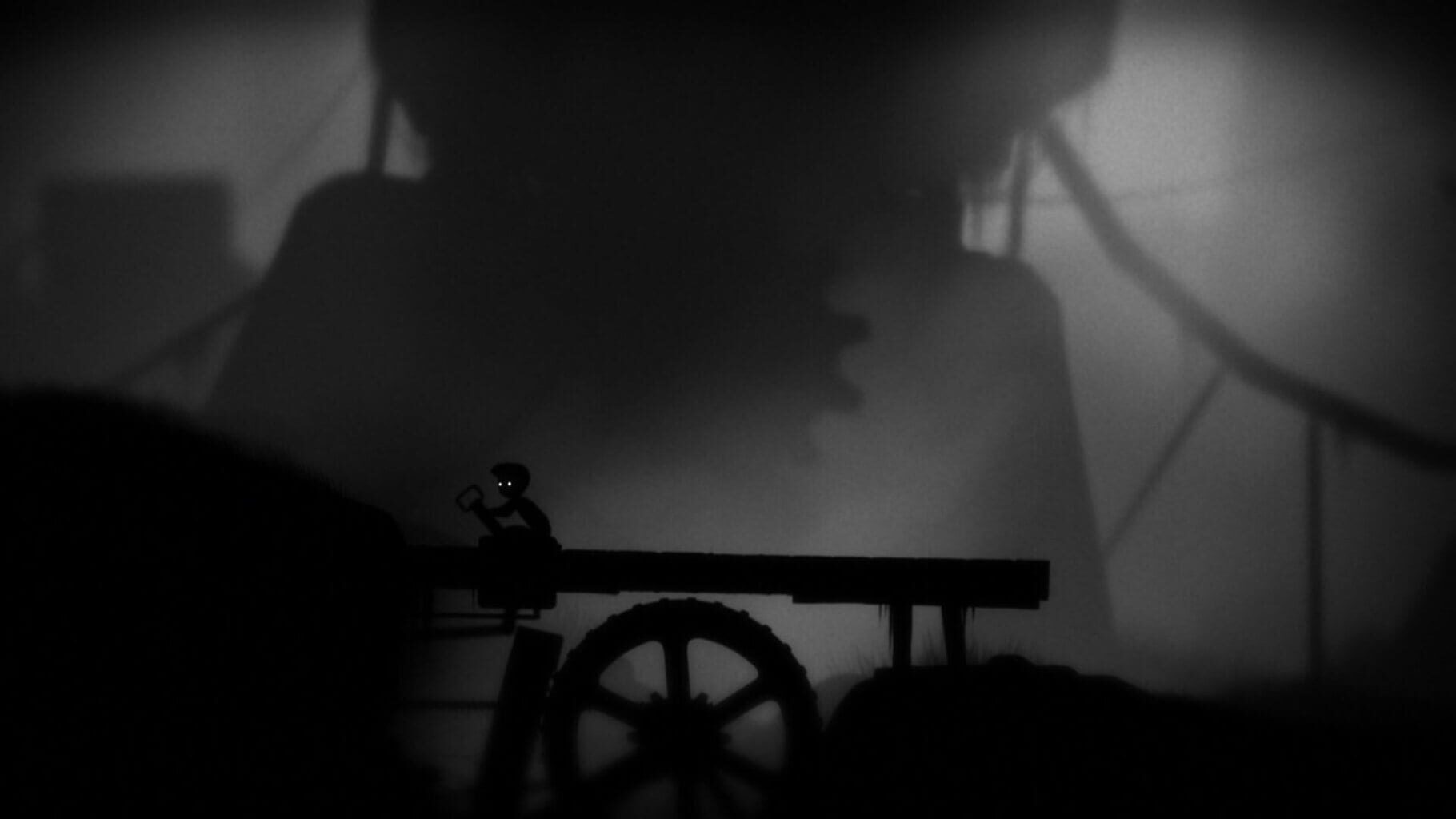
The player controls the boy throughout the game. As is typical of most two-dimensional platform games, the boy can run left or right, jump, climb onto short ledges or up and down ladders and ropes, and push or pull objects. Limbo is presented through dark, greyscale graphics and with minimalist ambient sounds, creating an eerie, haunting environment. The dark visuals also serve to conceal numerous lethal surprises, including such environmental and physical hazards as deadly bear traps on the forest floor, or lethal monsters hiding in the shadows. Among the hazards are glowing worms, which attach themselves to the boy's head and force him to travel in only one direction until they are killed.
The game's second half features mechanical puzzles and traps using machinery, electromagnets, and gravity. Many of these traps are not apparent until triggered, often killing the boy. The player is able to restart at the last encountered checkpoint, with no limits placed on how many times this can occur. Some traps can be avoided and used later in the game; one bear trap is used to clamp onto an animal's carcass, hung from the end of a rope, tearing the carcass off the rope and allowing the branch and rope to retract upwards and allow the boy to climb onto a ledge otherwise out of reach.
As the player will likely encounter numerous deaths before they solve each puzzle and complete the game, the developers call Limbo a "trial and death" game. Some deaths are animated with images of the boy's dismemberment or beheading, although an optional gore filter on the Xbox 360 blacks out the screen instead of showing these deaths (although audio is still played), as well as removing or replacing hanging/dead children. Game achievements (optional in-game goals) include finding hidden insect eggs and completing the game with five or fewer deaths.
Story
The primary character in Limbo is a nameless boy in search of his sister, who awakens in the middle of a forest on the "edge of hell" (the game's title is taken from the Latin limbus, meaning "edge"), where he encounters a humongous spider who tries to kill him. After using a trap to cut off the sharp points on half of the spider's legs, it retreats further into the forest, and the boy is allowed to pass. However, he is later caught in webs and spun into a cocoon. Shortly after freeing himself, he encounters a colony of other boys who actively try to kill him with traps, and later poison darts; they later fall victim to their very own final traps, after the boy finally manages to kill the spider after a short chase.
At one point during his journey, he encounters a female character, who he thinks might be his sister, but is prevented from reaching her. The forest eventually gives way to a crumbling city environment, followed by industrial and flooded environments. On completion of the final puzzle, the boy is thrown through a pane of glass and back into the forest area from the beginning. After he wakes up, he walks a short distance until he again encounters the girl, who, upon his approach, stands up startled.
At this point, the screen cuts to black, abruptly ending the game.
Development
According to Playdead co-founder Dino Patti and lead designer Jeppe Carlsen, Playdead's game director, Arnt Jensen, conceived Limbo around 2004. At that time, as a concept artist at IO Interactive, Jensen became dissatisfied with the increasingly corporate nature of the company. He had sketched a "mood image" of a "secret place" to get ideas, and the result, similar to the backgrounds of the final game, inspired Jensen to expand on it. Jensen initially tried on his own to program the game in Visual Basic around 2004, but found he needed more help and proceeded to create an art style trailer by 2006.
He had only intended to use the trailer as a means to recruit a programmer to help him, but the video attracted substantial interest in the project from across the Internet, eventually leading him to meet with Patti, who was also dissatisfied with his job. Their collaboration led to the founding of Playdead. Although Patti helped in the first few months with programming, he realised that the project was much larger than the two of them could handle, and Patti developed the business around the game's expanded development.
Initial development was funded personally by Jensen and Patti, along with Danish government grants, including funding from the Nordic Game Program, while large investors were sought later in the development cycle. Jensen and Patti did not want to commit to major publishers, preferring to retain full creative control in developing the title. Jensen originally planned to release Limbo as a free Microsoft Windows title, but by this point, Jensen and Patti decided to make the game a retail title.
Playdead chose to ignore outside advice from investors and critics during development, such as to add multiplayer play and adjustable difficulty levels, and to extend the game's length. According to Patti, Playdead felt these changes would break the integrity of Jensen's original vision. Patti also felt that the investors "tried to control the company with no usable knowledge or respect", citing that after Microsoft raised concerns about the death of the boy, "one of the investors suggested we make him appear older by giving him a moustache." Numerous iterations of the game took place during a 2+1⁄2-year development cycle, including changes Jensen had demanded to polish the title, some elements being added two months prior to the game's release.
Patti stated that they "trashed 70%" of the content they had developed, due to it not fitting in well with the context of the game. The core development team size was about 8 developers, expanding to 16 at various stages with freelancers. Playdead developed the design tools for Limbo in Visual Studio; Patti commented they would likely seek third-party applications for their next project given the challenges in creating their own technology. Patti later revealed they had opted to use the Unity engine for their next project, citing the development of their custom engine for Limbo as a "double product, doing both engine and game", and that their Limbo engine is limited to monochromatic visuals.
From the game's inception, Jensen set out three goals for the final Limbo product. The first goal was to create a specific mood and art style. Jensen wanted to create an aesthetic for the game without resorting to highly detailed three-dimensional models, and instead directed the art towards a minimalistic style to allow the development to focus its attention on the gameplay. Jensen's second goal was to only require two additional controls—jumping and grabbing—outside of the normal left-and-right movement controls, to keep the game easy to play.
Finally, the finished game was to present no tutorial text to the player, requiring players to learn the game's mechanics on their own. The game was purposely developed to avoid revealing details of its content; the only tagline the company provided was, "Uncertain of his sister's fate, a boy enters Limbo." This was chosen so that players could interpret the game's meaning for themselves.
Some aspects of Limbo bore out from Jensen's own past, such as the forest areas that were similar to forests around the farm where he grew up, and the spider coming from Jensen's arachnophobia. Jensen drew inspiration from film genres, including works of film noir, to set the art style of the game; the team's graphic artist, Morten Bramsen, is credited with recreating that art style. Much of the game's flow was storyboarded very early in development, such as the boy's encounters with spiders and mind-controlling worms, as well as the overall transition from a forest to a city, then to an abstract environment. As development progressed, some of the original ideas became too difficult for the small team to complete.
The storyline also changed; originally, the spider sequences were to be present near the end of the game, but were later moved to the first part. In retrospect, Jensen was aware that the first half of the game contained more scripted events and encounters, while the second half of the game was lonelier and puzzle-heavy; Jensen attributed this to his lack of oversight during the latter stages of development. Jensen purposely left the game with an open ending though with a specific interpretation only he knew, though noted after the game's release that some players, posting in forum boards, had suggested resolutions that were "scary close" to his ideas.
The game's audio was created by Martin Stig Andersen, a graduate from the Royal Academy of Music in Aarhus. Andersen's specialisation was in acousmatic music, non-traditional music created from generated sounds that have no apparent visual source. He was drawn to work with Jensen on the game after seeing the initial trailer, having been drawn in by the expressions of the boy character; Andersen compared the early visuals to his acousmatic music: "you have something recognizable and realistic, but at the same time it's abstract". Andersen sought to create acousmatic music exc
Reception
Limbo's initial release on the Xbox 360 has received acclaim from video game critics and journalists; the subsequent release of the game for the PlayStation 3 and Microsoft Windows platforms received similar praise, holding Metacritic aggregate scores of 90/100 and 88/100, respectively, compared to the 90/100 earned by the Xbox 360 version. Some journalists compared Limbo to previous minimalist platform games such as Another World, Flashback, Heart of Darkness, Oddworld: Abe's Oddysee, Ico, Portal and Braid. S. dollars.
Reviewers asserted this length-to-price ratio was the largest drawback for the game, and would be a deterrent for potential buyers. Some journalists contended that the length of the game was ideal; The Daily Telegraph's Tom Hoggins considered the short game to have a "perfectly formed running time", while Daemon Hatfield of IGN commented that "it's better for a game to leave us wanting more than to overstay its welcome". Numerous independent game developers, in an organised "Size Doesn't Matter" effort, commented on the critical response to Limbo's length-to-price ratio. The independent developers questioned the need to quantify that ratio, and noted that it only seems to be used as a factor in judging video games and not other forms of entertainment such as films.
Limbo was generally praised for its puzzle design and the simplicity of its controls. Jake Gaskill of G4 TV was impressed by the complexity of the puzzles based on the two simple actions of jumping and grabbing onto objects, similar to LittleBigPlanet, with a variety of elements to assure "you're always facing something new and challenging" during the game. Game Informer's Matt Miller commented that part of the success of Limbo is that "every one of these [puzzles] stands alone"; the game accomplishes this in Miller's opinion by varying the elements throughout the game, and preventing the player from getting too accustomed to similar solutions since "everything changes". GameSpy's Ryan Scott believed that the game empowered the player to work through solutions themselves, and its puzzle design, "with its elegant simplicity, offers up what feels like a world of meaningful possibilities".
The frequency of death was not considered a distraction from the game; not only were the deaths seen as necessary as part of learning and overcoming each obstacle, but reviewers found the checkpoints where the player would restart to be plentiful throughout the game. Will Freeman of The Guardian praised the game but noted that beyond the "smoke and mirrors" of Limbo's artwork, the game is "undermined by the title's lack of innovative gameplay", which he says has been seen in earlier platform games.
Limbo's graphical and audio presentation were considered by reviewers as exceptional and powerful elements of the game. The monochrome approach, coupled with film grain filter, focusing techniques and lighting, were compared to both film noir and dreamlike tableaus of silent films, allowing the visual elements of the game to carry much of the story's weight. Cian Hassett of PALGN likened the effect to watching the game through an old-fashioned film projector that creates "one of the most unsettling and eerily beautiful environments" in video gaming. Garrett Martin of the Boston Herald compared the art style and game design decisions to German Expressionism with "dreamlike levels that twist and spin in unexpected angles".
The art style itself was praised as minimalistic, and considered reminiscent of the art of Lotte Reiniger, Edward Gorey, Fritz Lang, and Tim Burton. The use of misdirection in the visuals was also praised, such as by using silhouettes to avoid revealing the true nature of the characters or shadows, or by showing human figures across a chasm who disappear once the player crossed the chasm.
Reviewers found the sound effects within the game critical to the game's impact. Sam Machkovech, writing for The Atlantic, called the sound direction, "far more colorful and organic than the fuzzed-out looks would lead you to believe". Edge magazine's review noted that the few background noises "[do] little else than contribute towards Limbo’s tone", while the sound effects generated by moving the boy character "are given an eerie clarity without the presence of a conventional soundtrack to cover them".
IGN's Hatfield concluded his review by stating, "Very few games are as original, atmospheric, and consistently brilliant as Limbo". Chad Sapeiha of The Globe and Mail summarised his opinion of the game's atmosphere as an "intensely scary, oddly beautiful, and immediately arresting aesthetic." Limbo is said to be the first game to attempt a mix of the horror fiction genre with platform games. The game has been considered an art game through its visual and audio elements.
The game's story and its ending have been open to much interpretation; the ending was purposely left vague and unanswered by Playdead. It was compared to other open-ended books, films and video games, where the viewer is left to interpret what they have read or seen. Some reviews suggested that the game is a representation of the religious nature of Limbo or purgatory, as the boy character completes the journey only to end at the same place he started, repeating the same journey when the player starts a new game. Another interpretation suggested the game is the boy's journey through Hell to reach Heaven, or to find closure for his sister's death.
Another theory considers that either the boy or his sister or both are dead. Some theories attempted to incorporate details from the game, such as the change in setting as the boy travels through the game suggesting the progression of man from child to adult to elder, or the similarities and differences between the final screen of the game where the boy meets a girl and the main menu where what cou


