The articlegameplay, story, development, reception
Gameplay
The game introduces several notable changes compared to previous Pac-Man World titles, placing a greater emphasis on action and combat elements while retaining the traditional platforming mechanics that have defined the series. Retained gameplay elements include the collection of pellets and fruit, which continue to grant points. A new feature has been added to each level, where players can find five 25th Anniversary Pac-Man Statues. Collecting all five statues within a level rewards the player with 2500 points and unlocks a bonus.
The Butt-Bounce move has been modified from previous versions, now limiting Pac-Man to a maximum of three consecutive bounces. The third bounce creates a small shockwave that extends the attack's radius, providing players with a strategic advantage in combat. Similarly, the Rev-Roll move, which was first introduced in earlier titles, functions similarly but with added flexibility. Players can now stop the Rev-Roll before it launches by pressing the jump button, allowing for more precise control. This move also has expanded utility, as it can activate certain machines and summon Pinky and Clyde through specific Summon Points scattered throughout the levels.
Story
In pursuit of greater power, Erwin, a short and malicious genius, discovered a method to siphon raw energy from the Spectral Realm, the dimension inhabited by the Ghosts. He created a syphon capable of penetrating this realm, destabilizing the boundary between the Spectral Realm and Pac-Land, causing the two worlds to merge. This resulted in an environmental catastrophe, threatening the stability of both realms. During Pac-Man's 25th birthday celebration, he was unexpectedly teleported by Orson, a former adversary from the original Pac-Man World.
Orson informed Pac-Man of Erwin's actions and the resulting danger to both the Spectral Realm and Pac-Land. Shortly thereafter, Pac-Man was attacked by hostile Spectral monsters, including fiery orange, green, and purple varieties, all of whom had been manipulated by Erwin's influence. Meanwhile, Inky and Blinky (Clyde) were kidnapped as part of Erwin's plan, while Pinky and Clyde (Blinky) managed to escape.
Development
The game was originally developed under the title Pac-Man Adventures, with animator Don Bluth contributing to the project. Bluth, who had previously worked on I-Ninja, created concept art featuring various alien and creature designs, as well as a version of the protagonist from Dig Dug. Some concept art also depicted Pac-Man with expressions suggesting a potential gameplay mechanic involving a loss of control, which ultimately did not appear in Pac-Man World 3. The project was eventually canceled and reworked into Pac-Man World 3, with Bluth's involvement ending.
Jeffrey Lujan, former director of external development at Namco, suggested Bluth for the project. UK-based developer Blitz Games was brought on due to Namco's internal restructuring at the time.
Reception
The game received generally mixed reviews from critics. While elements retained from previous entries were generally well received, the game was criticized for repetitive gameplay and lower difficulty.
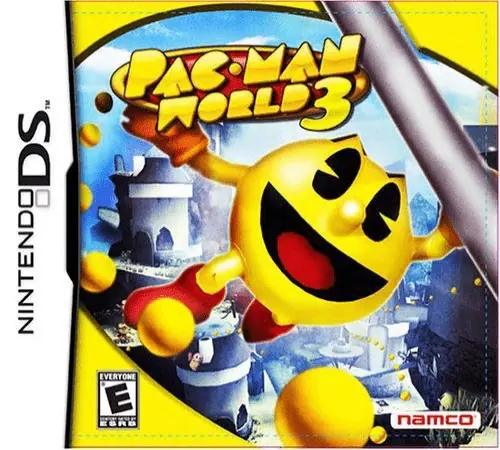
The Nintendo DS release, in particular, received lower scores than other versions and criticism for technical issues, including glitches.