The articlegameplay, story, development, reception
Gameplay
Tomb Raider: Underworld is a single-player action-adventure game where the player controls the protagonist, Lara Croft, from a third-person perspective, through a variety of locations around the world. Lara can jump, climb and shimmy along ledges and vertical poles or ladders, crawl through small spaces, and swing on ropes and horizontal poles. Some areas have climbable surfaces she can scale, and some ledges allow her to stand on them and shimmey along. Other abilities include wall jumping between two adjascent surfaces, interacting with objects and switches, using a grappling hook to latch onto special rings for both puzzle solving and environmental traversal, and swim and dive underwater for a limited time.
Different button combinations can create more moves such as a roll and swan dive. Puzzles revolve around Lara finding keys to mechanisms in the environment, or manipulating different mechanisms to trigger larger elements within and around the environment. There are also traps which need to be avoided, some of them involved in the puzzle design. During some levels, Lara has access to an all-terrain bike which is used in both navigation and puzzle solving.
During combat, Lara automatically locks on to enemies and fires with her equipped gun, with the player able to switch to another target within range and move freely to avoid enemy attacks. When using two weapons, she is able to target up to two enemies at once. Through most of the game Lara has access to seven weapons, selectable from the main menu; her default twin pistols with infinite ammunition, and a shotgun, submachine guns, assault rifle, speargun, tranquillizer gun, and sticky grenades all with limited ammunition. During the last two levels, Lara also has access to the magical artefact Mjolnir, which instantly kills most enemies.
Lara's health is represented by a coloured figure, with the game resetting to a checkpoint if she dies; medipacks and artefact collectables heal her, and hard-to-reach relics collected through the game raise her health cap. The difficulty setting can be tailored, with puzzle, combat and platforming difficulties each having sliders influencing their respective challenge in-game. There is also an option on Lara's PDA to receive tips about navigation or solving puzzles. A sonar map is accessible through the PDA, showing a generated 3D representation of Lara's environment.
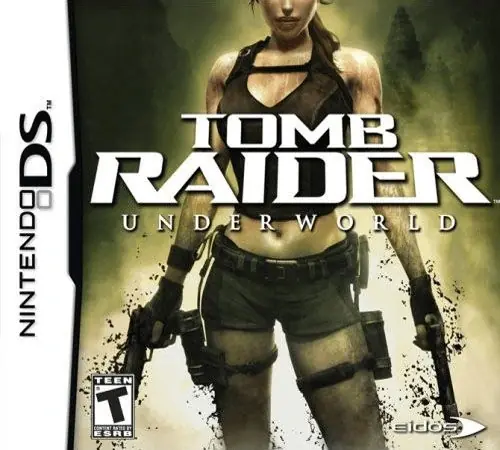
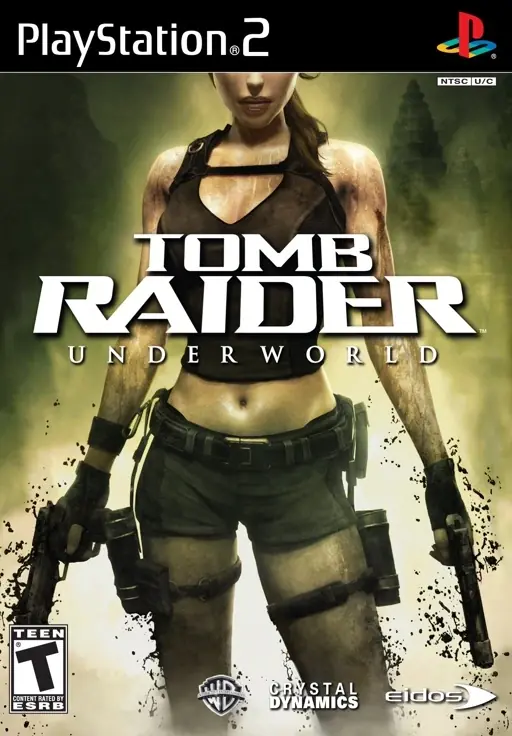
The PlayStation 2 and Wii versions are generally similar to other versions, but with smaller environments and puzzle structure due to hardware limitations; the Wii version also incorporates dedicated combat controls and puzzles revoling around the motion controls. The Nintendo DS (DS) is a two-dimensional (2D) side-scrolling platformer, with Lara navigating self-contained areas while progressing through each level. There are two mobile versions with differing gameplay styles; one is a 2D side-scrolling platformer similar to earlier mobile Tomb Raider games, while the other uses 3D graphics and incorporates platforming and combat elements similar to the home console versions though Lara is restricted to moving forward or backward and some movements are automatic triggered using button prompts.
Story
The story begins in medias res; Lara Croft navigates her home Croft Manor after an explosion, then is shot at by her tech assistant Zip. One week earlier, Lara is investigating a sunken island in the Mediterranean Sea as part of her search for Avalon, hoping it will lead her to an explanation for the disappearance of her mother Amelia and salvage her father Richard's academic reputation despite the scepticism of Zip and her research assistant Alister. The island houses ruins dubbed "Niflheim", one of the many Norse underworlds, and Lara discovers one of the gauntlets attributed to the god Thor to wield Mjolnir. While ambushed by mercenaries sent by rival Amanda Evert, Lara recovers the gauntlet, which has shaped itself to her hand.
On Amanda's ship she also meets an imprisoned Jacqueline Natla, former ruler of Atlantis presumed dead after their last encounter. Natla reveals that Amelia was sent to "Helhiem"−another name for Avalon−and directs Lara to ruins in Thailand, hinting that her father also searched for Mjolnir before she is taken by Amanda as the ship sinks due to an explosion caused by the mercenary leader who ambushed Lara.
In Thailand, Lara navigates the ruins of "Bhogavati" and finds more ancient ruins that housed a gauntlet; Richard was sent there by Natla, but removed the gauntlet and destroyed a map showing the location of Thor's relics. From the use of his initials referencing her grandfather, Lara deduces that Richard hid the gauntlet in Croft Manor. Finding Richard's study in Croft Manor's catacombs, Lara finds the gauntlet and a tape-recorded message from Richard, revealing Helheim contained a powerful weapon and that he destroyed the map after recording it to prevent its use. She also encounters a pair of Thralls, undead guardians of Thor's relics created from eitr.
Croft Manor is bombed, and Lara learns from Zip that the bomber, who looked identical to her, stole the magical stone Amanda used during Legend. Lara then encounters a Doppelgänger—a being modelled to look like Lara—who shoots Alister and flees; despite Zip's protests, Lara continues her quest so she can use Mjolnir to kill Natla. In the ruins of "Xibalba" in Mexico, Lara finds both Thor's belt−which powers the gauntlets and is protected by more Thralls−and ancient carvings detailing the myth of Jörmungandr, who will flood the world before fighting Thor, with both dying. In the ruin of "Valhalla" on Jan Mayen, Lara recovers Mjolnir, then confronts Natla.
Natla provides Lara with the coordinates of Helheim, but points out that only she knows the ritual to prepare its gates, so Lara reluctantly strikes a bargain and frees her from her cell. Amanda attempts to stop her, but the Doppelgänger attacks and apparently kills Amanda. Lara dives to the ruins of Helheim under the Arctic Sea, and with Natla's preparation opens its entrance with Mjolnir. Lara then discovers Amelia is turned into a Thrall and is forced to shoot her.
Natla appears and reveals that she killed Richard after his betrayal in Thailand, then sets the Doppelgänger on Lara before leaving to awaken Jörmungandr, revealed as a metaphor for the Earth's faultlines; Natla intends to activate an ancient device above the faultlines' weakpoint and trigger apocalyptic volcanic activity. Amanda appears and apparently throws the Doppelgänger to its death, allying with Lara to stop Natla's plan. Lara finds the device and destabilises it, then throws Mjolnir at Natla, knocking her into a lake of eitr. Lara and Amanda then use the chamber's dais travel device, escaping to the Nepalese monastery where Amelia first disappeared.
Amanda tries to restart their fight, but backs down and leaves when Lara refuses; before she leaves, Lara bids goodbye to her mother.
The downloadable content episodes "Beneath the Ashes" and "Lara's Shadow" are set after these events. The Doppelgänger, revealed to have survived, finds a disfigured Natla and is compelled through the magical command "Okh Eshivar" to take her to the Doppelgänger's birthplace in an ancient ruin. After the Doppelgänger restores the ruin's healing technology, Natla orders the Doppelgänger to kill Lara then itself. At Croft Manor, Lara finds notes on a Thrall-creating stone carved with the "Okh Eshivar" command.
After a Thrall attacks from a cavern, she descends deeper into the catacombs and finds the stone. The Doppelgänger then attacks, and Lara uses the command phrase bringing the Doppelgänger under her control. After Lara questions the Doppelgänger's nature and the Doppelgänger states that they are both driven by something beyond their control−compulsion for the Doppelgänger and obsession for Lara−Lara frees the Doppelgänger from all commands and sends it back to Natla as a means of avenging Alister. Back at the ruin, the Doppelgänger destroys the device, then watches as a trapped Natla is drowned in a rising pool of eitr.
Development
Planning for Underworld began during the final production stages of Legend in 2006, with the team feeling they had a strong-enough fan response and set of gameplay concepts to begin planning ahead. There were also features that could not be included in Legend which were envisioned as being possible in a sequel. Eric Lindstrom, who had previously worked as a scenario writer on Legend, acted as creative director. Alex Jones, later acting as a co-producer for DmC: Devil May Cry (2013), acted as the project's senior producer.
The other staff included Harley White-Wiedow as lead designer, lead programmer Rob Pavey, and Patrick Sirk acted as art director. Production lasted roughly two and a half years.
Development was troubled by multiple factors. Production of Underworld ran parallel to Anniversary, with Anniversary developed by a separate team based on the Legend game engine. Due to this, Underworld suffered due to staff shortages. For Underworld, a new engine was created that was later dubbed the CDC engine.
They had trouble adapting to the new technology, as the engine had to be built from scratch rather than carrying over the earlier code from Legend. Other troubles included the original lead level designer dying in the middle of production, and another core staff member needing to leave to have her baby. The ship escape Lara experiences in the opening level, intended to feel like an action movie, was almost cut from the game several times due to its technical challenges. Lindstrom later called the game's successful development "a miracle" due to the difficulties of transitioning onto next-generation hardware and the staff limitations.
While proud of their achievement, he regretted not being able to have a more polished product by release, attributing this failing mainly to over-ambition from himself and other team members.
": while carrying over the established platforming and action, the team wanted to remove as many arbitrary barriers as possible, allowing Lara to traverse the environment in a more natural manner. They also wanted to steer away from the corridor-style levels of their earlier games and have an open area with some freedom of choice for players, and better incorporate Lara's toolset such as the grappling line into puzzles. Some gameplay elements planned for Underworld were first shown off in Anniversary, with Lindstrom working with that game's director Jason Botta to test them out on the fan base before Underworld released. The separated elements of its difficulty settings were implemented to give players more control over their gameplay experience.
For the enemy artificial intelligence (AI), Crystal Dynamics licensed the NavPower middleware from BabelFlux, allowing for more variety in its AI behaviour. Adrenaline Moments were designed as an alternative to the previously used quick time events which were falling out of fashion in the gaming world. Adrenaline Moments allowed the team to create similar cinematic moments without removing player interaction. Designing the feature, which had slow motion elements, presented a challenge as the team did not want it compared to the bullet time used in other media.
After hand-animation was used for Legend and Anniversary, for Underworld Lara's animations were created using motion capture, chosen by the team to allow for a more fluid and natural style of movement compared to her earlier games. Her motion capture animations were then blended together using hand animation to create smooth transitions between different gameplay stances. Keeley Hawes returned from Legend and Anniversary to voice Lara. Her motion capture was performed by Olympic gymnast Heidi Moneymaker and stuntwoman Helena Barrett.
To portray her at trade shows, Eidos hired model Alison Carroll. Carroll was the last live model for Lara.
Underworld forms part of a trilogy together with Legend and Anniversary. The scenario was co-written by Lindstrom and Lara's credited co-creator Toby Gard; the script was written by Lindstrom. Gard was credited on the game as cinematic director. Additional writing work was done by the Freeman Group, led by screenwriter David Freeman.
Underworld was Gard's last project at Crystal Dynamics before leaving in 2009, and is his last Tomb Raider game to date. In an interview that year, he felt his influence on Lara had growing less since Legend due to the increasing size of the team and the input of the director and publisher, feeling it was the right time to leave Lara behind for other game projects. The story delivery was intended to balance the dialogue-heavy approach of Legend and more solitary atmosphere of Anniversary, in addition to the atmosphere being darker and having environmental weather and effects tying into the story. This was partly in response to negative feedback from players of Legend about Alister and Zip talking too much during gameplay.
The game's title "Underworld" had multiple meanings; she was visiting multiple underworld locations across different cultures as part of her adventure, reaching a darker part of her "internal journey", and the tone of the adventure and locations was more sombre than earlier games. The storyline of Underworld was made "epic" and dramatic, with the team wanting to raise the stakes. While a single location with multiple ruins to explore was considered, the team wanted a world-spanning adventure that would take in multiple ruins themed around underworld legends worldwide, informing the game and story design from that point on.
Norse mythology was chosen as the unifying thread for the story, with additional mythologies building on that. Lindstrom made the initial decision of which mythology the game would use during pre-production talks with Gard, with the two then making the story as brief and entertaining as possible. The story also referenced similar myths appearing worldwide, something that had fascinated Gard for years. A cent
Reception
Tomb Raider: Underworld received generally positive reviews from critics. The Xbox 360, PC and PlayStation 3 versions of the game were generally highly praised, with many critics comparing Underworld to older titles in the series, such as GamesRadar and The Guardian. In reviews, the environments have been widely praised, many reviewers also praised Lara's motion captured movements and the much less linear style of gameplay, while some criticisms aimed at its "haywire" camera angles and "dodgy" combat system.
IGN described the game as enjoyable for the puzzles, exploration and graphics. They went on to praise that quick time events were replaced with adrenaline moments and noted improvements in combat, such as the ability to aim at two enemies at once and new sticky bombs. Similarly, Edge described Underworld as a "rare game that manages to provide a real adventure to go along with its action", praising its frenetic pace and Lara's new abilities. However, GamesRadar marked the game down for "dodgy combat", but the exploration was highly praised.
Nintendo Power and GamesRadar also praised the game's platforming elements. Despite mentions of camera issues and weaker combat, critics described it as "as good as Tomb Raider has ever been" and "the Tomb Raider we've been waiting for!"
The Wii and PlayStation 2 versions received mostly mixed to negative reviews. IGN commented the Wii version "is not a bad game" but they were critical of its puzzles, minimal combat and the game's length. GameSpot called Underworld as an enjoyable adventure, but was critical of bugs, camera issues, and the extras for Wii version. The PlayStation 2 version was called "an embarrassment to the franchise" by IGN. They went on to say that the version was such a poor conversion that it shouldn't have been released, criticising the game's bugs, linear gameplay and minimal combat.
Tomb Raider: Underworld received a BAFTA nomination in 2009. For Underworld's story, Lindstrom and Gard received a nomination for the WGAW's Videogame Writing Award. During the 12th Annual Interactive Achievement Awards, the Academy of Interactive Arts & Sciences nominated Tomb Raider: Underworld for "Outstanding Achievement in Character Performance" (Lara Croft) and "Outstanding Achievement in Visual Engineering".
5 million copies worldwide as of 31 December 2008. 6 million copies worldwide. Also, on 8 May, Ian Livingstone, President of Eidos Interactive, said that Underworld has met their target expectations. The same month, Tomb Raider: Underworld was released as part of both the Xbox Classics and PS3 Platinum Range.
In December 2011, Tomb Raider: Underworld was given away for free to subscribers of the PlayStation Plus service. 8 million copies.