The articlegameplay, story, development, reception
Gameplay
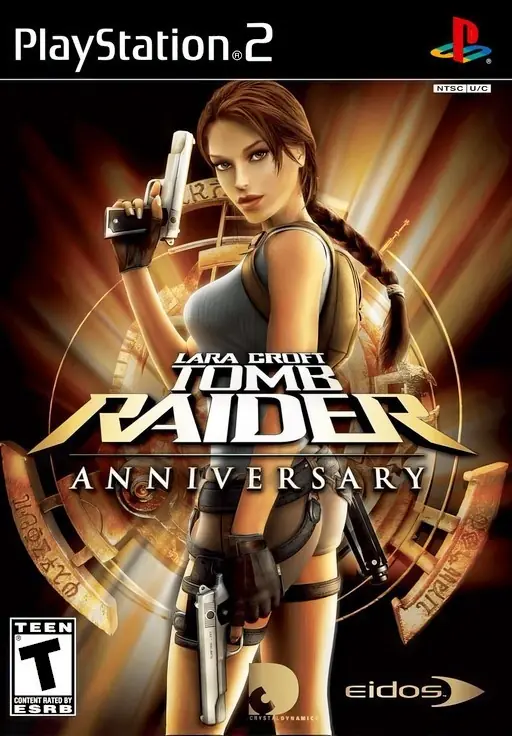
Tomb Raider: Anniversary is a single-player action-adventure game where the player controls the protagonist, Lara Croft, from a third-person perspective, through fourteen levels set across four locations around the world. Lara can jump, climb and shimmy along ledges and vertical poles or ladders, crawl through small spaces, and swing on ropes and horizontal poles. Other abilities include interacting with objects and switches, using a grappling hook to latch onto special rings for both puzzle solving and environmental traversal, and swim and dive underwater for a limited time. Different button combinations can create more moves such as a roll and swan dive.
Puzzles block progress through the levels until Lara solves them by activating switches or finding and using keys hidden within the area. These involve avoiding traps and timed environmental elements. In some sections, the player must pass quick time events by reacting to control prompts that appear on screen. While exploring, Lara can find large and small Medipacks that can heal damage suffered during gameplay, items which allow progress through a level or the larger game, and hidden artefacts and relics which unlock rewards such as costumes once collected. Once completed, a time trial is unlocked for each level, with further bonus features unlocking once the time trial is completed successfully.
During combat, Lara automatically locks on to enemies and fires with her equipped gun, with the player able to switch to another target within range and move freely to avoid enemy attacks. Animal enemies can grab and knock Lara down, leaving her vulnerable to damage until she breaks free or rights herself from a fall. Tougher enemies become enraged and charge at Lara after being shot a number of times. When they close in, time slows and Lara can dodge the incoming attack, allowing her time to counterattack.
A special attack triggered during this time is a head shot when two targeting reticles overlap; a head shot kills a standard enemy and deals high damage to boss characters. 50 caliber handguns and dual miniature submachine guns—with different attack power and limited ammunition which is picked up during levels. Should Lara die during gameplay, she restarts from the previous checkpoint.
The Wii port carries over the levels and general gameplay of the other versions, while incorporating motion controls. Wii-exclusive first-person puzzles include breaking through walls with a pickaxe, using a flash light in dark areas, assembling mechanisms from pieces found around the environment, manipulating symbol-based locks, and using paper and charcoal to take rubbings of puzzle-related symbols, all utilizing the Wii Remote. Motion controls are also used for some aspects of platforming, and free aiming in combat. In the mobile phone version of Anniversary, Lara navigates side-scrolling 2D levels, platforming, fighting enemies and activating switches to progress.
Story
British archaeologist-adventurer Lara Croft is approached by mercenary Larson, who is employed by wealthy businesswoman Jacqueline Natla. Natla hires Lara to find the Scion of Atlantis, an ancient artefact originally sought by Lara's father Richard Croft. It is buried in the tomb of Atlantean ruler Qualopec within the lost city of Vilcabamba. Making her way through Vilcabamba to Qualopec's tomb, Lara discovers that there are three pieces of the Scion, divided between Atlantis' Triumvirate.
Escaping the tomb, she is confronted by Larson, sent by Natla to take Lara's piece of the Scion. After beating him in a fight, he reveals that Natla has sent her rival Pierre Dupont to retrieve the next piece. Breaking into Natla's offices, Lara discovers a video showing the next Scion piece's resting place in Greece beneath a building called St Francis' Folly.
Navigating the catacombs beneath St Francis' Folly, Lara finds the tomb of Tihocan, another member of the Triumvirate, that led the survivors of Atlantis after a betrayal caused the city's destruction. Pierre steals the Scion piece, but he is killed by guardian centaurs outside the tomb. After defeating the centaurs and joining both pieces of the Scion, Lara has a vision which reveals that the third and final piece of the Scion was hidden in Egypt after the third member of the Triumvirate—the traitor who sank Atlantis—was captured by Tihocan and Qualopec. Recovering the third Scion piece, Lara assembles the Scion and sees the rest of the vision, revealing Natla to be the betrayer. Emerging from her vision, Lara is ambushed by Natla, who takes the Scion.
Lara escapes Natla's henchmen—with silent help from Larson—and stows away aboard Natla's boat, which arrives at an uncharted volcanic island holding an Atlantean pyramid filled with her monstrous creations. Lara is forced to kill Larson when he will not back down, which greatly disturbs her. Fighting Natla's remaining henchmen and navigating the pyramid−including an encounter with a doppelgänger of her−Lara confronts Natla, who offers her a place in the new Triumvirate and access to the Scion's knowledge to complete Richard's quest for knowledge. Lara instead shoots the Scion and sends Natla plummeting into a pool of lava, triggering a chain reaction that begins destroying the pyramid. After a final confrontation with a severely injured but still powerful Natla, ending after she is crushed by a pillar, Lara escapes the island and sails away in Natla's boat.
Development
Tomb Raider is the first game in the titular franchise, and introduced the series' gameplay standards and its protagonist Lara Croft. Developed by British studio Core Design and released in 1996, Tomb Raider was a commercial and critical success. It was followed by four successive games between 1997 and 2000. Their sixth Tomb Raider game Tomb Raider: The Angel of Darkness was beset by developmental problems and rushed to release, resulting in low sales and largely negative critical reception.
The game's failure and Core Design's fatigue with the series prompted franchise publisher Eidos Interactive to move development of Tomb Raider to the American studio Crystal Dynamics, who rebooted the franchise with Tomb Raider: Legend. Legend was released in 2006 to critical and commercial success. Following the success of Legend, Crystal Dynamics were requested by Eidos to develop a remake of the original Tomb Raider. Anniversary was co-developed by Crystal Dynamics and Buzz Monkey Software, the company responsible for Legend's PSP port.
The game's creative director and lead designer was James Botta, its producer was Lulu LaMer, and its art director was Andrew Wood.
The team were eager to develop Anniversary as they could use the development assets of Legend. They were also shocked by the request due to the original game's status amongst both Tomb Raider fans and video game history. Another reason for developing Anniversary over a new game was to help celebrate the series' tenth anniversary and create a "compelling gameplay experience" by remaking the first game rather than creating a new title. With two studios working on the game, the development structure was quite complex; a core team of fifteen was based at Crystal Dynamics, Buzz Monkey Software formed a large part of the game's staff, and Crystal Dynamic's executive Creative Services section oversaw development.
When designing Anniversary, the team emphasised creating the game first before making adjustments to keep paper documentation to a minimum in favour of face-to-face conversations. To facilitate a smooth process, the team created a merit-based "democratic" environment where ideas could be put forward by other team members.
Toby Gard, one of the original game's designers and Lara's credited creator, acted as story designer; the script and dialogue were written by Matt Ragghianti. The original game's story was described by Crystal Dynamics staff as "pretty sparse" and difficult to understand without Gard's explanations. One of the aims with Anniversary was to flesh out the narrative and tie it into the continuity of Legend. Gard fleshed out the lore and character motivations in Anniversary, something impossible with Tomb Raider as it needed to tell its story as quickly as possible. The narrative's conclusion, which included Lara's temptation by Natla's offer of the knowledge her father sought, thematically led into Lara's search for her mother in Legend.
Keeley Hawes, Lara's voice actress in Legend, reprised her role for Anniversary. Lara's personality was modelled upon that shown in Legend, but with suitable adjustments for who she was as a person during the events of Anniversary. Lara's initial drive for adventure—defined by Gard as an unstoppable "madness" contained within a proper British woman—was fleshed out to provide purpose for players. The aim was to make her appealing while staying true to her original portrayal.
Gard's expansion of the story became focused on how far Lara was willing to go and what moral boundaries she would cross in pursuit of her goals. The interactions of Natla, Larson and Pierre were extensively expanded by Gard, beginning with an infiltration sequence of Natla's Los Angeles offices by Lara prior to the Greece levels, which in Anniversary had her watching video messages between the characters. The character of Larson, who was carried over from the first game and merged with another of Natla's original henchman called Cowboy, was made a more ambiguous character who shared a "chemistry" with Lara. The moment where Lara kills Larson was written to show Lara crossing a moral line and killing a person for the first time in pursuit of her goals.
Natla's other henchmen were also reimagined to be more realistic, with Lara's confrontation with them being an intense battle following the emotional scene with Larson.
As described by art director Andrew Wood, one of the team's starting points was taking the most memorable moments from Tomb Raider and recreating them in Anniversary on a grander and more detailed scale. The art team wanted to show respect for the original game, designing environments to evoke nostalgia while being more complex and on a grander scale. All the original areas were brought back in Anniversary, but redesigned around modern gaming conventions. Botta said that the team picked out the most interesting parts of each area to preserve, leaving out the "less interesting hallway traversal" of the original.
The environmental design saw an upgrade compared to those in Legend. The animals, primary enemies in the original Tomb Raider, were carried over into Anniversary, but redesigned to appear as threatening and dangerous as possible so people would see them as a threat and not feel too uncomfortable about killing them. The graphic deaths of the original were also toned down at Botta's suggestion so they could earn a lower age rating and sell to a wider audience.
When designing each environment, the art team would first create them with a low colour palette and desaturated lighting to increase their realism. They would then add colourful elements such as foliage, combining that with different types of lighting. Changing levels of light and darkness as Lara explored each location were used to convey a sense of mystery. Peru was given a variety of environments, transitioning from snowy mountains to lush jungle to an underground tomb. The Lost Valley area, which had become a fan favourite since the orig
Reception
Anniversary received positive reviews following its initial release on PC and PS2, with many calling it a worthy remake of the original game. com's Joe Rybicki called the game a homage in its own right. Eurogamer's Kristan Reed said that Anniversary merited a higher score than Legend due to its less linear structure and lower frequency of tutorials. GameSpy's Patrick Joynt praised the recreation and expansion of the original game's locations and gameplay, but faulted the camera control and some "unforgiving" puzzles.
Ryan Davis of GameSpot greatly enjoyed Anniversary, calling it a further step in fixing the franchise following the success of Legend, though he faulted its unwillingness to experiment with the formula. Greg Miller, writing for IGN, praised the updated environments and controls, and despite problems with the graphics, found that it managed to capture the original game's spirit. Reviewers generally recommended the PC version over the PS2 due to lower quality graphics.
The 360 version saw praise for its gameplay and environments, comments shared with other versions, but the graphics were generally faulted. Common complaints were frame rate drops, low-quality textures, and a lack of the console-specific upgrades seen in Legend. The PSP port was lauded as a high-quality port of the PS2 version, although difficult camera control and technical issues such as frame rate drops and long load times were points of criticism.
The Wii port's redesigned controls—and the incorporation of motion controls into gameplay—divided opinion; some praised them or at least enjoyed their implementation, while others found several elements clumsy or unnecessary. The port's graphics also received praise, being cited as visually equal or superior to the PS2 version despite noticeable drops in frame rate. Unintuitive camera control was a frequent criticism. IGN's Matt Casamassina called the port a competently executed enhanced port of PS2 that happens to be good fun at its best and frustrating at its worst. Tom East of Official Nintendo Magazine was very positive in his review, praising the game's implementation of Wii control functions in addition to its general gameplay and design.
Anniversary was nominated at the 2007 National Academy of Video Game Trade Reviewers awards under the "Art Direction in a Game Engine" category. The mobile version won the award for "Best Mobile Game" at the 2007 The Independent Game Developers' Association ceremony.
Upon its release, both the PC and PS2 versions topped their respective charts in the United Kingdom. In North America, the PS2 version was among the top five most rented console games for June 2007. The game remained in the top five best-selling games in Europe during June 2007. Speaking in September of that year, Eidos parent company SCi Entertainment stated all profits for that period were created by the success of Anniversary and Hitman: Blood Money.
The PS2 and Wii versions received a "Silver" sales award from the Entertainment and Leisure Software Publishers Association (ELSPA), indicating sales of at least 100,000 copies in the United Kingdom. 3 million copies worldwide. This makes Anniversary the worst-selling Tomb Raider game to date.