The articlegameplay, story, development, reception
Development
Williams Arcade Classics was developed by Digital Eclipse for home computers: Macintosh, Windows, and MS-DOS. Digital Eclipse's president, Andrew Ayre, served as the title's producer while Brian Johnson, from Williams Entertainment, was the product manager. Williams' director of marketing, John Fowler, decided to release the compilation in order to appeal to people who had played the games as children. He expected that many of the people, who had become adults and parents since the games' original releases, would want to share their arcade experiences with their own children.
Additionally, Williams' vice president of third-party development, Mike Rubinelli, felt this was an opportunity to introduce their popular classic games to new players. He believed that despite changes in video game trends, the elements that make games successful remained unchanged.
Digital Eclipse's team handled the bulk of the production. The developers obtained the original source code for the arcade games and aimed to accurately recreate them. To achieve this, the team chose to emulate the arcade hardware in order to replicate the original games' subtleties they felt encapsulated their unique gameplay experiences. Although computing hardware in the 1990s was more advanced and powerful than that from the early 1980s, remaking the source code for contemporary hardware requires programmers to reproduce every idiosyncrasy from the original, including unintentional software bugs, with a high attention to detail.
The lead programmer, Jeff Vavasour, created a compiler that emulated the entire chipset of the hardware used in Williams' arcade games, including the Motorola 6809 microprocessor. William's early arcade games use hardware similar to that of Defender, its first video game. The emulation allowed the games to run in fullscreen mode without impacting the games' speed. However, alterations were necessary to account for a portion of the arcade monitor that was intentionally unused.
The original Williams arcade releases feature an "overscan" area that the developers left devoid of content, resulting in a smaller game screen dimension.
Despite working with more advanced hardware, the team still found emulating the original hardware challenging, specifically getting Joust to operate at an acceptable speed on the Windows 3.1 operating system running at 20MHz. Vavasour considered accurately emulating the audio an obstacle as well. Because the computer hardware at the time could not simultaneously emulate the games and synthesis the arcade sounds in real-time, Vavasour instead used a "pre-processing" technique to save an audio file to the computer's hard drive to be played when needed. The emulation software he created allowed him to isolate the individual sounds and their respective event triggers. With this information, the team created audio files from those sounds and adjusted the emulator to play the prefabricated sound at the appropriate time during gameplay.
When selecting the titles to include, the developers focused on highly recognizable games that would catch consumers' attention and aid in sales. Technical limitations were also a factor; as a general guideline, Vavasour aimed to develop on hardware that is ten times more powerful than the original in order to properly support the emulation's computing overhead. However, because several of Williams' games used similar hardware, the team was able to easily add Bubbles, a more obscure game, as a bonus title. Bert Monroy created the graphics used in the opening sequence featuring the arcade room, and Vavasour created the opening's animation.
Game testing was handled by Williams' team of testers. Digital Eclipse conceived the idea to include supplemental materials and video interviews, something they would repeat for future projects. Chris Charla and Jon Synder of Flying Rhino Productions conducted the Behinds the Scenes interviews with the original arcade creators. An outside company, Midnight Design, handled the multimedia post-production for the Behind the Scenes portions.
GT Interactive Software Corp. published the CD version for Windows machines. Previously in 1994, Williams Entertainment's subsidiary Midway Games entered into an agreement with GT Interactive Software to distribute Midway's PC titles.
Reception
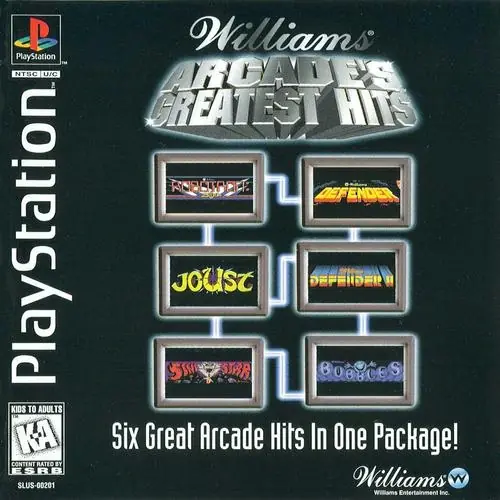
Williams Arcade's Greatest Hits received a mixed reception, with each platform release receiving different responses. The early computer and PlayStation releases were generally well received, but the last release on the Dreamcast was criticized more. Staff for IGN, Edge, and GamePro drew comparisons to Namco Museum Vol. 1, which was released in North America for the PlayStation the same year.
Reviewing the PC version, Next Generation magazine staff praised the "arcade-perfect" conversions of the compilation's games, particularly the retention of the software bugs, which the reviewer felt were among the best features of the arcade originals. They noted the titles' historical importance to the video game industry and expressed admiration for the settings mode as well as the bonus multimedia material. The magazine staff also reviewed the Macintosh release, rating it a point lower than its PC counterpart. The reviewer noted the accurate reproduction and how enjoyable the games are, calling them "six of the greatest arcade classics", but wrote that players would lose interest after about half an hour.
The PlayStation version received overall positive reviews. Critics for Electronic Gaming Monthly, GamePro, and Maximum: The Video Game Magazine praised the arcade-perfect emulation of the games and the strong selection, generally concurring that most of the included games are classics that remain immensely fun. Electronic Gaming Monthly's four critics—Andrew Baran, Mark Lefebvre, Mike Desmond, and Sushi X—lauded the games' nostalgic enjoyment and accurate reproduction. However, Lefebvre noted that the original sounds are "scratchy and irritating".
While all four recommended the compilation for arcade fans, Desmond commented that those unfamiliar with the games might not enjoy them. IGN's staff echoed similar statements about the emulation quality and the appeal towards older fans versus unfamiliar players. Tommy Glide of GamePro described Williams Arcade's Greatest Hits as a "true collectible" for retro gaming enthusiasts; conversely, he noted that younger players might be scared off. Glide considered all the games except for Bubbles, which he called "unique but mundane", a great value.
Maximum's reviewer praised the replay value and challenge of all the games sans Bubbles, noting that those aspects elevated Williams Arcade's Greatest Hits above many of the PlayStation titles at the time. Developers from Iguana Entertainment ranked the PlayStation port as their sixth most wanted game in GameFan magazine's July 1996 guest section of its "Most Wanted" feature. Writing for the Fort Worth Star-Telegram, Malcom Mayhew noted the games' historical impact on modern games, praising the titles for their challenging yet fun gameplay. However, he described Bubbles as an exception, calling it lame.
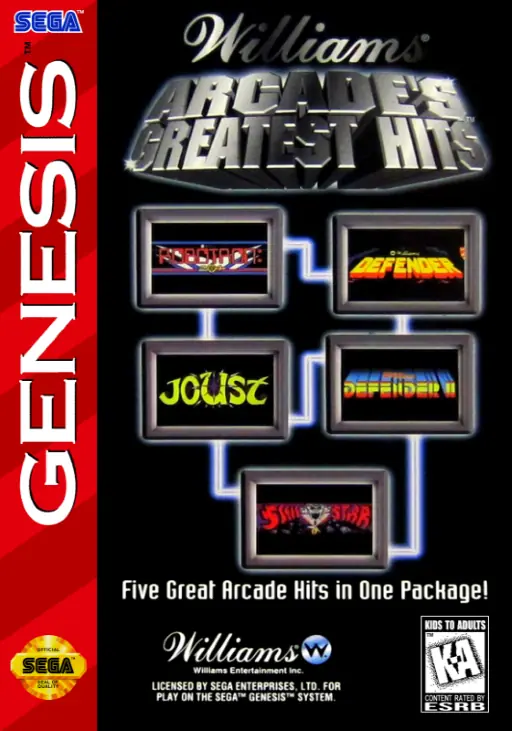
Reviews for the Genesis version were more mixed. Four Electronic Gaming Monthly reviewers—Shawn Smith, Dan Hsu, Crispin Boyer, and Sushi-X—were enthusiastic about the arcade-perfect conversions and enjoyed the games but questioned Bubbles's omission. Smith scored the game the lowest of the four and expressed surprise that such a title would take long to release. While he noted the insignificance of a selection screen, Smith commented that the developers didn't appear to have spent much time on it, describing the screen as "lame".
Hsu and Boyer both praised the individual games' gameplay but recommended playing Robotron with a six-button controller as the standard three-button controller made the game too difficult. Sushi-X considered the collection a technical achievement and expressed excitement at the ability to play these arcade titles on the portable Genesis Nomad. GamePro's Captain Cameron criticized the gameplay controls, calling them "hit-and-miss", and the compilation's lack of extras compared to Namco Museum. While he opined that the games are "average", Cameron singled out Robotron: 2084 as the best of the five "with its swarming enemies that create genuine suspense."
Writing for Mean Machines Sega, Angus Swan and Matt Yeo praised the collection for its nostalgia and lasting playability. While the two described the visuals as “basic”, they praised the graphics' speed and quality replication. Similarly, the reviewers described the audio as "unremarkable" but "crisp".
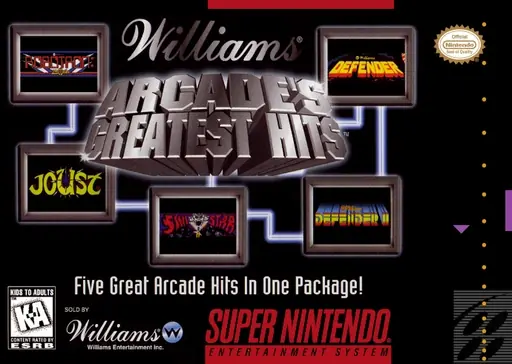
Upon the Super Nintendo port's release, the title debuted on Nintendo Power's Top 20 SNES Power Chart at number twenty based on reader input. Although the magazine's staff described Arcade's Greatest Hits as a great value for "all-time favorite Arcade games", they rated the title lower than most other titles in terms of audiovisuals, challenge, gameplay, and enjoyment. However, three of the six review staff listed it as an "Editor Pick". Blockbuster Video reported the Super Nintendo port as the console's sixth top rented game in October 1996. Additionally, GamePro senior editor Lawrence Neves ranked it as the tenth "Can’t Miss Title" of the same month.
Rich Leadbetter gave Midway Presents Arcade's Greatest Hits a strong recommendation in Sega Saturn Magazine, saying that the gameplay design, originality, and challenge of the included games had held up well. Unlike most of the compilation's reviewers, he argued that Bubbles, though obscure, is solidly entertaining. Reviewing the Game.com port, Brett Alan Weiss of AllGame noted the "inherent limitations of a black-and-white handheld system" and commended the designers for utilizing the system to its limit. Despite the lack of color, he praised the accurate reproduction of the originals' audiovisuals but called the animation "choppy". Weiss summarized the collection's quality as "hit-and-miss"; he called Joust a near-perfect emulation while noting that the two Defender games experience slowdown and that the remaining titles are enjoyable but awkward to control.
GamesMaster magazine's reviewer Robin Alway criticized the Dreamcast release, commenting that the extra features were sparse and illu
Legacy
Video game historians Henry Lowood and Raiford Guins attributed a resurgence of retrogaming via emulation in part to Digital Eclipse's work on Williams Arcade Classics in the mid-1990s. The company would go on to produce more compilations on various platforms. Midway later released a Game Boy Advance version of Midway's Greatest Arcade Hits in 2002. Developed by a different company, Pocket Studios, the collection features only Joust, Defender, Robotron 2084, and Sinistar.
The publisher partnered with Digital Eclipse again in 2003 to release Midway Arcade Treasures, a multiplatform anthology of over 20 arcade titles, including the six games from the original Williams Arcade Classics. The company followed it with two additional compilation volumes.