
The articlegameplay, story, development, reception
Gameplay
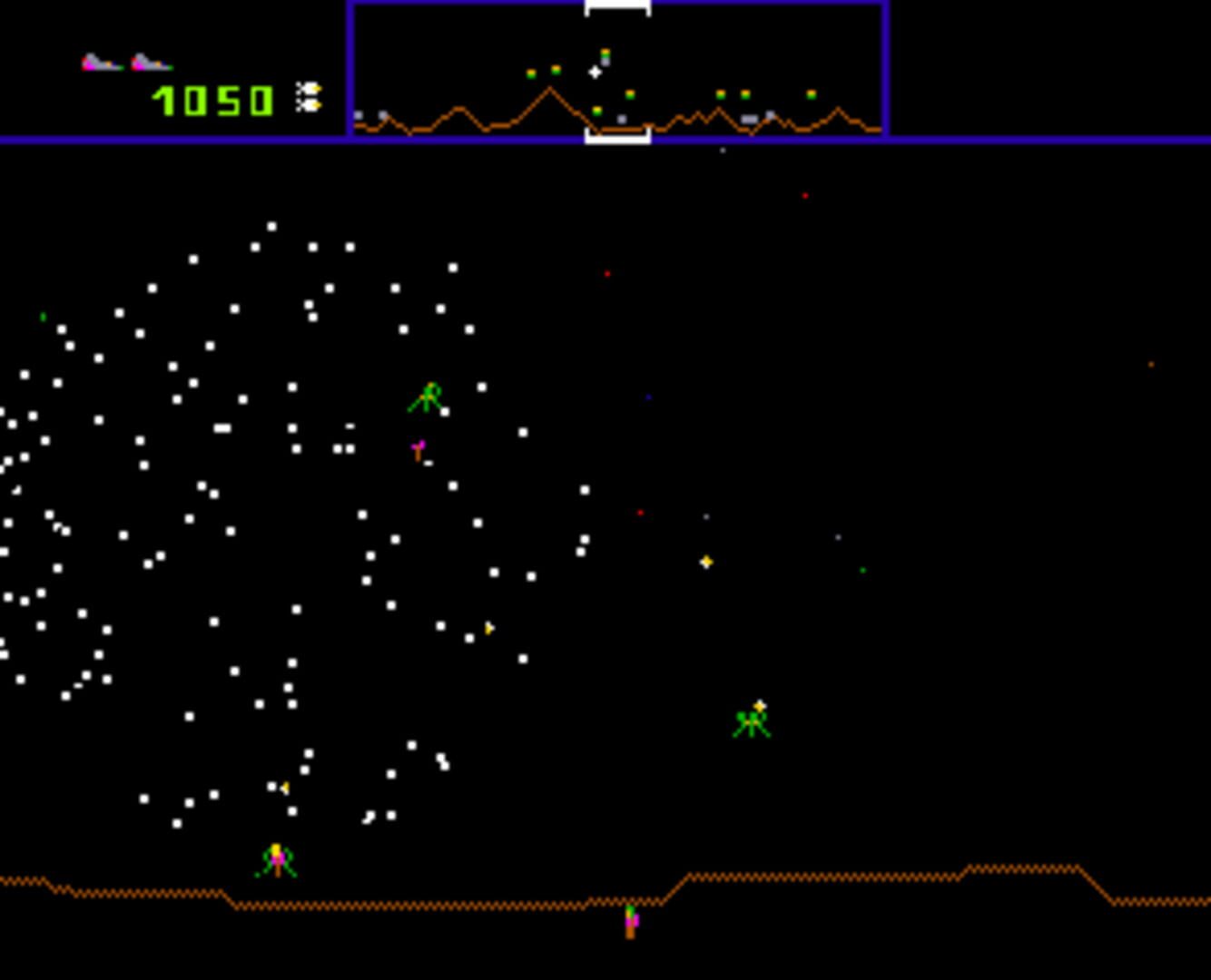
Defender is a side-scrolling shooter set on the mountainous surface of an unnamed planet. The game tasks the player with piloting a space ship to attack invading enemies; a second player can take turns with the first player in the two-player mode. The player controls the space ship with a two-way joystick, which adjusts the ship's elevation, and five buttons that activate weapons and special maneuvers. The ship's two weapons are a forward-facing laser that can be fired continually and a supply of three smart bombs.
Buttons are available for the player to change the ship's direction, provide it with a burst of speed, and use hyperspace to randomly transport it elsewhere in the game world. Hyperspace can be activated repeatedly, but it can result in the ship being teleported into a dangerous situation that results in destruction.
The player must destroy all alien invaders while protecting ten astronauts on the landscape from abduction. Defeating the aliens allows the player to progress to the next level. Landers capture humans and attempt to carry them to the top of the screen at which point they turn into fast-moving mutants. Mutants track the player's ship, firing projectiles at it.
A captured human can be freed by shooting the lander, then catching the human before it falls to its death, and dropping it off on the ground. Additional enemies—baiters, bombers, pods, and swarmers—appear after the first stage. Baiters are fast moving discs that will shoot at or crash into the player ship. Bombers continually desposit floating mines throughout the playfield.
Pods are slow moving objects that burst into a group of swarmers when shot. Swarmers, like baiters, home in on the player ship while shooting at it.
Failing to protect the astronauts causes the planet to explode and mutants to swarm the level. Surviving the waves of mutants restores the planet. A ship is lost if it is hit by an enemy or its projectiles. The game ends after exhausting the available ships.
As the game world is larger than what the screen displays, a scanner at the top of the screen displays a miniature representation of the landscape along with the locations of humans and enemies. A set of brackets on the map indicate the portion of the game world that the player is currently viewing.
Development
Defender was Williams Electronics' first attempt at developing an original video game; the company's earlier game was a Pong clone. The popularity of coin-operated video games in 1979 spurred it to expand beyond pinball games. The company chose Eugene Jarvis, who had a successful record of Williams pinball games, to head development. Additionally, the release of Taito's Space Invaders in 1978 inspired Jarvis to pursue arcade game development. Larry DeMar, Sam Dicker, and Paul Dussault assisted Jarvis.
Development began around October 1979. The team first determined the specifications of the game's hardware. They aimed to portray Williams games as technologically advanced and included more capabilities than the game required. At the time, Williams had a small staff, and its management was unfamiliar with the technology used for its electronic games.
As a result, the developers were afforded a large amount of creative freedom. They used a Motorola EXORciser computer to develop the game's program.
's Asteroids. Space was a popular setting for video games at the time, and Jarvis felt the abstract setting would help obscure simple graphics. First inspired by Space Invaders, he created a prototype with similar gameplay that included new mechanics. After spending a few weeks with the design, however, the team felt it was dull and abandoned the idea.
Development then shifted to emulating Asteroids, which displays vector graphics on a special monitor, and the team experimented with recreating the game with pixel graphics. They abandoned this design as well, deeming it a poor recreation and visually unappealing.
Believing the first attempts to be too derivative, the developers held brainstorming sessions. During a session, they agreed that one of Asteroids's favorable elements was its wraparound screen effect. They felt that allowing the player to fly a ship off the screen would be exciting and decided to create a game world larger than the screen displayed. The game's environment was made wider than the screen and scrolled horizontally.
Expanding on the idea, they envisioned Space Invaders' design rotated 90 degrees to have the ship move up and down while flying horizontally. Large asteroids, an element from Asteroids, were added to the game world but later removed. Jarvis intended the screen to scroll only from left to right; fellow Williams employee Steve Ritchie, however, convinced him the game should be able to scroll in either direction.
After six months of development, the team considered the progress insufficient. They examined other games and concluded that survival was a necessary component. The team devised enemies to present a threat, the first of which was the "Lander". Jarvis enjoyed violent, action entertainment, and he wanted to include those elements but felt the action should have a reasonable objective.
Inspired by the 1960s television show The Defenders, Jarvis titled the game Defender, reasoning that the title helped justify the violence. He added astronauts to expand on the space theme and give the player something to defend while shooting enemies. Jarvis believed the combination of offensive and defensive actions created a "rich tactical and strategic experience" that forced the player to frequently evaluate the situation's priorities. He further noted that the added complexity made the gameplay less monotonous, which differentiated it from other games that solely rely on a relentless battle that eventually kills the player character.
The element of flying over a planetscape was added after a brainstorming session between Jarvis and Ritchie. The landscape is depicted as a line only a pixel wide, primarily because the hardware was not powerful enough to generate anything more detailed. The background stars' movements were made slower than the ship in order to create a sense of depth.
By July, development was behind schedule and Jarvis's supervisor pressured him to finish the game to display at the then-upcoming Amusement & Music Operators Association (AMOA) trade show in September. Jarvis spent several weeks creating the astronauts, which his boss wanted to omit if the process did not hasten. The pressure frustrated Jarvis to the point he considered resigning. Around that time, Sam Dicker was hired as a new programmer.
He assisted in programming the game and added audiovisual effects. Dicker implemented a particle effect algorithm to generate unique explosions when enemies were destroyed. The new elements re-invigorated Jarvis, who felt the project began to show promise.
Development then shifted focus to the enemies. Landers were given the ability to capture humans, and a new enemy was devised from the mechanic: "Mutants", captured humans that had turned hostile. The Mutants added a rescue element that Jarvis believed made the game more interesting and would encourage the player to continue playing. He applied the element of making a "comeback" to the planet and restored it and the humans after surviving five waves following the planet's destruction; Jarvis felt it mimicked the ups and downs of real life.
"Bombers", enemies which release floating bombs on the screen, were added next. More enemies were added to create different gameplay elements. "Swarmers" and "Pods" were designed to attack the ship rather than the astronauts. "Baiters" were included prevent the spaceship from lingering and add pressure to the player.
Based on a similar enemy in Asteroids, Baiters quickly follow the ship to collide with it.
Defender remained unfinished by September, and almost every Williams programmer assisted with meeting the deadline for the AMOA trade show. The evening before the trade show, the arcade cabinets were delivered for display. However, the developers realized they had not created an attract mode to entice an audience and a high score system. After measuring how much spa
Reception
The game was slow to gain popularity, not attracting much attention at the 1980 AMOA trade show. In retrospect, Jarvis believed its complexity intimidated many passersby. Defender's promotional debut elicited mixed reactions. Reviewing the trade show, David Pierson of Play Meter magazine felt Defender had the potential to be "top video [game] of the year" and listed it as an example of quality American products in response to the recent popularity of imported Japanese video games.
He also praised Williams for releasing a strong initial product in a "highly competitive" market. Conversely, Dick Welu, also writing for Play Meter, felt it was a step backward in game design, negatively comparing it the 1977 Flying Fortress by Electra Games, and criticized the complex control panel.
Readers of Play Meter voted Defender the ninth top arcade game in March 1981. The game began to climb the poll's rankings soon after. At the beginning of April, it reached fourth and continued to rise a rank every two weeks, plateauing at second in May. It briefly topped the poll at the beginning of July.
Six months after its release, the game was one of the top earners in the United States video game industry. In the first half of Williams' 1981 fiscal year, its net income—almost US$6 million—had already exceeded that of the previous fiscal year. Stroll attributed the increase to the success of Defender. On the 1981 arcade game charts, it topped the Play Meter arcade chart in August, and the RePlay arcade charts for most months between March and November.
The annual Cash Box and RePlay arcade charts listed Defender as the second highest-grossing arcade game of 1981 in the US, below Pac-Man. The AMOA later listed Defender among the United States' six highest-grossing arcade games of 1982. Electronic Fun with Computers & Games magazine staff ranked it the thirteenth top arcade game of 1982. Defender also saw success in Japan, although not as much compared to Western markets; it tied with Turbo and Galaxian as Japan's 18th highest-grossing arcade video game of 1981.
Defender eventually became one of the highest grossing arcade games ever, earning over US$1 billion.
Demar was surprised by Defender's popularity. At the time of its release, Stan Jarocki, director of marketing at then-competitor Midway Manufacturing, described the game as "amazing". Soon after its release, Tony Licata of Play Meter considered Defender a "solid entry" in the arcade market and described it as "extremely high" quality. He praised the audiovisuals, describing the graphics and sound as "excellent" and "super, respectively. However, Licata considered the explosions "too much" and "unnecessary".
A common point of discussion was Defender's challenging gameplay. In his 1981 video game guide How to Master the Video Games, Tom Hirschfeld noted that mastery requires perseverance and those that reach that level find it "worthwhile". Licata extolled the gameplay, specifically the complexity, which he felt increased its replay value. While he acknowledged it could dissuade some players, he believed them to be a small percentage and wrote that the variety of options will "hook" experienced players.
He commended the designers for including the mini-map, which he considered an essential component. Conversely, Atari programmer Dona Bailey considered too many buttons troublesome and cited Defender as the "worst" example of such control schemes. Derrick Bang of Softline wrote in 1983 that Defender "remains one of the hardest arcade games ever developed" and that novices are rarely able to play longer than ten seconds.
The Atari 2600 release was overall received well in contemporary video game publications and became a best seller. Ed Driscoll of The Space Gamer wrote that despite the console's graphical limitations compared to the arcade hardware, Defender should be in players' game library. In comparing the port to the source material, he felt that arcade "purists" will miss the original controls. The port won the "Best Science Fiction/Fantasy Videogame" category in Electronic Games's 1983 Arcade Awards.
The magazine editors praised the console conversion, calling it a "loving tribute to the original" that demonstrated the developer's ability to work within the Atari 2600's technical limitations. Reviewers for Computer and Video Games later rated the port favorably with 90% score, writing that it captures the original's "spirit and atmosphere". Atari sold over 3 million units in 1982, and that year, Defender became Atari's second best-selling home video game after Pac-Man. The next year, however, sales plunged during the video game crash of 1983.
The port to the Atari 5200 also received a generally favorable reception. David H. Ahl of Creative Computing Video & Arcade Games favorably compared the Atari 5200 release to the original version while noting the differences in controller hardware. He also highlighted the gameplay variations and wrote that it provide a "substantial challenge".
The editor of The Video Game Update, Celeste Dolan, praised how well the console port reproduced the source material, calling it "a superior home rendition". She commended the audiovisuals and noted the improvements from the Atari 2600 port. Writing for AllGame, Earl Green praised it in a retrospective review years later. He called the port "decent" and a "pleasing mix" of the arcade game and the Atari 2600 conversion. He noted that the Atari 5200's controllers allowed for a more faithful reproduction of the arcade's controls; Green described the console's controls as "smooth and instinctive".
Reviews for the home computer versions were mixed. In 1983, Softline readers named the port for the Atari 8-bit computers fifth on the magazine's top thirty list of Atari programs by popularity. The magazine staff were more critical, stating that the "game's appeal does not justify its unreasonable cost" of being shipped on ROM cartridges. A reviewer for Computer Games magazine was
Legacy
After the success of Defender, Williams expanded by building a new facility and hired more employees. Jarvis was able to work in isolation prior to the expansion, but the influx of people created an environment he was unhappy with. Additionally, he felt that corporate structures were "stuffy". Despite Williams offering Jarvis a bonus for his work on Defender, he and DeMar resigned soon after to found their own development company, Vid Kidz. The company served as a consulting firm to Williams and developed a few games that Williams published.
Jarvis's contributions to the game's development are often cited among his accolades. John Vince, a professor of digital media, considered him one of the originators of "high-action" and "reflex-based" arcade games, citing Defender's gameplay among Jarvis's other games. Ellis described Jarvis as the inaugural "hard-core" designer due to Defender's challenging yet commercially successful gameplay. Barton and Loguidice as well as Sellers wrote that the game helped establish Williams and Jarvis as key figures in the arcade game industry.
Defender was listed as one of Jarvis's achievements when he was awarded the Lifetime Achievement Award at the 2005 Game Developers Choice Awards. In 2007, IGN editors listed Eugene Jarvis as a top game designer whose titles, including Defender, have influenced the video game industry.
The game has been followed by sequels and remade multiple times since its arcade release. The first was the 1981 Stargate, which Vid Kidz developed for Williams. The success of Defender prompted Williams to release more video games as soon as possible. Rather than create a new original game, DeMar suggested making an enhanced version of Defender to meet Williams' four-month deadline.
Developed as a sequel to Defender, Stargate features new more challenging elements and improved the original's performance. Stargate was also released on home platforms, sometimes as Defender 2. However, it was not as successful as its predecessor and did not receive as wide as a release. Epyx published Revenge of Defender in the North American market in 1988.
Before Epyx obtained an official license, the game was a clone named StarRay that Logotron had released in the United Kingdom. Atari Games released another sequel, also titled Defender 2, for Atari ST and Amiga home computers in 1990 under its Arc label. Developed by Jeff Minter, the sequel combines features from the first two games and incorporated new elements. Both the original Defender and Stargate are included.
Remakes have taken the form of electronic games, board games, and video games. Williams released a Defender-themed pinball machine in 1982. It has many elements from the original game: sound effects, enemies, waves, and weapons. Williams produced fewer than 400 units.
Milton Bradley adapted the arcade game into a board game. Entex Industries created an handheld electronic game version in 1982. It also released a ROM cartridge version for its LED-based tabletop game console, the Entex Adventure Vision. Tiger Electronics released a keychain-sized electronic game adaption with a grayscale LCD screen in 1997.
In 1991, Midway Games released Strike Force, which features gameplay similar to Defender. The gaming press noted the similitude and referred to Strike Force as an update or possible sequel to Defender. Following a successful remake of Tempest, Atari tapped Minter again to create Defender 2000 for the Atari Jaguar in 1996. In addition to the original version, the remake has two updated modes—Defender Plus and Defender 2000—that feature new visuals and gameplay elements.
Midway released two remakes in 2002, one for home consoles and another for the Game Boy Advance. Similar to Defender 2000, the handheld console release has three modes of play: Classic, which is the original arcade version; Defender XP, which features updated visuals; and Defender XGP, which has new visuals and gameplay elements. A 3D remake titled Defender was released in 2002 for major sixth generation home consoles. Featuring 3D graphics, it depicts the gameplay from a third-person viewpoint behind the starship.
James Hague of Dadgum Games called Defender a landmark title from the 1980s. It is considered the first side-scrolling shoot 'em up, predating Scramble by two months. In describing it as a classic title, Vince wrote that Defender introduced new technology to games, specifically scrolling. Stearny said that its use of scrolling helped remove design limitations associated with the screen.
Cuciz stated that the scrolling introduced the "first true gaming environment". Minter made similar comments.
Bill Kunkel of Electronic Games observed that numerous Defender clones had appeared in the arcade market in 1981. Loguidice and Barton noted that later side-scrolling shooters derived their basic format from Defender, listing the 1983 The Tail of Beta Lyrae and the 1987 R-Type as examples. Other games draw more heavily on Defender; for example, the 1986 Fantasy Zone and its sequels allow the player to fly ships in all directions in a scrolling environment that loops.
Several home console and computer games copied Defender, while others built upon its design. Early clones include the 1981 releases Gorgon and Alien Defense on the Apple II and the TRS 80 Model III, respectively. Acornsoft released a clone titled Defender in 1982 for its BBC Micro platform; the company later renamed it to Planetoid to avoid litigation. More facsimiles, such as Defense Command, Repton, Dropzone, and Protector II, continued to be released from 1982 to 1984.
Chopper Command for the Atari 2600 and Choplifter for the Apple II, both released in 1982, feature attack helicopters while drawing inspiration from Defender's gameplay. Minter also based several games on its design, starting with Andes Attack for the VIC-20 computer. While many of his projects retain similar elements from Defender, Minter aimed to inject more originally into his subsequent


