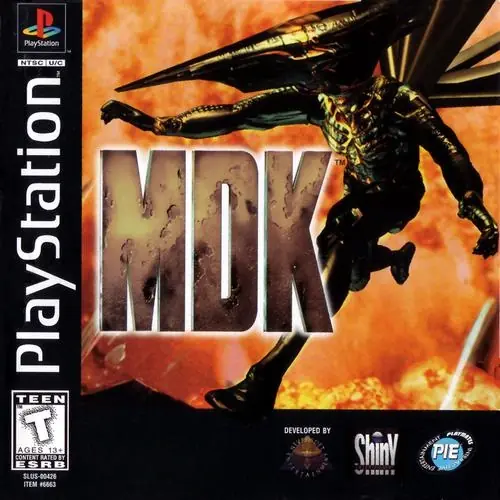
The articlegameplay, story, development, reception
Gameplay
For the most part, MDK is a run-and-gun third-person shooter. It also features several minigames, and allows the player to enter first-person mode at any time they wish to use their sniper weapon. The basic design of the game involves distinct levels in which the player character, Kurt Hectic, must infiltrate a "Minecrawler", fight his way through an array of enemies, tackle some rudimentary puzzles, and reach the control center, where he must then eliminate the pilot in a boss fight. Every level is completely different; enemies, level design, aesthetic, and control center layout, with a different strategy required to eliminate each pilot.
During the run-and-gun gameplay, the player must frequently use Kurt's "ribbon chute", a parachute contained within his outfit that can be used indefinitely. The chute allows Kurt to make long jumps, survive long falls, and utilize updrafts. It deploys immediately and retracts automatically when not being used. Kurt also has access to a smart bomb feature, where he can call Max to fly a bomber over the battle area and drop bombs on the enemies.
Story
The story of the game begins in 1996 when inventor/scientist Dr. Fluke Hawkins believes he has made a revolutionary discovery; an outer space phenomenon he calls "Flange Orbits". However, when he approaches the scientific community with his discovery, he is ridiculed. Determined to prove his colleagues wrong, Hawkins builds a space station, the Jim Dandy, and bribes aboard his laboratory janitor, Kurt Hectic, by means of Hungarian goulash.
He then launches the station into orbit, projecting that the mission will last five days. However, after a week, Hawkins realizes Flange Orbits do not actually exist, but rather than return to Earth in shame, he decides to remain on the Dandy to try to discover something, anticipating another week in space. Kurt is extremely unhappy with this development, but once Hawkins shows him how to program the VCR, he calms down.
Development
MDK's writer, co-designer and co-artist Nick Bruty has said the initial impetus for the game was his desire to move away from the type of game on which he had previously been working; family-friendly games such as Aladdin (1993), The Jungle Book (1993), Earthworm Jim (1994) and Earthworm Jim 2 (1995), all of which Bruty had worked on for the Sega Genesis. According to Bruty,
MDK was a reaction, or outburst, from having worked back-to-back on cartoon games such as Aladdin, Jungle Book and Earthworm Jim. Don't get me wrong, I loved working on those games and learning new styles; but my heart is in fantasy and science fiction. I knew straight away that this was what I wanted to do next.
Reception
It received generally positive reviews on both PC and PlayStation. The Windows version holds an aggregate score of 89% on GameRankings, based on five reviews. The PlayStation version holds a score of 76%, based on six reviews.
Next Generation reviewed the PC version of the game, stating that "MDK is a game that no self-respective gamer will want to miss." 0 out of 5 in all four categories (graphics, sound, control, and funfactor), saying it "easily lives up to all its rampant hype, delivering one of the year's most creative, engrossing, and just plain fun games." The reviewer particularly applauded the "floating third-person view", Kurt's arsenal of abilities, the effective realization of the setting, and the varied gameplay experiences. Game Revolution's Johnny Lee called the game "Non-stop 3D shooting, killing, exploding, dodging, parachuting, running, ambushing, assassinating, jumping, mind blowing action!"