
The articlegameplay, story, development, reception
Gameplay
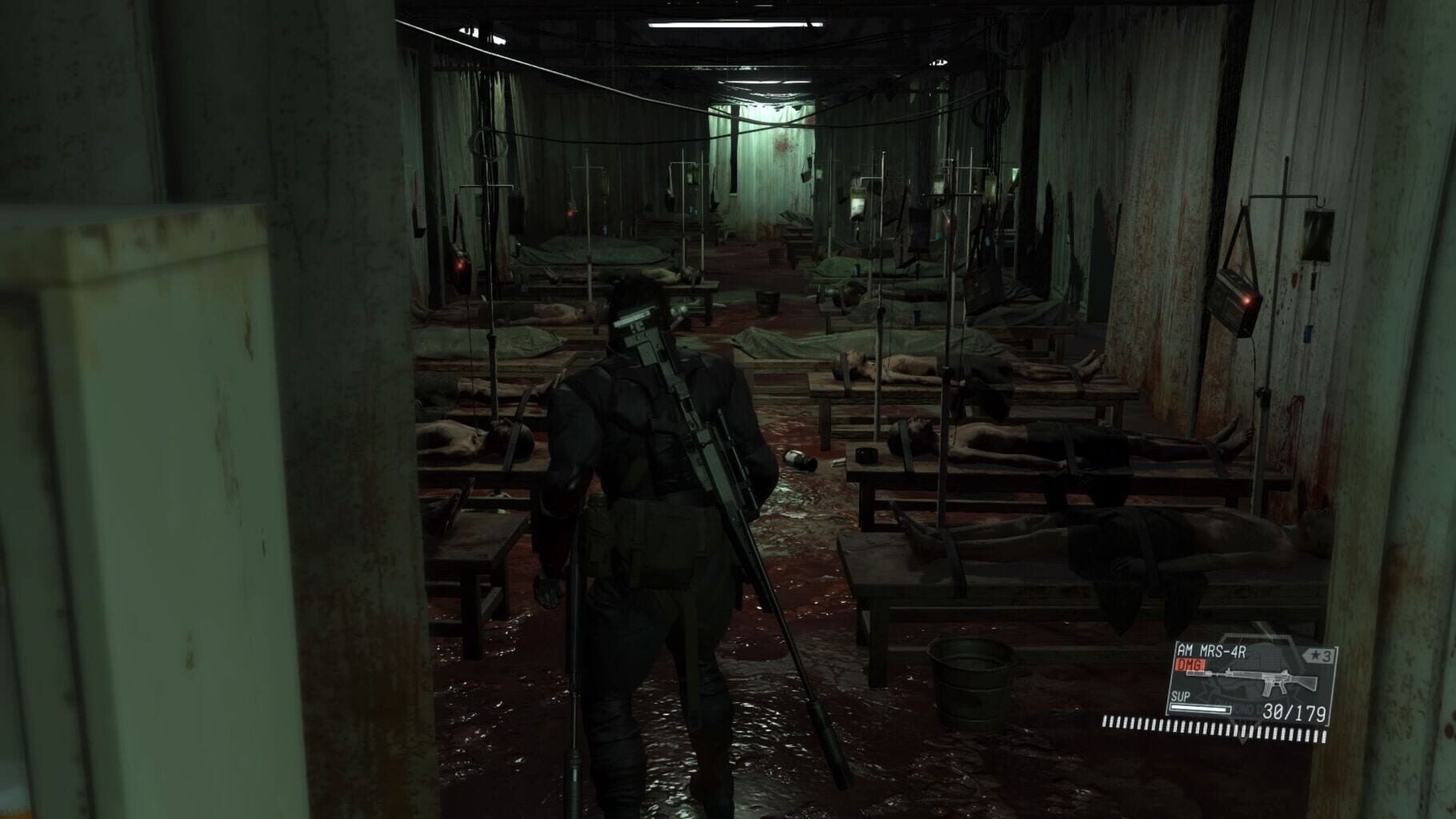
Metal Gear Solid V: The Phantom Pain is a stealth game in which players take the role of Punished "Venom" Snake from a third-person perspective in an open world. Gameplay elements are largely unchanged from Ground Zeroes, meaning that players must stealthily traverse several areas in the game world, avoiding enemy guards and remaining undetected. Included in Snake's repertoire are binoculars, a variety of weapons, explosives, and stealth-based items such as cardboard boxes and decoys. Following one of the series traditions, The Phantom Pain encourages players to progress through the game without killing, using non-lethal weapons such as tranquilizer darts to subdue enemies.
Players may traverse the game world with vehicles such as jeeps and tanks, in addition to traveling on foot or on horseback, and as certain locations are mountainous, players may opt to go rock climbing as a shortcut. They may call for helicopter support against enemy soldiers or request airstrikes that can bombard the target area or change the weather. Snake can call on one of a few AI "buddy" companions: D-Horse, a horse capable of wearing armor and hiding Snake during travel; D-Dog, a wolf pup raised to assist Snake in the field; Quiet, a mute female sniper with supernatural abilities; and D-Walker, a piloted, highly agile mobile weapons platform that can provide heavy weapons support. The companions' abilities and their effectiveness depends on the player's relationship with them.
There is a large emphasis on tactics in The Phantom Pain.
As in Metal Gear Solid: Peace Walker, The Phantom Pain features a base-building system that allows players to develop weapons and items from their headquarters, Mother Base. Recruitment of enemy soldiers and prisoners has returned for this purpose, allowing the base to grow through organization. The player is given the option to access their base from their real-life smartphones and other devices via a companion app. Unlike in Peace Walker, where players can only view Mother Base from the air, The Phantom Pain allows players to control Snake as he explores the complex on foot.
The Fulton surface-to-air recovery system, an item introduced into gameplay in Peace Walker, returns as well, with players able to transport captured soldiers and other objects such as animals and vehicles back to Mother Base. An in-game currency called GMP is used for upgrading Mother Base's defenses and technology, and can be collected from objects found all over the map, such as rough diamonds, shipping containers, and special blueprint boxes, as well as sending recruited soldiers on combat missions around the world. The income is invested in upgrades to the appearance and abilities, weapons and equipment of Snake, his companions, and vehicles. For example, Snake's prosthetic arm can be modified with a taser, echolocation function, or remote controls that allow it to fly as a missile-like drone.
Game design direction allows the player to choose in what order the story events take place by selecting missions in any order they like, and yet still "understand the encompassing message by the end". The enemy AI has improved in terms of situational awareness. If players frequently use particular weapons or tactics to subdue enemy soldiers, enemies will increase in number and be outfitted with better equipment; for example, frequent use of headshots will result in enemy soldiers donning metal helmets to make targeting the head harder. Other actions from the player can affect the wider game world further; for example, sabotaging a radar installation will open up a new landing zone.
The game has a dynamic weather system and day-night cycle that runs in real-time. The cycle is able to be fast-forwarded when Snake lights a "Phantom Cigar", a type of electronic cigar; a digital silver Seiko watch panel appears on screen to denote time. The passage of time enables players to analyze the movement of marked enemy forces in the area, such as shifts in sentry patrols and individual patrol routes. Weather conditions, such as sandstorms and rain, affect the gameplay environment by reducing visibility or masking the sound of footsteps.
Metal Gear Solid V: The Phantom Pain includes two multiplayer modes: first, the new Metal Gear Online 3, developed by Kojima Productions' newly formed Los Angeles division (now known as Konami Los Angeles Studio). The second multiplayer mode is an extension of the Mother Base base-building feature. Players are able to expand their operations to include Forward Operating Bases, which can be used to generate resources and income for the single-player campaign. These facilities can be attacked by other players, making a player-versus-player mode available whereby the attacking team attempts to steal resources and/or soldiers and the defending team tries to protect the Forward Operating Base from the intruder.
Defenders are able to call on their friends to aid in the defense, especially if their Forward Operating Base is attacked during a story mission. Players are able to customize the security, staffing, and layout of their Forward Operating Bases, allowing for a large number of compound configurations. Following the success or failure of the intrusion, the location of the attacking player's Forward Operating Base is revealed to the defending player; however, defending players can only launch a retaliatory strike if the attacker was discovered during their infiltration. The Forward Operating Base feature is a separate multiplayer experience to Metal Gear Online 3 and is needed to increase the number of combat units the player can deploy.
Story
In the aftermath of the events of Ground Zeroes and the destruction of Militaires Sans Frontières (MSF), Big Boss (Kiefer Sutherland/Akio Ōtsuka) falls into a coma. Nine years later, he awakens and helps lead a new mercenary group, Diamond Dogs. Adopting the codename "Venom Snake", he ventures into Afghanistan during the Soviet–Afghan War and the Angola—Zaire border region during the Angolan Civil War to track down the people responsible for MSF's destruction. Along the way, he becomes reacquainted with his former rival Ocelot (Troy Baker/Satoshi Mikami) and encounters Quiet (Stefanie Joosten), an assassin and sniper with supernatural abilities. While he and Kazuhira Miller (Robin Atkin Downes/Tomokazu Sugita) are initially driven to exact revenge, Snake unearths a plot by the Cipher organization to develop a new model of the Metal Gear system known as the ST-84 "Sahelanthropus".
In contrast to previous Metal Gear installments, Kojima Productions conducted the voice acting and motion capture with English-speaking actors and stuntmen first. While facial motion capture was used before for Metal Gear Solid 4: Guns of the Patriots, it was done separately from the actual voice acting. The Japanese voice acting was dubbed over the English cast's performance afterward, in contrast to previous releases in the series since Metal Gear Solid 2: Sons of Liberty, which had the characters' vocal and facial expressions lip-synched specifically to both Japanese and English voice acting.
At E3 2013, Konami confirmed that actor Kiefer Sutherland would provide Snake's voice and motion capture work for the game, taking a role over voice actor David Hayter. Kojima's reason for replacing Hayter was to "have a more subdued performance expressed through subtle facial movements and tone of voice rather than words", and that he "needed someone who could genuinely convey both the facial and vocal qualities of a man in his late 40s". Hollywood producer and director Avi Arad suggested to Kojima that Sutherland could fulfill his requirements. Akio Ōtsuka was unaffected by this casting change and continued to voice Snake in the Japanese version.
On March 4, 2015, Kojima revealed that Snake would have less dialogue in The Phantom Pain than previous installments. The reasoning behind it was to make Snake come across as an extension to the player and that he "will act based on [player's actions] rather than doing things like making spontaneous comments or flirting with women."
Other members of the voice cast include Troy Baker as Ocelot, Jay Tavare as Code Talker, James Horan as Skull Face, Robin Atkin Downes as Kazuhira Miller, Christopher Randolph as Dr. Emmerich, and Piers Stubbs as Eli. The Japanese dub features Tomokazu Sugita as Miller, Hideyuki Tanaka as Emmerich, Takaya Hashi as Skull Face, Satoshi Mikami as Ocelot, Osamu Saka (whose previous roles include Sergei Gurlukovich in Metal Gear Solid 2: Sons of Liberty and The End in Metal Gear Solid 3: Snake Eater) as Code Talker, and Yūtarō Honjō as Eli. Dutch model Stefanie Joosten provides the likeness, voice and motion capture for the new character Quiet, a mute sniper with supernatural abilities who may assist Snake on missions depending on the player's actions during a certain mission. She provides the vocals for "Quiet's Theme".
In 1984, nine years after the destruction of MSF, Big Boss awakens from a coma in a hospital on a British military base in Cyprus. Quiet, a Cipher assassin, attempts to kill him, but he is rescued by a heavily bandaged man called "Ishmael". The pair escape the hospital while evading pursuit from Cipher soldiers and two superhumans, the "Third Child" and the "Man on Fire". Big Boss loses Ishmael, but is recovered by Revolver Ocelot and brought aboard Diamond Dogs, a new mercenary group founded by Kazuhira Miller on an offshore platform near Seychelles.
Big Boss adopts the code name "Venom Snake" and begins searching for Cipher. Snake becomes involved in the Soviet–Afghan War and the Angolan Civil War. He recruits the superhuman mute sniper Quiet; scientist and MSF associate Dr. "Huey" Emmerich; and Code Talker, a Navajo expert on parasites forced to work for Cipher. Snake captures Eli, a British child believed to be a clone of Snake and the leader of several child soldiers; a DNA test confirms that Venom Snake and Eli are not genetically related.
Snake learns that Cipher's leader Zero was usurped and XOF, a rogue faction of Cipher, was responsible for destroying MSF. XOF's leader Skull Face considers Cipher's plan for world peace akin to making it culturally American, and intends to release a parasite that kills anyone who speaks English; a modified parasite gave Quiet and XOF's elite soldiers their unusual abilities. After releasing the English strain, Skull Face plans to use the threat of the latest Metal Gear "Sahelanthropus" to make nuclear weapons desirable, believing that nuclear deterrence will attain world peace while protecting other cultures; in secret, he will retain control of the weapons. Skull Face refuses to use an AI for Sahelanthropus, so is dependent on the Third Child's psychic abilities.
During a test, the Third Child betrays Skull Face, having Sahelanthropus seriously wound him and crush the Man on Fire. Snake defeats Sahelanthropus and recovers two of Skull Face's three parasite vials to destroy them; the third is missing, while one of those recovered is taken by the Third Child and given to Eli. Skull Face is left to die by Snake and Miller, but Huey executes him. Sahelanthropus is brought to Mother Base.
Eli, the Third Child, and the child soldiers later steal Sahelanthropus and flee. It is revealed that the Third Child's powers enthralled him to the will of the most vengeful person nearby, meaning that Sahelanthropus' attack was instigated by Eli.
A parasite epidemic occurs on base, forcing Snake to kill many of his men to contain it. To honor them, he has their cremated remains turned into diamonds to carry in
Development
In February 2012, a site owned by Konami, "Development Without Borders", promoted development for a new Metal Gear title, for "The 'next' MGS". The site was recruiting staff for the 2012 GDC pavilion in March, and requested applications for several positions for the latest Metal Gear Solid targeted for "high-end consoles" and a "next-gen Fox engine". As the year went on, screenshots and videos of the newly announced Fox Engine were unveiled by the team. This media demonstrated many random settings and characters, although none related to the Metal Gear series. Certain screenshots, however, were noted to feature a character who resembled the Big Boss character of Metal Gear, walking up to a Stryker AFV previously seen in Metal Gear Solid 4.
Konami unveiled Ground Zeroes at a private function celebrating the twenty-fifth anniversary of the Metal Gear series on August 30, 2012. The game made its public debut two days later at the 2012 Penny Arcade Expo. Kojima revealed very little detail about the project at the time other than that it was a prologue to Metal Gear Solid V, and that it would be the first game to use the Fox Engine, a game engine developed by Kojima Productions. In January 2013, Kojima revealed that Ground Zeroes would be the first title in the series to be subtitled in Arabic, a feature the team had planned for previous games. He also confirmed that the length of the cutscenes was reduced, as he believed that long cutscenes had become outdated.
In an interview with VG247, Kojima expressed concerns over whether or not Ground Zeroes would be released. He claimed that his aim was to target taboos and mature themes, which he considered to be "quite risky", adding that his roles as creator and producer were in conflict with one another; as creator, Kojima wanted to take the risk of exploring themes that might alienate audiences, but as producer, he had to be able to tone down the content in order to sell as many copies of the game as possible. Ultimately, the role of creator won out, and Kojima described his approach as "prioritizing creativity over sales".
At the Spike Video Game Awards in December 2012, a teaser trailer for a game known as The Phantom Pain was shown, credited to a new Swedish developer known as Moby Dick Studio, and was described as being "100% gameplay". Allegedly led by Joakim Mogren, the studio's mission statement read that it aimed to "deliver an uncompromising, exciting, and touching game experience to people all around the globe". After the presentation, commentators speculated that The Phantom Pain was actually a Metal Gear game, noting the protagonist's resemblance to Big Boss, graphics similar to those produced by the Fox Engine, the quote "V has come to" at the end of the trailer, and that the title Metal Gear Solid V fits in the negative space and indentations of the game's logo when using the same font. The name "Joakim" was an anagram of "Kojima", the domain name for the studio's website had only been registered about two weeks prior to the announcement, and that several people wearing Moby Dick Studio shirts were sitting in a VIP area intended for Konami staff. Kojima stated he was impressed by the trailer and how Mogren was inspired by Metal Gear.
An actor playing a heavily bandaged Mogren appeared in an interview on the March 14, 2013 episode of GameTrailers TV; while stating that he could not reveal many details, he confirmed that more details about The Phantom Pain would be revealed at the upcoming Game Developers Conference, and showed a series of screenshots on an iPad to the show's host Geoff Keighley. After Keighley pointed out the Fox Engine logo in the screenshots, Mogren appeared nervous and the segment abruptly ended.
On March 27, 2013, at GDC 2013, Kojima confirmed that his studio was behind the trailer, and announced that Metal Gear Solid V would be two separate games; Ground Zeroes would now serve as a prologue for the main game, which was officially announced as Metal Gear Solid V: The Phantom Pain. He subsequently presented a trailer for the game and showcased the Fox Engine. The trailer featured the song "Not Your Kind of People" from Garbage's 2012 album of the same name.
In an interview with GameTrailers on March 29, 2013, Kojima revealed that The Phantom Pain was initially presented as an independent game so as to assess the public and industry response to the Fox Engine, as he felt that announcing the game as part of Metal Gear Solid V would bias reactions to the engine. He stated the idea had been conceived and planned with Keighley over the course of two years and was designed to encourage social media activity from fans.
While the official trailer announcing the game was running on a PC, the game was released for the seventh and eighth generations of video game consoles. In an interview during E3 2013, when asked about a PC release, Kojima stated: "We are making it, and it will be on par with the PlayStation 4 and Xbox One versions." However, he made it clear that the PC port was not their priority. Kojima confirmed that the visuals seen in the trailer would look close to those in the final game.
He also stated that he would like Metal Gear Solid V to be his final Metal Gear game, noting that unlike previous titles where he had announced that he had finished making games in the series, only to return for subsequent games, his involvement with the franchise would be over this time around. Although the trailer had Snake suffering from hallucinations in the form of a flaming whale, Kojima assured that there would be a balance in realism.
At E3 2013, a fourth trailer was shown at the Microsoft press conference, demonstrating the new gameplay mechanics, as well as the cast of characters. The development of an Xbox One version was also announced at the conference. The PlayStation 4 version was announced the following day when Konami uploaded the red band version of the trailer on their YouTube channel in addition to the standar
Reception
Metal Gear Solid V: The Phantom Pain received "universal acclaim" from critics, according to the review aggregator website Metacritic. Reviewers considered it to be one of the best Metal Gear games. It has also been cited as one of the greatest stealth games, and one of the greatest video games of all time.
Rich Stanton of Eurogamer wrote that "every hand-polished element slots together into a head-spinningly ambitious structure and they combine into something you can only call visionary". IGN's Vince Ingenito felt they had never expected a game to exist "where every minute gameplay detail has true purpose", and Spencer Campbell of EGM described The Phantom Pain as "changing the idea of what can be accomplished with an open world game, both narratively and mechanically". GameSpot's Peter Brown wrote that there had never been a Metal Gear game "so consistent in tone, daring in subject matter, and so captivating in presentation [...] with such depth to its gameplay, or so much volume in content." The Phantom Pain was the twenty-third game—and the third in the Metal Gear series—to receive a perfect 40/40 review rating from Japanese magazine Famitsu.
Critics lauded the gameplay systems and mechanics, controls, and open world design. GameSpot's Brown wrote that playing was an "engrossing and varied experience", calling the gameplay "near-impeccable" and discoverable scenarios "the third pillar" of the world design. Stanton of Eurogamer commended how the open world felt alive through "density and intimacy" over scale, making tasks like crossing a guarded bridge "thrilling". Writing for Time, Matt Peckham described the world as an "unparalleled tactical toybox", a sentiment echoed by other critics; Game Informer's Joe Juba likened each mission to a playground that encouraged players to experiment with tools, and Destructoid's Chris Carter noted the "hundreds" of loadout variations to confront scenarios in "completely different ways".
Some praised the artificial intelligence of enemies, and how their tactics changed to combat the player's favored playstyles. David Roberts of GamesRadar+ felt that the game's handling of its systems respected the player's intelligence during mistakes. Conversely, USgamer's Kat Bailey wrote that the game was sometimes too unforgiving in its room for error. The action set pieces were praised as "exhilarating" by PC Gamer's Samuel Roberts, and "terrifying" for their consequences by Eurogamer's Stanton, though some voiced frustration at encounters with the Skulls.
Campbell of EGM noted that attacks on the player's Forward Operating Bases could distract from completing concurrent story missions. Time's Peckham found the requirements to unlock the fast travel system excessive.
The narrative divided critics. EGM's Campbell praised it as "one of the strongest yet" in the Metal Gear series, writing some of the game's final moments were exceptionally moving. Polygon's McWhertor described it as "captivating" but often "a bit messy". Brown of GameSpot was similarly captivated by the story and characters, and lauded the tonal consistency and handling of mature themes.
Other critics echoed praise of the latter aspect; Eurogamer's Stanton commended how the theme of war was used to explore subject matter, contrasting with other game series "in thrall to the military". Conversely, IGN's Ingenito felt the subject matter was only acknowledged, while plot-related questions were answered in a "rushed and unsatisfying" way. Roberts of GamesRadar+ described the narrative as being uneventful between brief periods of exposition, and criticized the game's handling of its villains. Roberts of PC Gamer called the story "aimless" and the worst in the series, due in part for its "mostly dry" script and the opening and ending sequence for feeling extraneous.
Jason Schreier of Kotaku considered the story "damn unfulfilling" and incomplete, criticizing its pacing, dialogue, and characterization. Reviewers disapproved of the requirement that missions were replayed on higher difficulty settings to unlock the final missions; some felt that it added unnecessary padding to the most emotional section of the plot.
PC Gamer's Roberts found the ending twist that the player character is not Big Boss as "one perfect moment in a bad story". He felt that by removing their identity, the epilogue became "a perfect thematic match" for the game by reflecting the player's own gameplay experience. Carter of Destructoid wrote that the series had always "dabbled in the concept of "the legend" being stronger than the actual person". GamesRadar+'s Roberts called a player-created avatar for Big Boss as "purely and distinctly Metal Gear", but felt that the reveal lacked closure and caused the story to feel "hollow" because of the "slapped in" ending and repeated missions. Kotaku's Schreier thought that experiencing a character arc that was not Big Boss' cheapened the rationale for the player's actions, and that the story failed to explain how Venom Snake and Big Boss would become villains.
Many noted changes to typical conventions of the series. USgamer's Bailey felt it was the right approach that risks were taken to distance The Phantom Pain from the usual Metal Gear formula. Roberts of PC Gamer described the boss fights as being "pretty dull" to previous installments, but appreciated the lack of an "overbearing mythos" in the story; Polygon's Michael McWhertor and Eurogamer's Stanton praised the shorter length of the cutscenes. Conversely, Ingenito of IGN felt they would have preferred excessive cutscenes and emotional moments that they thought Guns of the Patriots had suffered from.
Some criticized the choice to include story information in optional audio logs, noting it left certain plot points without necessary context. Others commented on the game's more serious tone compared to its predecessors. Roberts of GamesRadar+ wrote that the "brilliantly horrifying and bizarre-even-by-Metal-Gear-standards" prologue establi