
The articlegameplay, story, development, reception
Gameplay
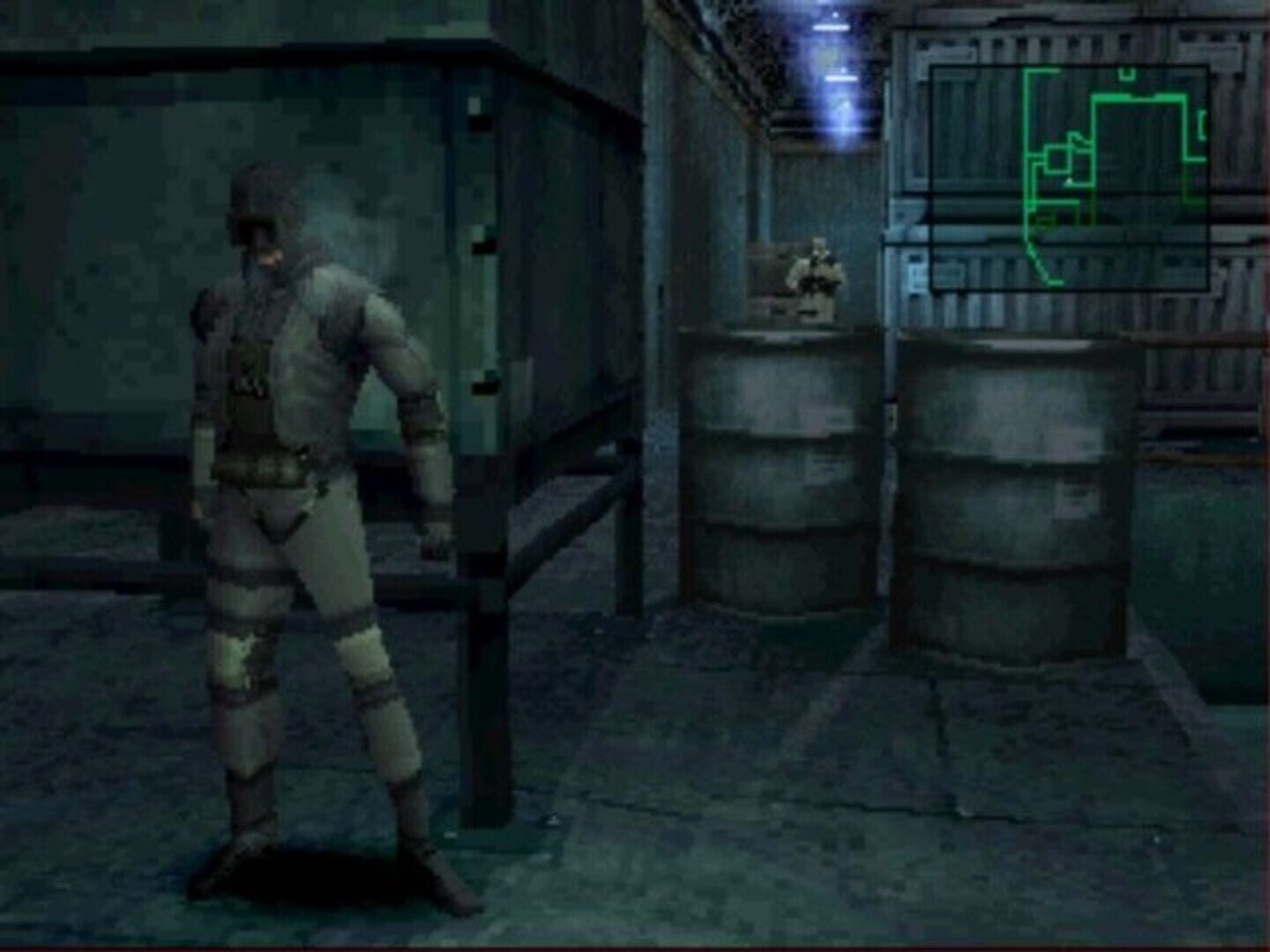
The player must navigate the protagonist, Solid Snake, through a nuclear weapons facility without being detected by enemies. When Snake moves into an enemy's field of vision, he sets off an "alert mode" that draws enemies. The player must then hide until "evasion mode" begins; when the counter reaches zero, the game returns to "infiltration mode", where enemies are no longer suspicious. The radar cannot be used in alert or evasion mode. In addition to the stealth gameplay, set-piece sequences entail firefights between the player and enemies.
To remain undetected, the player can perform techniques that make use of Snake's abilities and the environment, such as crawling under objects, using boxes as cover, ducking or hiding around walls, and making noise to distract enemies. An on-screen radar provides the player with the location of nearby enemies and their field of vision. Snake can also make use of many items and gadgets, such as infra-red goggles and a cardboard box disguise. The emphasis on stealth promotes a less violent form of gameplay, as fights against large groups of enemies will often result in severe damage to Snake.
Story
Metal Gear Solid takes place in an alternate history in which the Cold War continued into the 1990s, ending at some point near the end of the 20th century. The game takes place in 2005, six years after the events of Metal Gear 2: Solid Snake, and form the third chapter in an overarching plot concerning the character of Solid Snake.
The protagonist is Solid Snake (Akio Otsuka/David Hayter), a legendary infiltrator and saboteur. During the mission, Snake receives support and advice via codec radio. Colonel Roy Campbell, Solid Snake's former commanding officer, supports Snake with information and tactics. While he initially keeps some secrets from Snake, he gradually reveals them. He is joined by Naomi Hunter, who gives medical advice; Nastasha Romanenko, who provides item and weapon tips; Master Miller, a former drill instructor and survival coach; and Mei Ling, who invented the Soliton radar system used in the mission and is also in charge of mission data; the player can call her to save the game.
Development
Director Hideo Kojima originally planned his third Metal Gear game in 1994 for the 3DO Interactive Multiplayer. Kojima was initially planning Metal Gear Solid while Policenauts (1994), an adventure game, was still in development. Conceptual artwork by Yoji Shinkawa of the characters Solid Snake, Meryl Silverburgh, who was also a character in Policenauts, and the FOXHOUND team, were included in the Policenauts: Pilot Disk preceding the release of the full 3DO version of Policenauts in 1995.
The game was titled Metal Gear Solid, rather than Metal Gear 3, as Kojima felt that the previous MSX2 games that he worked on were not widely known, due to the fact that they were not released in North America and only the first one was released in Europe (an NES version of the first Metal Gear was released in North America, but Kojima had no involvement with it or its sequel Snake's Revenge). The word "Solid," derived from the codename of series's protagonist Solid Snake (as well as the title of the second MSX2 game), was chosen not only to represent the fact that it was the third entry of the series, but also the transition from 2D to 3D computer graphics.
Reception
Prior to release, the game's demonstrations at several trade shows between 1996 and 1998 had received a positive response. This had generated significant worldwide interest in the game prior to its release in 1998.
Metal Gear Solid received "universal acclaim", according to review aggregator website Metacritic.
Legacy
Metal Gear Solid is credited with popularizing the stealth game genre. The idea of the player being unarmed and having to avoid being seen by enemies rather than fight them has been used in many games since. It is also sometimes acclaimed as being a film as much as a game due to the lengthy cutscenes and complicated storyline. IGN called it "the founder of the stealth genre."
The game is often considered one of the best games for the PlayStation and was featured in best video games lists by Computer and Video Games in 2000, by Electronic Gaming Monthly and Game Informer in 2001, by Retro Gamer in 2004, by GameFAQs and GamePro in 2005, and by Famitsu. Hyper magazine in 2001 called it "Probably the single best game on the PlayStation."


