The articlegameplay, story, development, reception
Gameplay
The gameplay system of Mortal Kombat II is an improved version of that from the original Mortal Kombat. There are several changes in standard moves: a crouching punch was added, low and high kicks have greater differentiation (be they crouching or standing up), roundhouse kicks are made more powerful (knocking an opponent across the screen, like the game's uppercut), and it is easier to perform combos due to reduced recovery times for attacks. Returning characters also gained new special moves, including some to be used in mid-air, and the game plays almost twice as fast as the original.
As with its predecessor, matches are divided into rounds, and the first player to win two rounds by fully depleting their opponent's life bar is the winner. At this point, the losing character will become dazed and the winner is given the opportunity of using a finishing move. Mortal Kombat II lacks the "Test Your Might" bonus games and point system from the first game, in favor of a consecutive win tally where wins are represented by icons.
The game marked the introduction of multiple Fatalities (special moves allowing the victorious character to execute their opponent at the end of a match) as well as additional, non-lethal finishing moves to the franchise: Babalities (turning the opponent into a crying baby), Friendships (a non-malicious interaction, such as dancing or giving a gift to the defeated opponent) and additional stage-specific Fatalities (the victor uppercutting their opponent into an abyss below, spikes in the ceiling, or a pool of acid in the background). Finishing moves cannot be performed either by or against the boss or secret characters.
Story
Following his failure to defeat Liu Kang in the previous Mortal Kombat tournament, the evil Shang Tsung begs his master Shao Kahn, supreme ruler of Outworld and the surrounding kingdoms, to spare his life. He tells Shao Kahn that if they hold the next Mortal Kombat Tournament in Outworld, the Earthrealm warriors must travel away from home to attend. Kahn agrees to this plan, and restores Shang Tsung's youth and martial arts prowess. He then extends the invitation to the thunder god and Earthrealm's protector, Raiden, who gathers his warriors and takes them into Outworld. The new tournament is much more dangerous, as Shao Kahn has the home field advantage.
According to the Mortal Kombat series' canon, Liu Kang won this tournament as well, defeating Shao Kahn and his bodyguard Kintaro. The game's story mode can be also finished using any other playable character, resulting in a variety of non-canonical endings for each of them. This game also establishes that the original Sub-Zero Bi-Han was killed by Scorpion in the first game, and Bi-Han's younger brother Kuai Liang took the identity of the new Sub-Zero.
Development
According to lead programmer Ed Boon, Mortal Kombat II was "intended to look different than the original MK" and "had everything we wanted to put into MK but did not have time for." In 2012, Boon named creating the game among his best Mortal Kombat memories, recalling: "When we did Mortal Kombat II, we got new equipment and all that stuff, but it was funny because when we started working on Mortal Kombat II, the mania, the hysteria of the home versions of Mortal Kombat I was literally all around us. We were so busy working on the next one, going from seven characters to 12 and two Fatalities per character and all these other things that that consumed every second." Both the theme and art style of MKII were slightly darker than those of its predecessor, although a more vibrant color palette was employed and the new game had a much richer color depth than the previous game.
A new feature was the use of multiple layers of parallax scrolling in the arcade version. The game was made to be less serious with the addition of humorous alternative finishing moves. Some of the considered Fatalities were rejected as being too extreme at the time.
Care was taken during the programming process to give the game a "good feel", with Boon simulating elements such as gravity into the game's design. Lead designer and artist John Tobias noted that the first game's reliance on juggling the opponent in the air with successive hits was an accident, and had been tightened in Mortal Kombat II. Boon said that the reason to not completely remove it in favor of a different system of chaining attacks together was to set the game apart from the competing titles such as Street Fighter, and allow for players to devise their own combinations of attacks. A double jump ability was implemented but later removed.
At one point, a bonus stage was planned to feature "a bunch of ninjas jumping all over the place and you would swing at them, just like you're in the middle of a fight in a kung fu movie." All of the music was composed, performed, recorded and mixed by Dan Forden, the series' sound designer and composer, using the Williams DCS sound system.
As with the first game, Acclaim Entertainment published the home conversions. San Francisco Chronicle claimed in 1994 that Acclaim had spent $50 million on developing, manufacturing and marketing the game.
To create the character animations for the game, actors were placed in front of a gray background and performed the motions, which were recorded on videotape using a broadcast-quality, $20,000 Sony camera instead of the standard Hi8 camera used for the original Mortal Kombat. The video capture footage was then processed into a computer, and the background was removed from selected frames to create sprites. Towards the end of the game's development, they opted to instead use a blue screen technique and processed the footage directly into the computer for a similar, simpler process. The actors were lightly sprayed with water to give them a sweaty, glistening appearance, while post-editing was done on the sprites afterward to highlight flesh tones and improve the visibility of muscles, which Tobias felt set the series apart from similar games using digitized graphics.
Animations of Shang Tsung morphing into other characters were created by Midway's John Vogel using a computer, while hand-drawn animations were used for other parts of the game, such as the Fatalities. For Goro and Kintaro, clay sculptures were created by Tobias' friend Curt Chiarelli and then turned into 12-inch latex miniatures that were used for stop motion filming. Because of technical restrictions, the actors' costumes had to be simple and no acrobatic moves such as backflips could have been recorded; the most difficult moves to perform were some of the jumping kicks.
Several characters (namely Jade, Kitana, Mileena, Noob Saibot, Reptile, Scorpion, Smoke, and Sub-Zero) were created using the first game's palette swap technique on just two base models. The game was noted for its "strong female presence", as it was featured more than one female character, which was uncommon in the fighting genre at the time. Due to memory limitations and the development team's desire to introduce more new characters, Sonya Blade and Kano, two fighters from the original Mortal Kombat whom Boon cited as the least-picked characters in the game, were excluded, substituted by two palette swaps: Mileena and Reptile. In place of Sonya, two new playable female characters, Kitana and Mileena, were introduced so the game might better compete against Capcom's Street Fighter II: The World Warrior featuring Chun-Li.
Another planned female fighter, based on the real-life kickboxer Kathy Long whom Tobias admired, was omitted due to time constraints. A male bonus character played by Kyu Hwang was also cut from the game.
Reception
Mortal Kombat II proved to be an enormous commercial success and even a cultural phenomenon. WMS Industries, then owner of Midway, reported that its 1993 sales in the quarter ending December 31 rose from $86 million to $101 million, and said much of its revenue gain was related to the sale of the arcade version of MKII. The game went on to become America's highest-grossing arcade game of 1994, according to the Amusement & Music Operators Association (AMOA). By 1996, the number of arcade machines sold approached 25,000 units; at that time, arcade games that sold 5,000 units were considered strong titles (Midway printed special T-shirts to celebrate 300 machines being manufactured in one day), and an arcade cabinet cost $3,000–4,000.
The arcade version went on to sell 27,000 units, and grossed $600 million as of 2002. MKII was considered an arcade game of the year, taking over from the original Mortal Kombat.
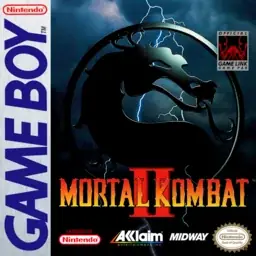
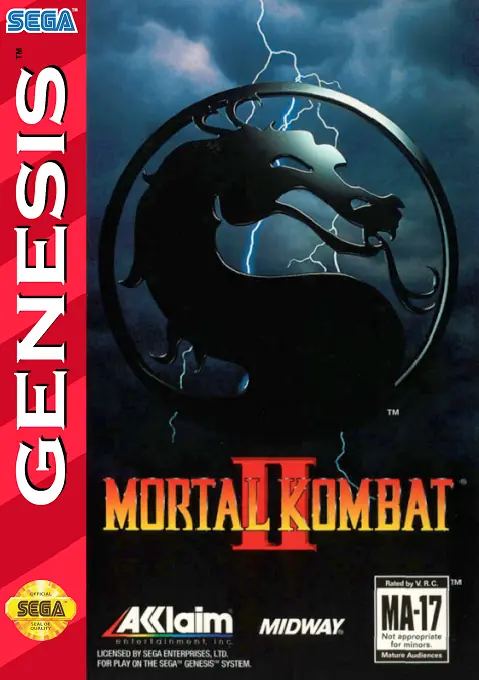
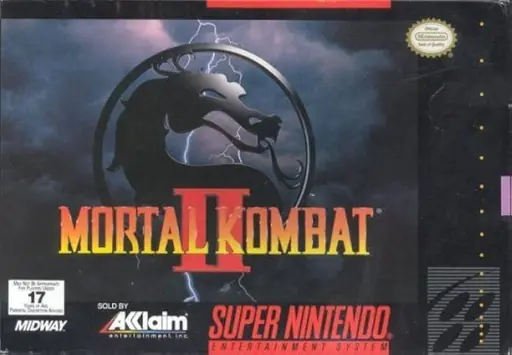
On the day of the release of Genesis, Game Gear, SNES and Game Boy versions, dubbed "Mortal Friday" (September 9, 1994, celebrated annually by the fan community on the second Friday of September), an unprecedented number of more than 2.5 million copies were shipped to be distributed, with the best opening week sales in video game history at that point. Acclaim analysts expected that the number of copies sold would reach at least 2.5 million within the first few weeks of release (at an average retail price of $60) and the sales to top $150 million by the end of the year.
In the first week of its console release, the game made sales to $50 million, which Acclaim Entertainment said was "The largest introduction of a video game in history". 5 million copies around 15,000 stores required 65 trucks and 11 jumbo jets. First-week sales of over $50 million in the United States surpassed the opening box office results of that season's Hollywood film blockbusters, such as Forrest Gump, True Lies, The Mask, and The Lion King. 5 million units were shipped to stores within a month.
Mortal Kombat II became the world's best-selling video game until it was eclipsed by Donkey Kong Country, released in November 1994. In the United States, it was the top-selling Genesis, SNES, and Game Gear title of September 1994, and the top game for the latter console the following month. 51 million copies for the SNES in that same region. In the United Kingdom, it was the top-selling game in September 1994, including for the Mega Drive, SNES, Master System, Game Gear and Game Boy; it remained the top-selling game for the Master System, Game Gear, and Game Boy in October, and for the Game Gear in November.
By 2002, estimated gross sales of the home versions of Mortal Kombat II exceeded $400 million. The PSN version, released in 2007, continued to occupy the service's top ten monthly sales chart nearly three years later in February 2010.
Initial critical reception towards Mortal Kombat II was overwhelmingly positive, with Sega Visions describing the way in which the sequel was directed as "sheer brilliance", and Nintendo Power calling it "the hottest fighter ever". Tony Brusgul of The Daily Gazette opined that the "incredible" hype surrounding the game was "well deserved", describing it as "a perfect blend of great graphics, action and violence". In his review of the arcade release, Rik Skews of Computer + Video Games (C+VG) said that "the only true rival to Street [F]ighter II" returned "in a sequel that bites off the head of the original."
Regarding the Genesis version, Mark Patterson of C+VG wrote that "Probe has done an incredible job with this conversion. Everything is here, and I mean everything." Sushi-X of Electronic Gaming Monthly (EGM) called the Genesis version "a great translation considering its limitations," saying that its graphics and sounds are not as good as those of the SNES version. A reviewer for The Detroit News was "very disappointed" with the Genesis port and recommended the SNES version instead.
The four reviewers of EGM hailed the SNES version as a "near-perfect" translation of the arcade game. A reviewer for The Baltimore Sun called the SNES version "the best game I've ever played - a true translation," and Patterson noted it was the bloodiest game Nintendo has yet allowed to be released. C+VG declared it "the most perfect coin-op conversion ever". Next Generation said of the SNES version that "with full creative license, Acclaim has produced possibly the best arcade conversion ever."
Regarding the game's handheld ports, Patterson stated of the Game Boy version that "no Game Boy owner should go without this," and called the Game Gear version "still the best handheld beat-'em up" on the market, despite said version lacking much canonical content. EGM reviewers concurred that the Game Gear version "has eye-popping graphics, and great control - so much so that you won't believe this is a portable", but were less enthusiastic about the Game Boy version. Though they commented that it is better than most fighting games for the system, two of their four reviewers said that it was not worth getting with the game available on much more powerful platforms.
Critical reception of the Amiga version was also mostly favorable, with Ed Lawrence of CU Amiga declaring that "every person who own an Amiga has to own Mortal Kombat 2. In terms of revitalising the Amiga market, this is far more important than any Commodore buy-out could ever be." In a rare dissenting opinion, Jonathan Nash of Amiga Power dismissed Mortal Kombat II as "a clearly nonsensical title", recommending to "buy Shadow Fighter instead". The later PC version was also well-received, with Next Generation stating that "if you like fighting games, this is the best that's available."
Reviewing the 32X version, IGN's Levi Buchanan said that "if you do not have a SNES, this is the home version of MKII to get
Legacy
On December 26, 2022, the source code for the game, which included cut content, was uploaded online to GitHub. In response, on January 6, 2023, Warner Bros. Discovery sent a DMCA takedown notice to GitHub, and public access to the repository was disabled as a result. The leaker then created a new repository titled "not-mk2", which contained the "Controversies" section of the NetherRealm Studios article on Wikipedia.
While many games have been subject to urban legends about secret features and unlockable content, such myths were particularly rampant among the dedicated fan community of Mortal Kombat in regards to Mortal Kombat II. According to GameSpy, "the [arcade gaming] community was abuzz about myriad secrets both true and false." The game's creators did little to dispel those rumors that included supposed "Nudality" or "Sexuality" finishing moves for Kitana and Mileena, Shang Tsung's ability to transform into Kano and Goro, a chance to fight Sonya after defeating Jade in a specific way, and "Hornbuckle" being featured as an additional secret character.
Some of them were eventually implemented in subsequent MK games. Among these rumors to be adapted later were the Animalities (used in Mortal Kombat 3 and its updates) and an ability to throw an opponent into the mouth of a tree in the Living Forest stage (first used in Mortal Kombat: Shaolin Monks). Rumored characters included false reports of a red female ninja character dubbed "Scarlet" by fans, who was officially introduced as Skarlet in 2011's Mortal Kombat, and the male ninja Ermac, who originated from a misinterpreted indicator in the original game's audits menu and was teased in MKII before finally becoming playable in Ultimate Mortal Kombat 3. A nameless, flaming palette swap of Liu Kang seen in the background of the Pit II stage, initially dubbed "Torch" by fans, officially debuted in Mortal Kombat: Deadly Alliance as secret character Blaze, who later became the final boss of Mortal Kombat: Armageddon.
Although the 1995 film Mortal Kombat was primarily based on the first game, it features elements from Mortal Kombat II, such as the characters Kitana and Shao Kahn, and the setting of Outworld. The Mortal Kombat II game also has some influences upon the 2026 film of the same name which has the highest critical reception of all movies in the Mortal Kombat franchise..
The plot and characters of the game served as the basis for the 2005 spin-off game Mortal Kombat: Shaolin Monks, a beat 'em up title which follows Liu Kang and Kung Lao as they fight their way through Outworld to defeat Shao Kahn. Some of the plot of Shaolin Monks, such as the death of Jade, is not cannon with the general Mortal Kombat game series.
The events of Mortal Kombat II, along with the first Mortal Kombat and Mortal Kombat 3 (including its expansions), were later retold in the 2011 game Mortal Kombat, which was an effective reboot of the series. In it, Raiden uses time travel to revisit the tournaments from the original games in the series in order to change the future in the aftermath of Armageddon. The ladder/arcade mode of this game can follow the same order of bosses as in MKII (with Shang Tsung, Kintaro and Shao Kahn as the final three opponents, although Goro will often be the ninth opponent instead of Kintaro) and its controls and Fatality system are most reminiscent of MKII. Classic costumes from MKII were also brought back as alternate outfits for female ninja characters, with some of these costumes exclusive to the PlayStation Vita version.
Mortal Kombat II was to be one of the three games remade in HD in the cancelled fighting game Mortal Kombat HD Arcade Kollection. A compilation titled Mortal Kombat Arcade Kollection was released instead.