The articlegameplay, story, development, reception
Gameplay
Diablo is an action role-playing video game with dungeon crawl elements. The player moves and interacts with the environment primarily by way of a mouse. Other actions, such as casting spells, are performed in response to keyboard inputs. The player can acquire items, learn spells, defeat enemies, and interact with non-player characters (NPCs) throughout the game.
The dungeon levels are procedurally generated with themes for each level; for instance, the catacombs tend to have long corridors and closed rooms, while the caves are more non-linear. Players are assigned a random number of quests from several tiers; these quests are optional but usually offer powerful unique items as rewards and help to level up the character and/or reveal more of the backstory. The final two quests are mandatory in order to finish the game.
Diablo has three character classes: the Warrior, the Rogue, and the Sorcerer. Each class has a different level of assigned attributes along with a unique skill. Each class is capable of using almost all of the same items and spells, in contrast to later titles in the Diablo series, which have class-specific items and spells/skills. However, the limitations in the attributes for each class reward play that utilizes them efficiently; for instance, the Warrior's low maximum level of Magic prevents him from learning the higher levels of powerful spells like the Sorcerer.
Warrior: The most physically able of the three classes, the Warrior is primarily a close-quarters fighter. His primary character attribute is Strength, of which he has the highest maximum value among the three classes, allowing him to equip the heaviest weaponry and armor. The armor available to the Warrior, combined with his higher Vitality, which gives him more hit points, allows him to withstand the most physical damage. The Warrior starts with the skill to repair objects in his possession at the cost of overall durability.
Rogue: A master of ranged weapons. While not as strong as the Warrior, the Rogue is very effective at attacking enemies from a distance with the bow. A jack-of-all-trades class, the Rogue has moderately higher Magic than the Warrior, so she can make better use of spells, while her somewhat higher Strength and Vitality enable her to fare better in melee than the Sorcerer. The Rogue's primary character attribute is Dexterity. The Rogue's unique starting skill is the ability to disarm traps.
Sorcerer: A spellcaster, the Sorcerer's primary character attribute is Magic, which can be raised much higher than that of the other classes, enabling him to learn spells and raise them to higher levels. It also grants him the largest mana pool, allowing him to cast spells more often. The Sorcerer is the physically weakest of the three classes, with the lowest maximum Strength, Dexterity, and Vitality, but compared to the other two classes, he can make the best use of the "Mana Shield" spell so that enemy damage is directed to his mana reserve rather than his health. The Sorcerer's unique starting skill is the ability to recharge spell staves at the cost of lowering the maximum number of spell charges that a staff can hold.
In the expansion set, Diablo: Hellfire, the Monk was added. The Monk is proficient at melee combat with the staff. Two other classes, the Bard and Barbarian, were unfinished but remained hidden characters in Diablo: Hellfire, and could be enabled using a hack. Using the in-game sprites of the Rogue and Warrior, respectively, the Bard is capable of dual-wielding weapons, while the Barbarian is a two-handed axe specialist.
White-colored items are normal items, blue-colored items are magic items, and gold-colored items are unique items. Any items that are not white in color must be identified to make use of their magical effects, although characters can use unidentified items as they would the base item. Magic items can have a maximum of two of these effects, while unique items can have as many as six. Furthermore, unique items can have special properties, or properties not found in the usual prefixes/suffixes for that item type; most unique items have a very rare chance of being dropped, although certain unique items are guaranteed quest rewards.
Items wear down through use and have fixed amounts of durability that decrease as they receive damage; when an item's durability reaches zero, it is destroyed. Players can return to the town and pay a fee to an NPC, Griswold the Blacksmith, to have the items restored, while the Warrior can repair objects in his possession at the cost of overall durability.
Bows are the ranged weapon of the game, best used by Rogues. Staves, while capable of physical attacks, are mainly used for the spell charges they contain, as casting from a staff does not require the player to learn the spell or use mana. A staff's spell can only be cast a certain number of times before it requires recharging, usually by returning to town and paying an NPC, Adria the Witch, while the Sorcerer can recharge a staff at the cost of lowering the maximum number of spell charges it can hold. Swords are typically one-handed (though two-handed varieties also exist), while axes are all two-handed.
Maces and clubs add a 50% damage bonus against the undead. Two-handed melee weapons allow the player to inflict more damage. Shields, when paired with one-handed weapons, allow attacks to be blocked. There are three classifications of armor: light, medium, and heavy.
Characters are also allowed to wear a helmet, two rings, and one amulet. Many higher-level weapons and armor can only be equipped if the player meets the minimum Strength and/or Dexterity requirements.
Books contain spell formulae and cannot be used more than once; reading the first book places that particular spell in the character's repertoire, while using multiple books of the same spell increases the spell level, up to a maximum of 15. A character needs a minimum Magic attribute level in order to read spell books, parti
Story
The setting of Diablo includes the mortal realm which is the world of Man as well as the High Heavens and the Burning Hells.:61, 62, 64 & 72 After eons of war between angels and demons, the ascension of man prompted the three Lords of Hell (including Diablo himself) to seek victory through influence, prompting their exile into the mortal realm. There, they sowed chaos, distrust, and hatred among men until a group of magi, called the Horadrim, trapped them in enchanted crystals called "Soulstones". Diablo's soulstone was buried deep in the earth and a monastery was built over the site.
Generations passed and the purpose of the monastery was forgotten. A small town named Tristram sprang up next to the monastery's ruins. When King Leoric rebuilt the monastery as a cathedral, Diablo manipulated its archbishop, Lazarus, to destroy his soulstone prison. Diablo briefly possessed the king, sending out his knights and priests to battle against peaceful kingdoms, and then possessed the king's son, Prince Albrecht, filling the caves and catacombs beneath the cathedral with creatures formed from Albrecht's nightmares.
Tristram became a town of fear and horror, where people were abducted in the night. With no king, no law, and no army left to defend them, many villagers fled.
The game starts when the player's character arrives in Tristram. Several of the remaining townsfolk assist the player such as Deckard Cain the Elder. The labyrinth under the Cathedral descends from the dungeon/church, to the catacombs, followed by the caves, and finally Hell itself, each with a mixture of the undead, animals, and demons. King Leoric has been re-animated as the Skeleton King.
Late in the game, the hero must defeat Archbishop Lazarus, and eventually Diablo himself. At the end of the game, the hero kills Diablo's mortal form. The hero then takes the Soulstone out of Diablo's forehead after which Diablo transforms into a lifeless Prince Albrecht. The hero then drives the Soulstone into their own forehead, and they contain the essence of Diablo within themselves.
As told in the sequel Diablo II, canonically the warrior was the hero that defeated Diablo only to become possessed. The Rogue became Blood Raven while the Sorcerer became the False Summoner, both of them NPC enemies. Diablo III further retconned the story by establishing the nameless warrior as Prince Aidan, the eldest son of Leoric and older brother of Albrecht.
Development
David Brevik met the brothers Erich and Max Schaefer while working at FM Waves, a clip art production company, and with a common interest in developing video games, co-founded Condor Games with the Schaefers in 1993. Though they initially worked on conversion contracts to port games to different consoles, Brevik had the ideas of creating Diablo from the start, a combination of Dungeons & Dragons and the roguelike genre, particularly Angband, its name based on his family's home near Mount Diablo near San Francisco. He wanted improve how quickly the player would be able to get into the game compared to typical role-playing games. Brevik was inspired by NHL '94 and similar sports games to make it so that players only had to select a pre-determined class and would be able to jump into the game with minimal interactions.
Brevik also wanted these classes to be combinations of typical character classes so that players would be not overly restricted in what type of attacks or equipment they could use. A further departure from the roguelike approach was to make the loot system from felled monsters more expansive. Brevik also wanted a "modern and cool" interface intended to bring the quick directness of console games as well as Doom (1993) to computer RPGs.
One of Condor's first contracts was through Sunsoft to develop the Sega Genesis version of the fighting game Justice League Task Force. Brevik attended the 1994 Consumer Electronics Show (CES) to showcase the game and pitch his Diablo to other publishers. Bill Roper said that the team's "initial pitch, in a nutshell, was to take the excitement and randomness of games like Moria, Nethack, and Rogue, and bring them into the 1990s with fantastic graphics and sound". However, most publishers turned down the idea on the grounds that "RPGs are dead".
While at CES, Brevik encountered Allen Adham, co-founder of Silicon & Synapse (later named Blizzard Entertainment) after learning they had done the SNES version of Justice League Task Force. The two found common ideas in gameplay development, and Adham showed him a prototype of their first original game, the real-time strategy game Warcraft: Orcs & Humans. Brevik offered to discuss his ideas for Diablo then, but Adham asked him to wait until after they had released Warcraft.
Adham and Pat Wyatt came to visit Condor in January 1995, after Warcraft's release, by which point his company had been purchased by Davidson and Associates and rebranded to Blizzard. After reviewing Brevik's idea, Blizzard offered to work with them on Diablo but requested two major changes, to make it real-time and to have multiplayer, having had done these steps during their work in creating Warcraft. By the end of January, Condor had a contract with Blizzard to build Diablo. Despite Adham's insistence to make the game real-time, Brevik did not want to make this change fearing that it would add extra time onto development, and Condor's development team put the idea to a vote, with the real-time approach winning out.
Brevik prepared Blizzard for the potential added development time and to ask for extra development costs, and then on a Friday afternoon as everyone had left, started to toy around with converting the game from turn-based to real-time; within hours he had the basics of the system in place, and was able to show this to the rest of Condor by the following Monday. They kept this news from Blizzard for a short while but eventually revealed how fast they had come up with the change, which Blizzard readily accepted. The game was also originally conceived to be made in claymation (much like ClayFighter), but they decided to have a 3D isometric style instead. Despite the contract, Condor Games lacked funds to fully complete development by the end of 1995, leading to debt to keep their employees paid.
Davidson & Associates and its subsidiaries, including Blizzard, were acquired by CUC International in February 1996. Condor had been in negotiations to be acquired by Davidson a few months prior, and with CUC's acquisition, it was decided to acquire Condor as a subsidiary of Blizzard, allowing the two teams to work together on Diablo. Condor wanted to change their name but did not want to share the Blizzard name directly, and instead renamed themselves to Blizzard North, with Blizzard's original Irvine, California studio colloquially was known as Blizzard South. Around eight months before the planned release, Blizzard South were finishing up Warcraft II, and began focusing on the upcoming release of Diablo.
Blizzard did not want to rely on existing online gaming services like Total Entertainment Network for matchmaking. net. net, they discovered then that Diablo had no multiplayer code as Brevik nor others had any idea how to write such code. net over the last six months of development.
Brevik revealed in 2018 that he initially hated the ending because it was the cinematic department's idea and did not follow the story outline he provided them, but after a few days he calmed down and decided the ending was pretty good after all.
The music of Diablo was composed by Matt Uelmen. The soundtrack consists of six tracks. It was released after 15 years, in 2011.
Diablo normally requires the original CD to play, however also included on the disk is a shareware version of the software that could be played without the CD called Diablo Spawn. This version of the game allows access to the first two areas of the dungeon, and locks out two of the three playable classes and many of the NPC townsfolk. It is playable in both single- and multiplayer with those restrictions. The
Reception
According to Max Schaefer, Blizzard's initial sales estimates for Diablo were modest. He remarked, "We were thinking that if everything went well, we would sell 100,000 copies." Following the game's positive press coverage before its release, estimates by the team were increased to roughly 500,000 copies, David Brevik later said. Pre-orders had surpassed 450,000 units globally by December 17, at which point the game was set to launch with a shipment of 500,000 units staggered across its initial days on shelves.
Diablo debuted at #1 on PC Data's monthly computer game sales chart for January 1997. It held the position for another three months, before being displaced to #2 by X-Wing vs. TIE Fighter in May. Diablo remained in second place until September, when it dropped to fifth.
It exited the top 10 that October.
In the United States, the game was the highest-selling computer title of the first six months of 1997. Its worldwide sales surpassed 500,000 units by April, 750,000 by June and 1 million by late November. By the end of 1997, Diablo had sold 670,155 copies in the United States alone. It was declared the country's fourth-best-selling computer game of the year by PC Data. Schaefer attributed the game's success in part to its December 27 shipment date, and noted that "there weren't any other games released after Christmas, so we were the only game in town for a long time."
After being absent from PC Data's charts during the final months of 1997, Diablo took 13th place in the rankings for February 1998. It remained in the top 20 for another month, dropped out in April and reappeared in June. It returned to the top 10 from July through October, rising to #3 in August. For the first half of 1998, it was the United States' 14th-best-selling computer release.
At the time, Jason Ocampo of Computer Games Strategy Plus called Diablo one of the charts' "'perennial' inhabitants", and compared its longevity to that of Myst and NASCAR Racing 2. The game's average sale price during the January–June period was $36; by October, it had fallen to $26. 57 million in the region. In August 1998, Diablo received a "Gold" sales award from the Verband der Unterhaltungssoftware Deutschland (VUD), indicating sales of at least 100,000 units across Germany, Austria and Switzerland.
Diablo's global sales reached almost 2 million units by September 1998. One year later, its sales in the United States alone had grown to 1.17 million copies, which made it the country's seventh-highest computer game seller since January 1993. This number rose to 1.3 million copies by March 2000. Remarking upon these sales, GameSpot's writer Desslock hailed Diablo as an "undisputed commercial blockbuster". The game returned in 2000 to PC Data's annual top 20 for the United States, with 260,020 copies sold.
Worldwide, Diablo broke 2 million sales by mid-2000 and reached 2.3 million by January of the next year. Ultimately, the game sold over 2.5 million units by mid-2001. According to GameSpot Japan, the game was a "big hit" among Japanese players.
Diablo has received critical acclaim, with an average rating of 94/100 on Metacritic. Most praised the game's addictive gameplay, randomly generated dungeons, superior graphics, moody musical score, and great variety of possible magic items, enemies, levels, and quests. This last aspect was noted by GameSpot editor Trent Ward in his review: "Similarly, although a set number of monsters is included, only a few will be seen during each full game. This means that players going back for their second or third shot at the game will very likely fight opponents they haven't seen before. Talk about replay value."
Reviewers commonly cited the online multiplayer aspect as one of the strongest points of the game, with it being described as greatly extending its replay value. Columnist Bernard Yee commented that compared to contemporary online multiplayer games such as Quake, Diablo gives newcomers a much better chance of enjoying themselves, as they can either cooperate with other players or build their character so that they can hold their own against hostile players. Computer Games Magazine's Cindy Yans said that "weapons, armor and items are so numerous that you're always acquiring something new to try... not to mention the game's multiplayer universe"; she went on to say that "for anyone who enjoys a good multiplayer dungeon crawl, Diablo can't be beat".
Yans finished her review, "Despite the rather pale storyline, [...] watered-down quests and a fair amount of necessary repetition, Diablo is a must for anyone interested in 'just plain fun.'" Ward stated: "Diablo is the best game to come out in the past year, and you should own a copy. Period."
Macworld's Michael Gowan wrote, "The only downside to this role-playing game is that the adventure ends too soon." Steve Klett's review for PC Games, which was reprinted in sister magazine GamePro, commented that "Diablo's definitely not your typical dungeon hackfest. ... In fact, its closest rivals are games like Gauntlet and Loaded on the PlayStation, but they really don't compare." Next Generation similarly remarked that Diablo is more of a modern incarnation of Gauntlet than an RPG, "but with enough changes and improvements to make it a completely new experience, and one of the best titles so far this year."
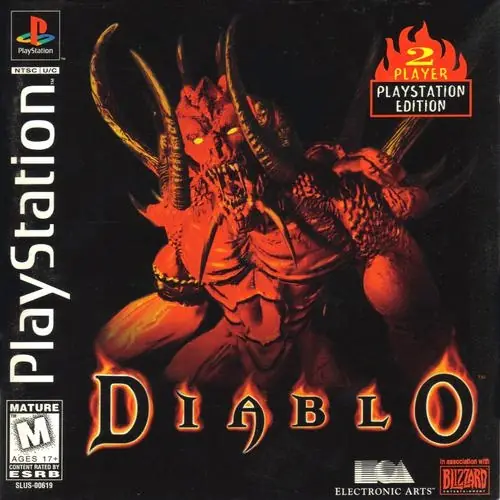
Reviews for the PlayStation version generally remarked that while it is clearly inferior to the PC original, it is a much better translation than might have been expected and carries over the essential elements that make the game enjoyable. Most agreed that the use of button combinations and menus was a sufficient solution to getting the complex controls to work intuitively on the PlayStation, and Next Generation went so far as to say that the controls are an improvement over the PC version's, particularly arguing that the auto-targeting makes attac