
The articlegameplay, story, development, reception
Gameplay
Don't Starve is a survival game with a randomly generated open world and elements of action-adventure and roguelike gameplay. Combat is handled by pointing and clicking with the mouse, or by using "force attack" (ctrl+f), while other activities are controlled by the keyboard, or using the inbuilt gamepad support to play using a controller, giving it a console-like gameplay feel. The goal is to survive as long as possible, and a count of the number of days the player has survived is shown onscreen. The game keeps few records of player progress besides the total number of experience points and the playable characters unlocked.
Wilson is the default playable character, unlocked upon purchase of the game, but the next character, Willow, can be unlocked with 160 experience points. Woodie, the last character unlockable with experience, requires the game's limit of 1,600. Each character has a perk that is specific to them, as well as a disadvantage. The player earns 20 experience points each in-game day and receives them after dying.
Story
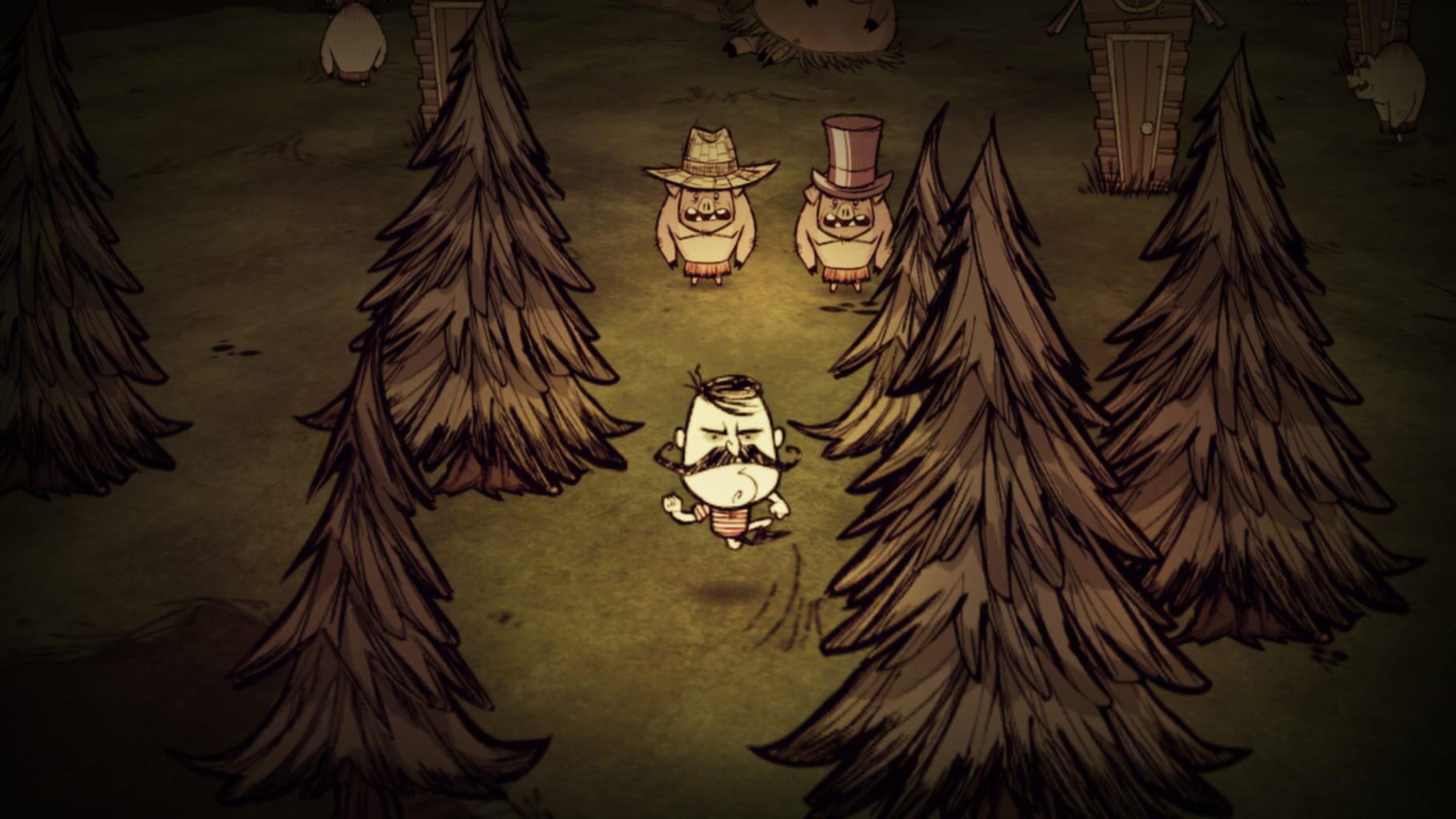
Wilson, a gentleman scientist, is the everyman protagonist of Don't Starve. While Wilson has no special abilities beyond growth of "a magnificent beard", which slows the speed of freezing in winter and accelerates overheating in summer, other playable characters do: Willow, a firestarter, spawns into the world with a unique lighter which acts as a better initial light source and is immune to fire damage, but will start spreadable fires on the ground when she has low sanity. A girl named Wendy receives visits from her deceased twin sister Abigail when summoned, who can help her attack monsters. The strongman, Wolfgang, has high health and significant offensive capabilities that grow better the more his hunger meter is full, but he starves faster and loses more sanity when near danger.
WX-78 is an automaton who nonetheless needs to eat, sleep, and stay mentally stimulated, but does not become ill from spoiled food, can increase their maximum health, hunger, and sanity with gears (reset to the original maximum after dying and respawning; the corpse leaves behind a portion of the used ones), and takes damage from rain (which causes sparks bright enough to ward off Charlie). Being made of conductible material, WX-78 also attracts lightning that surrounds them by a glow that gradually dies down as time passes and refills their health, but also lowers their sanity. Wes is a mime with fast depleting hunger and low damage. His maximum health and hunger are lower than most characters and he cannot talk, making him unable to warn the player of status ailments or incoming enemy waves.
Development
Don't Starve was developed and published by indie studio Klei Entertainment. The game began development as part of a 48-hour game jam in 2010. The team liked the idea but shelved it until two years later, when they had the time to flesh it out. Full development commenced in 2012, while Klei was nearing the end of the development process of Mark of the Ninja.
This was during the heat of an industry trend of creating games in which players are dropped into a world with few instructions and a goal of survival. The torch of this movement was held by the 2011 sandbox game Minecraft. Member Kevin Forbes stated in an interview that Minecraft was one of the team's biggest influences, particularly its exploration elements. However, as the game was conceived as a "weird experiment", the team's main goal was to innovate in terms of gameplay and aesthetics, specifically by adding a layer of emphasis on characterization and themes.
Reception
Don't Starve received "generally favorable" reviews, according to video game review aggregator website Metacritic. The game sold one million copies by the end of 2013. Don't Starve was a finalist for the grand prize and "Excellence in Design" subcategory at the 2014 Independent Games Festival awards ceremony. It also received honorable mentions for "Excellence in Visual Art" and "Excellence in Audio."
The game's art style was critically acclaimed. Summarizing that the "distinct art style and atmosphere set a cool vibe," GameSpot's Nathan Meunier commended the atmosphere and visual design. Marty Sliva of IGN claimed an "immense appreciation for the paper-cutout graphical style and whimsical presentation", going on to praise the threatening qualities bestowed upon mundane objects by the "gothic-inspired look." Game Informer writer Jeff Marchiafava stated that "the cartoony art style makes exploring your massive, randomized world a joy."


