The articlegameplay, story, development, reception
Gameplay
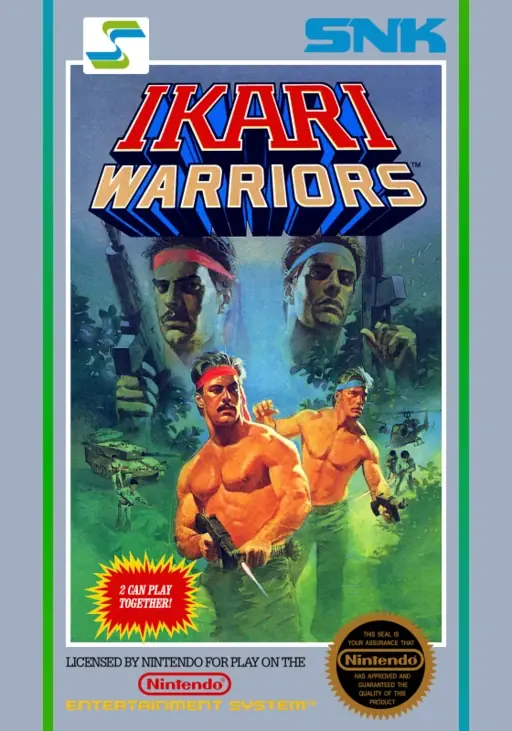
The player takes the role of commandos named Colonel Ralf Jones (red) and Second Lieutenant Clark Still (blue), who must try to reach the village of Ikari to free a captive high-ranking officer named Colonel Cook. Enemy units attempting to kill the player include tanks, enemy soldiers and helicopters. A number of power-ups along the way help the player achieve victory.
Players must proceed from the bottom of the screen upwards, towards the village of Ikari. Trying to prevent them from reaching the village are enemy soldiers and other units. Along the way, players may commandeer enemy tanks and helicopters (NES version) to help fight their way through the enemy personnel. The tanks are immune to enemy bullets, but have a limited supply of fuel and will sustain damage when it runs out or the tank is caught in an explosion, taking the player with it unless he can exit the tank and get clear before it blows up. The helicopters have two different weapons, a spread gun and a cannon, and may fly over water.
Development
The game was developed by SNK, where it was designed and directed by Koji Obada. He had previously designed SNK's TNK III (1985), known as T.A.N.K. in Japan and Europe, a vertical tank shooter inspired by Taito's Front Line (1982) that used rotary joystick controls. The same year, Capcom's vertical run-and-gun shooter Commando (1985), known as Senjō no Ōkami ("Wolf of the Battlefield") in Japan, had become a major global arcade hit. Ikari combined the run-and-gun shooter gameplay of Commando with the rotary joysticks and tank vehicles of T.A.N.K.
The game was also inspired by the action film Rambo: First Blood Part II (1985), released as Rambo: Ikari no Dasshutsu ("Rambo: The Furious Escape") in Japan. Obada had originally intended the game to be an official licensed adaptation of Rambo, but SNK were initially unable to acquire the rights to the film. This resulted in the game's title being shortened to Ikari, referencing part of the film's Japanese title. After the game made its North American debut at an arcade game expo, they got in touch with the film's star Sylvester Stallone, who was friends with SNK's president, about acquiring the rights to the film, but it was too late by that point, as the game had already become popularly known by its Japanese title Ikari among arcade players in Japan and North America, leading to the game being officially released as Ikari Warriors in North America.
Reception
In Japan, Game Machine listed Ikari as the most successful table arcade cabinet of March 1986. It remained at the top of the magazine's table arcade cabinet charts through April and early May, before returning to the top in June 1986. It went on to become Japan's second highest-grossing table arcade game of 1986. In the United Kingdom, it was one of the top three highest-grossing arcade games of 1986 in London, appearing at number-three on the annual 1986 Electrocoin chart.
In North America, Ikari Warriors was the second top-grossing arcade game on the monthly Play Meter charts in July 1986. It went on to be one of the top five highest-grossing dedicated arcade games of 1986 according to AMOA, and the year's eight highest arcade video game according to RePlay. It was also among the top five dedicated arcade games of 1987.
Legacy
Ikari Warriors spawned two sequels Victory Road (1986) and Ikari III: The Rescue (1989).
SNK released an Ikari Warriors clone in 1987 called Guerrilla War (known as Guevara in Japan). The game features communist fighters Che Guevara and Fidel Castro as its protagonists.