The articlegameplay, story, development, reception
Gameplay
The game is set in the late 1780s, and all the characters wield weapons. The game uses music from the time period, with sounds of traditional Japanese instruments, such as the shakuhachi and shamisen. A refined version of the camera zoom first found in Art of Fighting is used in Samurai Shodown. The game includes the portrayal of blood.
The game became renowned for its fast pace. Focusing more on quick, powerful strikes than combos, the slow motion was added to intensify the damage dealt from hard hits. During a match, a referee holds flags representing each player (Player 1 is white; Player 2 is red). When a player lands a successful hit, the referee lifts the corresponding flag, indicating who dealt the blow.
A delivery man occasionally appears in the background and throws items such as bombs or health-restoring chicken, which can change the outcome.
Story
Shiro Tokisada Amakusa, slain in Japan of 1638 by the forces of the Tokugawa Shogunate for his part in the Shimabara Rebellion, was resurrected in 1787 as an akuma from making a deal with the dark god Ambrosia by bringing the evil entity into the world with the Palenke stone and its energy. Driven by hatred for the Shogunate and having a nihilistic streak towards the world, he unleashes his dark powers to bring chaos to all of existence in 1788. A variety of warriors—some historic, some fictional—converge upon the source of the chaos, each driven by their own reasons.
Haohmaru - A wandering samurai who is searching for strong opponents to hone his skills.
Nakoruru - A young girl aided by her pet eagle, Mamahaha, who strives to protect nature.
Ukyo Tachibana - An ailing samurai warrior who is fighting to gain a flower for his beloved; Kei Odagiri.
Charlotte Christine de Colde - A French noblewoman who vows to protect France from Amakusa's evil.
Galford D. Weller - An American who traveled to Japan to become a ninja. He is aided by his pet dog, Poppy.
Jubei Yagyu - A Ronin who strives to protect Japan from its enemies.
Earthquake - A large Texan thief who studied the art of Ninjutsu. He wishes to steal as much treasure as he can.
Hanzo Hattori - An Iga Ninja who fights to save his son; Shinzo from Amakusa's control.
Kyoshiro Senryo - A kabuki performer who uses his art to entertain and perfect his own fighting skills.
Tam Tam - A warrior from the Mayan city of Green Hell, charged with retrieving the stolen Palenke stone back from Amakusa.
Wan-Fu - A warrior from China, serving the Qing Emperor. He searches Japan for worthy fighters to help him unify his homeland.
Genan Shiranui - A member of the Shiranui clan, killing anyone who gets in his way as he progresses through the path of evil.
Non playable characters that appear are Kuroko; a man dressed in all black who judges each match during the game and Hikyaku; a delivery man working for Amakusa who disrupts fights.
Development
Samurai Shodown evolved from what was originally planned to be a traditional side-scrolling beat 'em up, featuring monsters as the dark heroes (similar to Data East's Night Slashers). However, after considering what would sell to a global audience, series-creator and director Yasushi Adachi decided that a fighting game with distinctly Japanese characters, such as samurai and ninjas, would do better. The only hold-over from the original concept was Genan Shiranui, the hunchbacked claw-handed creature that was inspired by Adachi's interest in Tim Burton's Edward Scissorhands.
The programming team for Samurai Shodown consisted of a combination of veteran SNK programmers and former Capcom employees.
The idea to spell the English title as "Shodown" rather than "Showdown" came from SNK's U.S. distributor. They felt the Japanese title "Samurai Spirits" did not adequately explain the game, and believed the spelling could be a play on the word shogun, based on the lingering popularity of the Shogun miniseries.
Reception
In Japan, Game Machine listed Samurai Spirits as the most popular table arcade game of August 1993. It went on to be Japan's sixth highest-grossing arcade game of 1993. In North America, RePlay reported Samurai Shodown to be the top-performing arcade software kit from August to October 1993, and then again in December. Play Meter listed it as America's third most popular arcade game of October 1993. It went on to be one of the top five highest-grossing arcade conversion kits of 1994 in the United States.
In the February 1994 issue of Japanese magazine Gamest, Samurai Shodown was awarded Best Game of 1993 in the Seventh Annual Gamest Grand Prize; it was also the first to win in the category of Best Fighting Game (Street Fighter II Dash, the previous Game of the Year, won Best Action Game). Samurai Shodown also placed first in Best VGM, Best Album and Best Direction, and second place in Best Graphics. In the Best Characters list, Nakoruru placed No. 1, Haohmaru at No.
6, Jubei Yagyu at No. 8, a tie between Ukyo Tachibana, Galford, and Poppy at No. 11, Charlotte at No. 16 (tied with Duck King from Fatal Fury Special), Kuroko at No.
18, Tam Tam and Hanzo Hattori tied for No. 22, Gen-an Shiranui at No. 29, and Wan-Fu tied at No. 45 with five other characters.
Samurai Shodown won multiple awards from Electronic Gaming Monthly in their 1993 video game awards, including Best Neo-Geo Game, Best Fighting Game, and Game of the Year. It was awarded "Game of the Year" at the April 1994 European Computer Trade Show (ECTS).
In 1997, Electronic Gaming Monthly ranked the Neo Geo AES version number 99 on their list of the "100 Best Games of All Time", citing the solid fighting engine, realistic use of blood, and easy to execute moves.
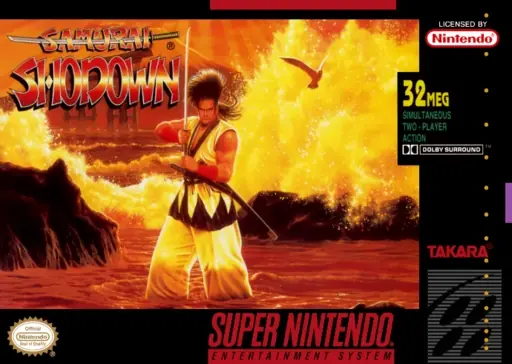
Famicom Tsūshin gave the Super Famicom version an 8 out of 10 in their Reader Cross Review. Electronic Gaming Monthly gave the Super NES version a 37 out of 50, commenting that despite the lack of scaling, it is still a very good port.
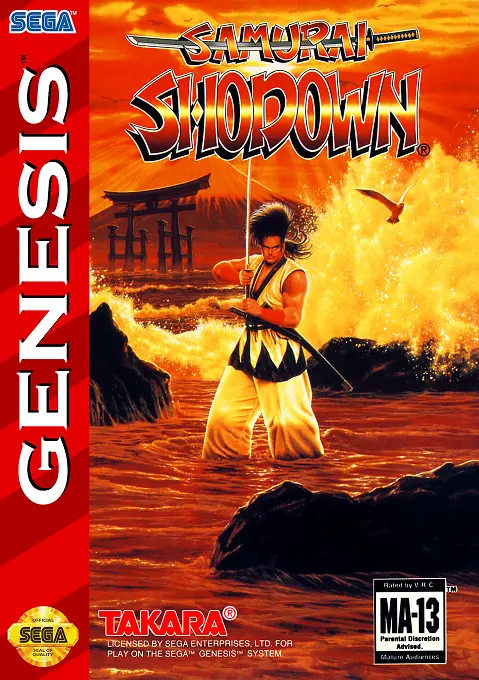
GamePro considered the Genesis version to be superior to the Super NES version, citing the Genesis version's better scale (zoomed-in versus the zoomed-out graphics of the Super NES version) and the awkward control configuration on the Super NES version. They held the Game Boy version to be surprisingly good given the hardware, but ultimately unsatisfying, and concluded that hardcore fans should pass on even the Genesis version in favor of the upcoming 3DO and Sega CD versions. Next Generation reviewed the Genesis version of the game, rating it three stars out of five, and stated that "fans of the arcade game won't be disappointed with this solid translation, complete with blood and all the varied endings of the original."
Famicom Tsūshin scored the 3DO version of the game a 25 out of 40. Electronic Gaming Monthly scored the 3DO version 38 out of 50, calling it "A very faithful home version of the arcade fighter". A reviewer for Next Generation remarked that "The 3DO conversion is nearly identical to the arcade version, much more faithful than the previous SNES, Genesis, and Sega CD versions. The load time between rounds is noticeable, but acceptable."
He gave it three out of five stars. GamePro praised the general gameplay, but criticized the quality of the conversion, complaining that the scaling is not as smooth as the arcade version, the animations are slower, the load times are interminably long, and the gameplay is crippled by a poor control configuration, which the player is not given the option to change.
GamePro named the Sega CD port the best game for the add-on at the 1994 Consumer Electronics Show. Their eventual review, however, was largely mixed, criticizing the slowdown, lack of scaling, frequent load times, and low-quality reproduction of the arcade version's sounds. They added that since Samurai Shodown was by then a three-year-old game, it made the faults of the Sega CD version stand out more. Electronic Gaming Monthly scored it 30 out of 40 and called it "the best conversion of the game that made the Neo Geo the system of choice for fighting games."
They praised the accurate graphics, short load times, and ease of pulling off special moves. In 2018, Complex ranked the SNES version of Samurai Shodown 40th on their list of "The Best Super Nintendo Games of All Time", praising the graphics and controls and saying everything is "on point" in the game. In 1995, Flux magazine ranked Samurai Shodown 80th on their list of the "Top 100 Video Games". In 1996, Super Play ranked the SNES version 99th on its list of the "Top 100 SNES Games of All Time".
Legacy
Three anime adaptations based on the game have been made. Samurai Spirits: Haten Gouma no Shou in 1994, which is a full-length film; Samurai Spirits 2: Asura Zanmaden in 1999, with two episodes and Nakoruru ~Ano hito kara no okurimono~ in 2002, a one-episode OVA.