The articlegameplay, story, development, reception
Gameplay
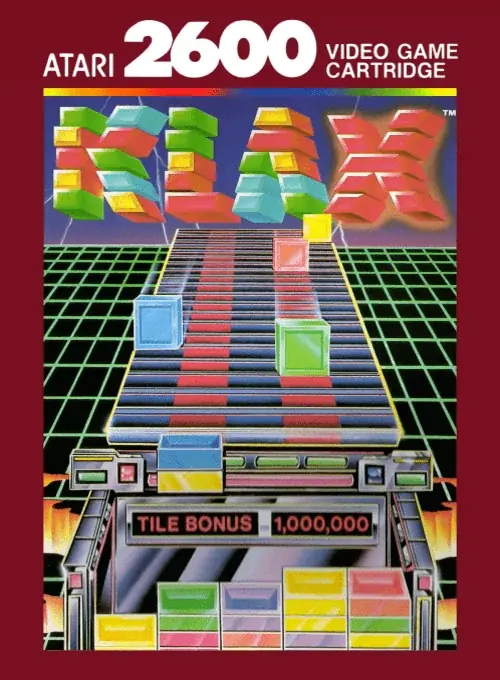
Controls consist of a four-position joystick and a button. The player controls a small paddle at the lower end of a conveyor belt. Using the joystick, the player can move the paddle left or right to catch tiles in various colors as they advance down the conveyor. Below the paddle is a well that can hold up to 25 tiles in five columns of five; pressing the button causes the topmost tile on the paddle to fall directly downward and into the well, as long as that column is not full.
The goal is to form "Klaxs", or unbroken horizontal/vertical/diagonal lines containing three tiles of the same color. Doing so awards points and causes those tiles to disappear, allowing any tiles above them to fall toward the bottom of the well. Bonus points are awarded for completing multiple Klaxs with a single tile (including lines of four or five matching tiles) and for Klaxs formed by the falling of already-placed tiles.
The paddle can hold up to five tiles at any given moment. The player is penalized with one "drop" whenever a tile falls off the conveyor without being caught or while the paddle is full. Pushing up on the joystick will flip the topmost tile on the paddle a short distance up the conveyor, while pulling down accelerates the motion of the tiles.
The game consists of 100 waves, presented as 20 groups of five waves each. At the start of the game and after every fifth wave, the drop meter is cleared and the player is presented with three options of which wave to play next; choosing a later wave awards bonus points and allows more drops. Each wave has an objective that must be reached, such as making a set number of Klaxs, scoring a certain number of points, or surviving a set number of tiles. At the end of a wave, bonus points are awarded for each tile still on the conveyor and paddle and for each empty space in the well. The game ends when the player either exhausts the available drops, completely fills the well, or finishes all 100 waves.
Development
Akers programmed Klax in just a few weeks using AmigaBASIC, then ported each line to C. In a 1990 interview, he said he wanted to "produce something playable, compact and relatively quick to develop". His influences were Tetris and tic-tac-toe. He chose the name from the sound that tiles make rolling across the screen.
Reception
In Japan, Game Machine listed Klax as the seventh most successful table arcade unit of March 1990.
On release, Famicom Tsūshin awarded the PC Engine version 30 out of 40. Klax was ranked the 26th best game of all time by Amiga Power in 1991. The NES version is ranked 44 in IGN's Top 100 NES Games.
In a capsule review of the Lynx version for STart, Clayton Walnum commended the gameplay, graphics, music, sound effects and speech. Julian Rignall reviewed the Atari Lynx version for CVG Magazine in January 1991, saying "the game is simple, but very, very addictive" and giving a rating of 93 out of 100.