Ludography
69/100
Players212 ratings

Where to get it

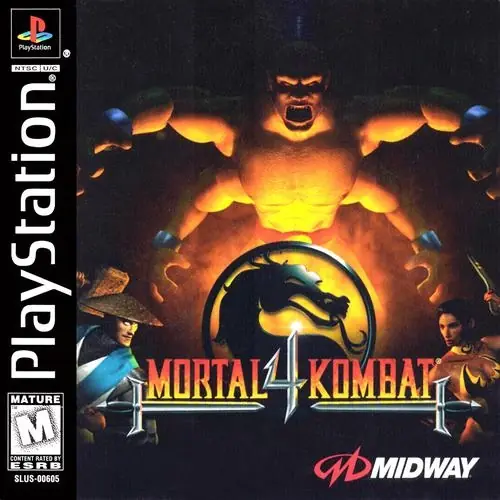
Mortal Kombat 4 cover

1997 · Midway Games · Fighting

Mortal Kombat 4

Mortal Kombat 4 is 1 vs 1 fighting game, similar to the other Mortal Kombat games, but this is first game in series with 3D characters models. The player can choose from 15 different fighters at the start (and several unlockables later on). Many fighters from earlier games in the series make a comeback (like Scorpion, Sub Zero, Liu Kang, Sonya Blade, Johnny Cage etc.) while other new fighters join in, like Shinook (who is the main evil character in this game), Fujin, Jarek, and Kai. Goro returns as a boss.

Also known as
MK4 · MKIV
Released
15 October 1997
Platforms
ArcadeNintendo 64PlayStationWindowsDreamcastGame BoyGame Boy Color
Genres
Fighting
Developers
Midway Games
Publishers
Midway Games
Series
Mortal Kombat
Modes
MultiplayerSingle-player
Perspective
Side view
Themes
Action
Country
United KingdomUnited States
Age ratings
ESRB M
Languages
English
Entry
#4 in Mortal Kombat
Time to beat
1hmain story4hwith extras10hcompletionist
Composers
Dan Forden

About

Mortal Kombat 4 is a 1997 fighting game developed and published by Midway for arcades. It is the fourth main installment in the Mortal Kombat franchise, and a sequel to 1995's Mortal Kombat 3. It is also the first title in the series to use 3D computer graphics, as well as the last in the series to have an arcade release. The game was ported to the PlayStation, Nintendo 64, Microsoft Windows, and Game Boy Color in 1998, followed by an updated version, titled Mortal Kombat Gold, for the Dreamcast in 1999.

The gameplay system in Mortal Kombat 4 is similar to that of the previous games; one of the most notable additions is the use of weapons and objects during fights. The storyline chronicles the attack from the corrupted Elder God Shinnok against his former comrades who trapped him in the Netherealm many years prior to the beginning of the series. The other 17 playable characters take part in the battle between good and evil, with the forces of light trying to stop Shinnok and the forces of darkness from conquering all the realms.

›Story

Thousands of years before the setting of the first game, Shinnok, one of the Elder Gods who control the six realms in the Mortal Kombat universe, attempted to become the conqueror of them all. Thunder god Raiden fought and defeated Shinnok in a war that spanned hundreds of years, sending him to the Netherrealm, where he would be trapped forever. Now, Shinnok has managed to escape from the Netherealm with help from the sorcerer Quan Chi, and seeks vengeance against the Elder Gods who banished him. In his plan, he first conquers the realm of Edenia, with the aid of a traitor, Tanya, while he prepares to attack the Elder Gods. In order to stop Shinnok's menace, Raiden requests help from the Earthrealm warriors who saved the realms from Emperor Shao Kahn in previous titles.

Keywords

  • martial arts
  • bloody
  • gravity
  • ninja
  • death
  • compilation
  • hand-to-hand combat
  • psychic abilities
  • special forces
  • sequel
  • free-to-play
  • drone

Media

The articlegameplay, story, development, reception

Gameplay

Mortal Kombat 4 is played in a similar way to the previous titles from the series; the run button and combos are still used, and despite the 3D graphics, characters are restricted to a 2D path except for sidestepping. MK4 introduces a limited weapon system, allowing each character to take out a special weapon using a set button combination. Once equipped, the weapons are primarily used through the punch buttons. This includes swinging, clubbing or even tossing the weapons.

The weapons can also be purposely dropped, in similar fashion to arena objects such as severed heads and rocks, another addition to the series. If an opponent's weapon is dropped, the other character is able to pick it up and use it.

Story

Millennia before the setting of the first game, Shinnok, one of the Elder Gods who control the six realms in the Mortal Kombat universe, attempted to become the conqueror of them all. The thunder god Raiden fought and defeated Shinnok in a war that spanned centuries, sending him to the Netherrealm, where he would be trapped forever. Now, Shinnok has managed to escape from the Netherrealm with help from the sorcerer Quan Chi, and seeks vengeance against the Elder Gods who banished him. In his plan, he first conquers the realm of Edenia with the aid of a traitor, Tanya, while preparing to attack the Elder Gods. In order to stop Shinnok's menace, Raiden requests help from the Earthrealm warriors who saved the realms from Emperor Shao Kahn in previous titles.

Development

Ed Boon, co-creator of the series, found it difficult to lead the development team for Mortal Kombat 4 due to the considerable increase in staff since the release of first Mortal Kombat title, with him as the only programmer. Therefore, Todd Allen and Mike Boon (Ed's younger brother) joined as programmers. The Midway staff wanted to remove the comical elements from the previous Mortal Kombat titles, so they focused on making Fatalities. On the other hand, the Animality finishing moves from Mortal Kombat 3 were removed since the transformation of a character into an animal was considered to be difficult to make in 3D graphics.

In order to make the Fatalities more entertaining, they decided to make some of the Fatalities replay from different camera angles. Since actors were no longer needed to make the characters' movements with the exception of adding some motion capture elements, the staff found it easier to make Fatalities, as it was all done by computer animation. Some members of the development team had previously worked on War Gods, Midway's first 3D fighting game. 2 million polygons per second.

Reception

Upon the start of the arcade's road tour, news programs commented on the violence from the game and expressed concern on how it would affect the players' personalities; Ed Boon replied that there were already games more violent than Mortal Kombat 4, which was only the most popular of the violent games and therefore the most prominent.

In reviews for the arcade version, Next Generation and GamePro both noted that while the graphics are in 3D, the gameplay is in the same 2D format as previous installments. Both also opined that the game had sharp graphics and a pleasing blend of old characters with strong newcomers. Next Generation called it "a fast-moving, dark, and disturbing fighter that retains many of the series' best qualities." The reviewer felt the lack of genuine innovation was a major strike against it, but concluded, "It may not be what we'd hoped for, but it's much better than War Gods."
Releases by platformdates and regions as published

Releases by platform
PlatformReleasedRegions
Arcade11 September 1997North America
Nintendo 6423 June 1998North America · Europe 15 September 1998 · Brazil 31 December 1998
PlayStation24 June 1998North America · Europe 1 October 1998
Windows31 July 1998North America · Europe 6 April 2001

Title IDsone per regional release, with its latest update

Title ids and disc serials by release
PlatformTitle IDRegionLatest update
Game Boy ColorDMG-A4KP-EUREurope—
Nintendo 64NUS-NM4P-EUREurope—
NUS-NM4E-USANorth America—
PlayStationSLES-01349Europe—
SLUS-00605North America—

Box artone per regional release we hold art for

Decompilations and portscommunity projects that rebuild or port the game

Editions and related releases

Included in
Mortal Kombat: Legacy KollectionMortal Kombat: Legacy Kollection - Deluxe EditionMortal Kombat: Legacy Kollection - Kollector's Edition
Expanded editions
Mortal Kombat Gold
Ported as
Mortal Kombat 4
Follows
Mortal Kombat 3
Built on it
Mortal Kombat Gold

In the same series

Games like this

Collections7 collections

Platform libraries

Series and characters

Genres

Description adapted from its source, CC BY-SA 4.0.