The articlegameplay, story, development, reception
Gameplay
Mega Man consists of six side-scrolling platform levels freely chosen by the player. In each level, the player-character, Mega Man, fights through various enemies and obstacles before facing a "Robot Master" boss at the level's end. Upon defeating the boss, the player assimilates the Robot Master's signature attack, or "Special Weapon", into Mega Man's arsenal for the rest of the game. Unlike the standard Mega Buster (Rock Buster in Japan), the Robot Masters powers have limited ammunition replenished by collecting ammunition cells dropped by defeated enemies at random.
Enemies also drop energy cells that replenish Mega Man's health gauge. Though the player is free to proceed through the game in any order, each Robot Master is especially vulnerable to a specific weapon, which encourages the player to complete certain stages before others. The player can also revisit cleared levels (except for Wily levels). Besides the weapons taken from the Robot Masters, the player is able to pick up a platform generator item known as the "Magnet Beam" in Elec Man's stage.
Mega Man features a scoring system where players can score points for defeating enemies, and earn extra points for collecting power-ups from fallen enemies and for clearing each stage. Each Robot Master was worth a random number between 50,000 and 100,000 points whereas Dr. Wily was always worth 200,000 points. The scoring system was removed in later Mega Man games as it was found to provide no meaningful benefit to players and felt unnecessary to designers.
When all six Robot Master stages are completed, the 7th (last) stage appears in the middle of the stage select menu. This stage, in which the player traverses Dr. Wily's robot factory, is a chain of four regular stages linked together, each containing at least one new boss. During these final stages, the six Robot Masters must also be fought again in a predetermined order before the final confrontation against Dr.
Wily. As Mega Man's ammo is not restored between stages, every action the player takes is consequential.
Story
In the year 200X, robots developed to assist mankind are commonplace thanks to the efforts of the renowned robot designer, Dr. Wright. However, one day, these robots go out of control and start attacking humans, and among them, there are six advanced humanoid robots created by Dr. Wright for industrial purposes.
Known as the "Robot Masters", they consist of Cut Man, Guts Man, Ice Man, Bomb Man, Fire Man, and Elec Man. Dr. Wright realizes that the culprit responsible for these attacks is his old rival Dr. Wily, but is unsure of what to do.
His helper robot, Rock, has a strong sense of justice and offers to be converted into a fighting robot to stop Dr. Wily's plans, dubbing himself Mega Man. He eventually defeats all six Robot Masters and recovers their central cores, then confronts Dr. Wily within his Pacific-based robot factory, where he is manufacturing copies of Dr.
Wright's robots. After defeating replicas of Dr. Wright's Robot Masters, and several robot masters designed specifically by Wily to defeat him, Mega Man confronts Wily in a final showdown and defeats him before returning home to his family.
The initial Western release of the game has the same plot, and some significantly changed details from the Japanese Famicom manual. In this version, Dr. Wright and Dr. Wily (who is portrayed as Dr.
Wright's former assistant) co-create the humanoid robot Mega Man alongside the six Robot Masters, each of whom were designed for the benefit of Monsteropolis's citizens (no such place existed in the original plot). Dr. Wily, angered by Wright taking credit for their work and desiring to use his creations for criminal purposes, steals the Robot Masters and modifies them, then creates his own army of robots to seize control of Monsteropolis and declare it his own personal empire. Dr.
Wright, horrified by Dr. Wily's betrayal, sends Mega Man to destroy the Robot Masters and free Monsteropolis from Dr. Wily's machines.
Development
Before Mega Man, Capcom made arcade games, and its console releases were mostly ports of these games. In the mid-1980s, Capcom made plans to develop Mega Man specifically for the Japanese home console market. They decided to bring in fresh, young talent for the small team, including artist Keiji Inafune, a recent college graduate who started on the Street Fighter team. Inafune recalled that the Mega Man development team worked extremely hard to complete the final product, with a project supervisor and lead designer who sought perfection in every possible aspect of the game.
The development team for Mega Man consisted of only six people. Inafune (credited as "Inafking") designed and illustrated nearly all of the game's characters and enemies, and the Japanese Rockman logo, box art, and instruction manual. He was responsible for rendering these designs into graphical sprite form. He said, "We didn't have [a lot of] people, so after drawing character designs, I was actually doing the dotting (pixelation) for the Nintendo.
Back then, people weren't specialized and we had to do a lot of different things because there was so few people, so I really ended up doing all the characters." Inafune was influenced by the eponymous protagonist of Osamu Tezuka's manga Astro Boy in his Mega Man designs. Mega Man is colored blue because it seemed that the color had the most shades in the console's 56-color palette (cyan included), and that selection was used to enhance Mega Man's detail.
Although he is often credited for designing the character, Inafune insists that he "only did half of the job in creating him", as his mentor, director Akira Kitamura, developed the basic character concept before Inafune's arrival. The basic sprites for Roll and Dr. Light were created before Inafune joined the project, and the designs for Cut Man, Ice Man, Fire Man, and Guts Man were in process. Aside from normal enemies, Inafune's first character was Elec Man, inspired by American comic book characters.
The artist has commented that Elec Man has always been his favorite design. The designs for Dr. Light and Dr. Wily were based on Santa Claus and Albert Einstein, respectively; the latter character was meant to represent an archetypal "mad scientist".
The team had initially considered names such as "Mighty Kid", "Knuckle Kid", and "Rainbow Man" before settling on their final decisions. The "Rainbow" name was considered because the character could change into seven colors based on the weapon selected. The production team chose a music motif when naming the main characters in Mega Man. The protagonist's original name is Rock and his sister's name is Roll, a play on the term "rock and roll".
This type of naming would later be extended to many characters throughout the series. One of the original storylines considered by the team but not used in the final game was to have Roll be kidnapped, and Rock had to rescue her. Another idea had included a boss fight against a giant Roll near the end of the game.
The team decided to incorporate anime elements for the game's animation. Inafune explained, "[Mega Man's] hand transforms into a gun and you can actually see it come out of his arm. We wanted to make sure that the animation and the motion was realistic and actually made sense. So with Mega Man, we had this perfect blending of game character with animation ideas."
The gameplay for Mega Man was inspired by the game rock paper scissors. The project supervisor wanted a simple system that offered "deep gameplay". Each weapon deals a large amount of damage to one specific Robot Master, others have little to no effect against them, and there is no single weapon that dominates all the others. Mega Man was originally able to crouch, but the team decided against it since it made players' ability to determine the height of onscreen projectiles more difficult.
Naoya Tomita (credited as "Tom Pon") began work on Mega Man's scenic backgrounds immediately after his Capcom training. Tomita proved himself amongst his peers by overcoming the challenges of the console's limited power through maximizing the use of background elements.
Mega Man was scored by Manami Matsumae (credited as "Chanchacorin Manami"), who composed the music, created the sound effects, and programmed the data in three months, using a sound driver programmed by Yoshihiro Sakaguchi (credited as "Yuukichan's Papa"). The musical notes were translated one by one into the computer language. Matsumae was challenged by the creative limits of three notes available at any one time, and when she was unable to write songs, she created the sound effects. She composed the music to be rock-oriented to fit its action gameplay and robotic protagonist, and to differentiate it from the classical style of other Capcom games.
When the game was localized for distribution in America, Capcom changed the title of the game from Rockman to Mega Man. This moniker was created by Capcom's then-Senior Vice President Joseph Morici, who claimed it was changed merely because he did not like the original name. "That title was horrible," Morici said. S.
games." com's Nadia Oxford attributed this change to Capcom's belief that American children would be more interested in a game with the latter title.
Reception
Critics received Mega Man well. AllGame described the NES version of the game as a "near-perfect blend of action, challenge and audio-visual excellence" and awarded it five stars, their highest rating. Lucas M. Thomas of IGN described the game as an "undeniable classic" for the NES, noting its graphics, innovative weapon-based platform gameplay, and music.
IGN editor Matt Casamassina proclaimed, "Mega Man is one of the best examples of great graphics, amazing music and near-perfect gameplay rolled into one cartridge". GameSpot writers Christian Nutt and Justin Speer identified the game as a "winner in gameplay" granted its "low-key presentation". com likewise outlined it as a "charming (if slightly rough) start for the series". InFamicom Hisshoubon, one reviewer complimented the action as the selling point of the game with its innovative ideas such as platforms that vanish and re-appear and the games "essence of ACG."
A second reviewer complemented it as an exciting, simple and fun game and hoped Capcom would focus on games likes this for the Famicom instead of porting games to personal computers.
Reviews in Weekly Famitsu had two reviewers complimenting the game for having new original characters and being a rare action game at the time. Three reviewers commented the game was too difficult, with one saying that the "difficulty seems cruel, but the game is exciting!" Whether positive or negative, Mega Man has been commonly perceived as very difficult and is listed among the difficult games of Nintendo, being described by USGamer as “the introduction of the Nintendo Hard difficulty”. Casamassina found the game the hardest in the franchise, and among the hardest titles on the NES.
Thomas observed that its combination of high difficulty and short length hurt its replayability. com, the "Nintendo-hard" Mega Man bosses set the game apart from its two immediate and more popular sequels. Total! retrospectively characterized the game as "an overhard and unenjoyably frustrating platform nightmare".
At the 1990 Golden Joystick Awards, Mega Man won the award for best console game of the year (8-bit).
Mega Man has additionally received various honors from video game journals and websites. IGN listed the game at number 30 on its "Top 100 NES Games of All Time". Nintendo Power ranked Mega Man at number 20 on its "100 Best Nintendo Games of All Time" in its September 1997 100th issue, then at number 61 in its "Top 200 Games" in its February 2006 200th issue. 1UP.com included it in their "Top 5 Overlooked Videogame Prequels" and as number 17 on its "Top 25 NES Games" list. British magazine The Games Machine awarded it the "Star Player" accolade after its launch in PAL regions.
Legacy
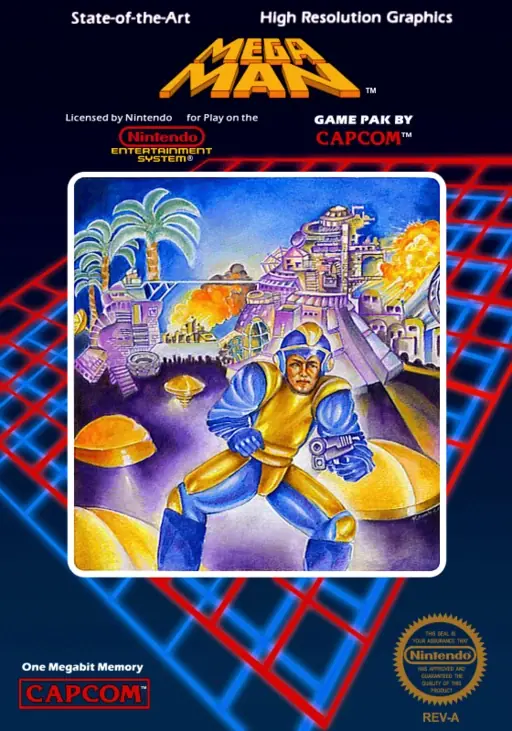
Capcom's sales department originally believed that the game would not sell, but after Japan had received limited quantities, it had been seen as successful enough to quickly commission an American localization. A. told the marketing representative to have a cover done by the next day, so he had a friend draw it within about six hours. Inafune blamed the game's relatively poor North American performance on its region-specific cover art, which visualized elements not found in the game: Mega Man himself resembles a man rather than a boy, his costume is colored yellow and blue instead of being entirely blue, and he is holding a handgun rather than having his arm cannon.
Over the years, the cover art has been infamous in the gaming community. It has been considered one of the worst game covers of all time by publications including GameSpy, Wired, and OC Weekly. The cancelled Mega Man Universe was planned to feature a "Bad Box Art Mega Man" playable character alongside the classic 8-bit Mega Man. "Bad Box Art Mega Man" has since become a playable character in Street Fighter X Tekken.
The TV series Mega Man: Fully Charged features an amateur superhero named Man Man whose outfit is physically based on the bad box art design.
With little overseas press coverage save for a full-page advertisement in Nintendo Fun Club News, sales gained momentum over word of mouth, making the game a sleeper hit. While Mega Man was not a large commercial accomplishment for Capcom, the company decided to allow the development team to create a sequel, Mega Man 2, for a 1988 Japanese release. Many of the design elements cut from the original Mega Man due to space limitations such as planned enemy characters were included in the follow-up game. Mega Man 2, with greatly improved box art, although still repeating the 'pistol' error, unchanged in directions from Capcom America, to veteran game illustrator Marc Ericksen, proved to be such a success that it solidified Mega Man as one of Capcom's longest-running franchises.
Due to "overwhelming demand", Capcom reissued the original Mega Man in North America in September 1991. Capcom carried the same 8-bit graphics and sprites present in the original Mega Man into the next five games in the main series. Even though the sequels feature more complex storylines, additional gameplay mechanics, and better graphics, the core elements initiated by Mega Man remain the same throughout the series. Mega Man 9 and Mega Man 10 would later revert to the familiar graphical style set forth by this title.
The scoring system in Mega Man has not been present in any of its sequels.
According to GamesRadar, Mega Man was the first game to feature a nonlinear "level select" option, as a stark contrast to linear games like Super Mario Bros. and open world games like The Legend of Zelda and Metroid. GamesRadar credits the "level select" feature of Mega Man as the basis for the nonlinear mission structure found in most multi-mission, open world, sidequest-heavy games, such as Grand Theft Auto, Red Dead Redemption, and Spider-Man: Shattered Dimensions.